

Growth Navigat: The Smart Data-Driven Roadmap Businesses Need to Scale Faster in 2026
Growth can look exciting from the outside, but scaling a business often creates hidden problems. More customers can bring heavier workloads, higher costs, and complicated workflows. Meanwhile, new technology can create more confusion instead of solving existing challenges. That is where Growth Navigat becomes valuable. Growth Navigat represents a modern approach to business growth built around data, technology, strategy, and continuous improvement. Instead of making decisions based on assumptions, companies can use measurable insights to guide their next moves.
Furthermore, this approach connects business goals with daily operations.
It helps leaders identify wasted resources, improve processes, evaluate technology, and discover profitable opportunities.
As competition becomes tougher, businesses need more than ambitious growth targets.
They need a practical system that shows where they stand and where they should go next.
What Is Growth Navigat and How Does It Work?
Growth Navigat is a structured framework for managing sustainable business growth.
It combines business analysis, technology evaluation, performance tracking, and strategic planning. The process usually begins with an assessment of current business performance.
Leaders then identify weaknesses, opportunities, and areas requiring immediate attention.
Next, organizations examine their technology, workflows, customer experience, and financial performance. They can then prioritize improvements according to potential impact and available resources.
Most importantly, Growth Navigat turns scattered business information into actionable direction. Therefore, teams can focus on measurable improvements instead of chasing every new trend.
Why Data-Driven Business Growth Matters
Modern companies generate enormous amounts of information every day. However, collecting data does not automatically create better business decisions. Companies must know which information matters and how to interpret it. For example, sales numbers can reveal demand, while customer behavior can reveal purchasing patterns.
Similarly, operational data can expose delays and unnecessary expenses. Marketing data can also reveal which campaigns generate meaningful returns.
Therefore, data-driven growth helps businesses replace assumptions with evidence. It also allows leaders to identify changes before they become expensive problems.
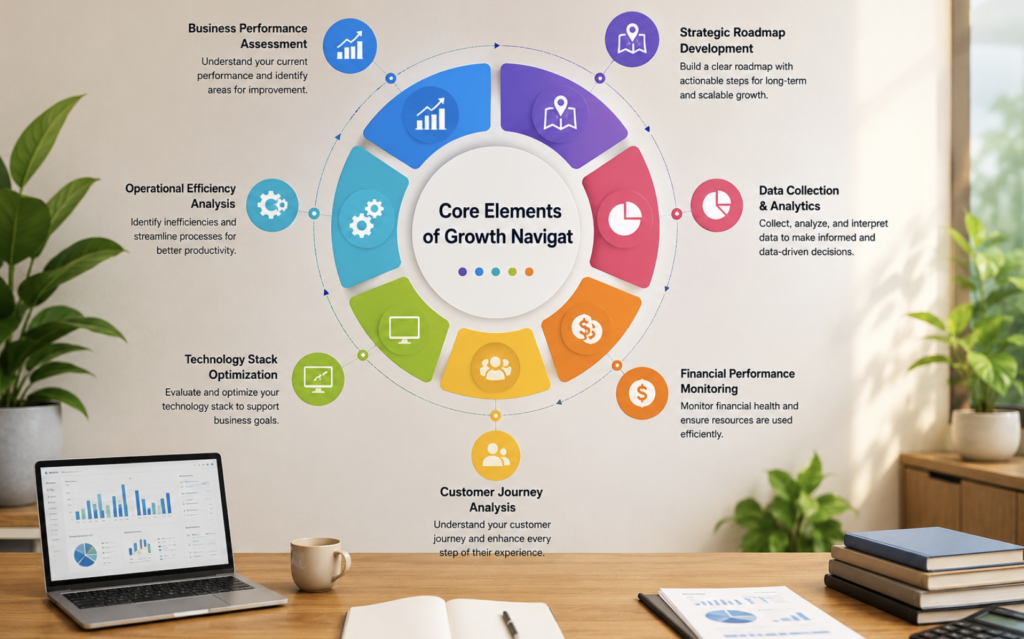
The Core Elements of Growth Navigat
An effective Growth Navigat strategy connects several important business functions.
Business Performance Assessment
Every growth strategy should begin with a realistic understanding of current performance. Businesses can examine revenue, customer retention, conversion rates, expenses, productivity, and operational capacity. Additionally, leaders should review existing goals and compare them with actual results. This assessment creates a reliable starting point for future decisions.
Operational Efficiency Analysis
Operational inefficiencies can quietly reduce profitability. Manual data entry, repeated approvals, poor communication, and outdated workflows can consume valuable time. Growth Navigat encourages companies to map important processes from beginning to end. Consequently, teams can identify unnecessary steps and improve workflow efficiency.
Automation can then handle repetitive activities where appropriate. Employees can therefore spend more time on strategic and customer-focused responsibilities.
Technology Stack Optimization
Technology should support business objectives rather than simply increase software spending. Companies often accumulate multiple platforms that perform similar functions.
Unfortunately, unused subscriptions can increase costs while creating unnecessary complexity.
Growth Navigat evaluates whether each technology solution delivers measurable value. It can also identify integration gaps between different business systems.
A stronger technology stack can improve collaboration, automation, reporting, and customer service.
Customer Journey Analysis
Growth depends heavily on customer experience. Therefore, Growth Navigat should examine the complete customer journey. Businesses can study how customers discover products, compare options, purchase solutions, and request support. They can also analyze where customers abandon the buying process.
This information helps organizations remove friction and improve customer satisfaction.
As a result, better experiences can support retention and long-term revenue growth.
Financial Performance Monitoring
Revenue growth means little when expenses grow faster than income. Growth Navigat therefore considers margins, operating costs, customer acquisition costs, and cash flow.
Businesses can compare spending against measurable outcomes.
This approach helps leaders determine where money creates value and where resources are being wasted.
How Growth Navigat Supports Smarter Decision-Making
Business leaders frequently make decisions under pressure. However, rushed decisions can create expensive consequences. Growth Navigat introduces measurable evidence into important strategic choices. For example, a company considering new software can evaluate expected savings and productivity improvements.
Likewise, marketing teams can compare campaign performance before increasing advertising budgets.
Sales leaders can analyze conversion trends before changing their sales processes. Therefore, decisions become more structured, transparent, and easier to evaluate.
Growth Navigat and Business Intelligence
Business intelligence can significantly strengthen the Growth Navigat approach. Dashboards can combine sales, financial, marketing, and operational information. Leaders can then monitor important indicators from a centralized view.
However, dashboards should remain focused on useful metrics. Too many indicators can create information overload and weaken decision-making.
Businesses should prioritize metrics connected directly to strategic objectives. These may include customer lifetime value, retention, conversion rates, recurring revenue, and operating margins.
The Role of Artificial Intelligence in Growth Navigat
Artificial intelligence is adding another layer to modern business strategy. AI systems can analyze large datasets faster than traditional manual processes. They can identify patterns, detect anomalies, and support predictive forecasting.
For example, businesses can use AI to forecast demand or identify customers at risk of leaving. They can also automate routine customer interactions and generate performance insights.
However, AI should support human judgment rather than replace strategic responsibility.
Businesses still need experienced teams to evaluate recommendations and consider real-world conditions.
Growth Navigat for Startups and Small Businesses
Growth Navigat is not limited to large organizations. Startups can use the framework to establish efficient systems before operations become complicated. They can also avoid investing heavily in tools that provide little value.
Small businesses can use data to prioritize limited resources more effectively. For example, owners can identify their most profitable customer groups and focus marketing efforts accordingly.
Furthermore, smaller organizations can track simple KPIs without building complicated analytics systems. Even basic performance tracking can reveal valuable opportunities.
Growth Navigat for Established Companies
Larger companies face different challenges during expansion. Multiple departments may use different systems, processes, and performance measurements. As a result, leadership can struggle to maintain consistent visibility.
Growth Navigat can help establish common objectives and standardized performance measurements. It can also support technology integration across departments.
Consequently, larger organizations can improve coordination while reducing duplicated efforts.
Building a Practical Growth Navigat Roadmap
A successful roadmap should turn strategy into specific actions. First, businesses should define their most important growth objectives. These objectives might involve revenue, customer retention, efficiency, market expansion, or profitability.
Next, leaders should establish measurable KPIs for each objective. Each department should understand how its work contributes to those measurements. Afterward, organizations can prioritize initiatives according to impact, cost, and complexity. High-value improvements should generally receive attention before low-impact projects.
Finally, teams should establish deadlines and assign clear responsibilities. This prevents strategic plans from becoming documents that nobody implements.
How to Measure Growth Navigat Success
Measurement determines whether the strategy is actually working. Businesses can compare performance before and after major improvements. For example, companies can track processing time after workflow automation.
They can also monitor customer retention after improving support services. Similarly, software optimization can be measured through reduced costs or increased employee productivity.
Importantly, businesses should review results consistently. Monthly reviews can support operational adjustments, while quarterly reviews can support broader strategic changes.
Common Mistakes When Implementing Growth Navigat
Growth strategies can fail when businesses focus on technology alone. Buying sophisticated software does not guarantee better performance. Without clear objectives, even advanced platforms can create confusion. Another common mistake involves tracking too many metrics. Teams may spend more time collecting information than acting on it.
Poor data quality also creates serious problems. Incorrect or outdated information can produce misleading conclusions.
Additionally, employee resistance can slow implementation. Therefore, businesses should communicate changes clearly and provide practical training.
Best Practices for Sustainable Business Growth
Successful Growth Navigat implementation requires consistency. Businesses should begin with clear priorities rather than attempting everything simultaneously. They should also connect technology investments with measurable business outcomes.
Furthermore, leaders should encourage collaboration between departments. Marketing, sales, finance, operations, and technology teams often hold different pieces of important information.
Regular experimentation can also support continuous improvement. Teams can test changes, measure results, and retain approaches that deliver stronger outcomes. Finally, businesses should remain flexible. Market conditions, customer expectations, and technology can change rapidly.
The Future of Growth Navigat
The future of Growth Navigat will likely become increasingly intelligent and predictive. AI-powered analytics may identify emerging opportunities before traditional reports reveal them. Predictive systems could also help businesses anticipate demand, customer churn, and operational risks.
Meanwhile, automation will continue reducing repetitive administrative work. Cloud platforms will also make business information easier to access across distributed teams. However, technology will remain only one part of sustainable growth.
Strong leadership, customer understanding, employee skills, and financial discipline will remain equally important. Therefore, the future belongs to businesses that combine intelligent technology with practical human decision-making.
Conclusion
Growth Navigat offers a structured way to turn business information into meaningful action. It connects strategy, technology, operations, customer experience, and financial performance. More importantly, it encourages companies to grow with purpose rather than simply growing larger. Businesses can identify inefficiencies, optimize resources, improve customer experiences, and make stronger strategic decisions.
As markets become more competitive, data-driven planning will become increasingly important. Companies that continuously measure, learn, and adapt can build stronger foundations for long-term success.
Growth Navigat is ultimately about creating a clearer path between today’s performance and tomorrow’s potential.
Frequently Asked Questions
1. What is Growth Navigat?
Growth Navigat is a data-driven framework that helps businesses plan, measure, and improve sustainable growth.
2. How does Growth Navigat improve business performance?
It identifies inefficiencies, optimizes technology, improves workflows, and supports evidence-based decisions.
3. Is Growth Navigat suitable for small businesses?
Yes, small businesses can use Growth Navigat to manage resources, improve efficiency, and identify profitable opportunities.
4. Can Growth Navigat support digital transformation?
Yes, it helps businesses evaluate technology, automate workflows, integrate systems, and modernize operations.
5. What data does Growth Navigat use?
It can use sales, financial, customer, marketing, operational, and productivity data.
6. Does Growth Navigat require artificial intelligence?
No, AI can enhance Growth Navigat, but businesses can implement the framework without artificial intelligence.
7. Which KPIs should businesses track?
Businesses should track KPIs directly connected to revenue, profitability, customers, productivity, and strategic objectives.
8. How often should Growth Navigat strategies be reviewed?
Businesses should monitor important metrics continuously and conduct structured reviews monthly or quarterly.
9. Can Growth Navigat reduce business costs?
Yes, it can identify inefficient processes, unnecessary software, duplicated work, and avoidable operational expenses.
10. What is the biggest benefit of Growth Navigat?
Its biggest benefit is creating a measurable and actionable direction for sustainable business growth.
11. Can Growth Navigat improve customer retention?
Yes, analyzing customer behavior and service performance can reveal opportunities to improve satisfaction and retention.
12. What is the future of Growth Navigat?
Its future will increasingly involve predictive analytics, artificial intelligence, automation, and real-time business intelligence.