What Successful Solopreneurs Use as Their Tech Stack
Building a successful online business no longer requires a large office, a huge development team, or dozens of expensive software subscriptions.
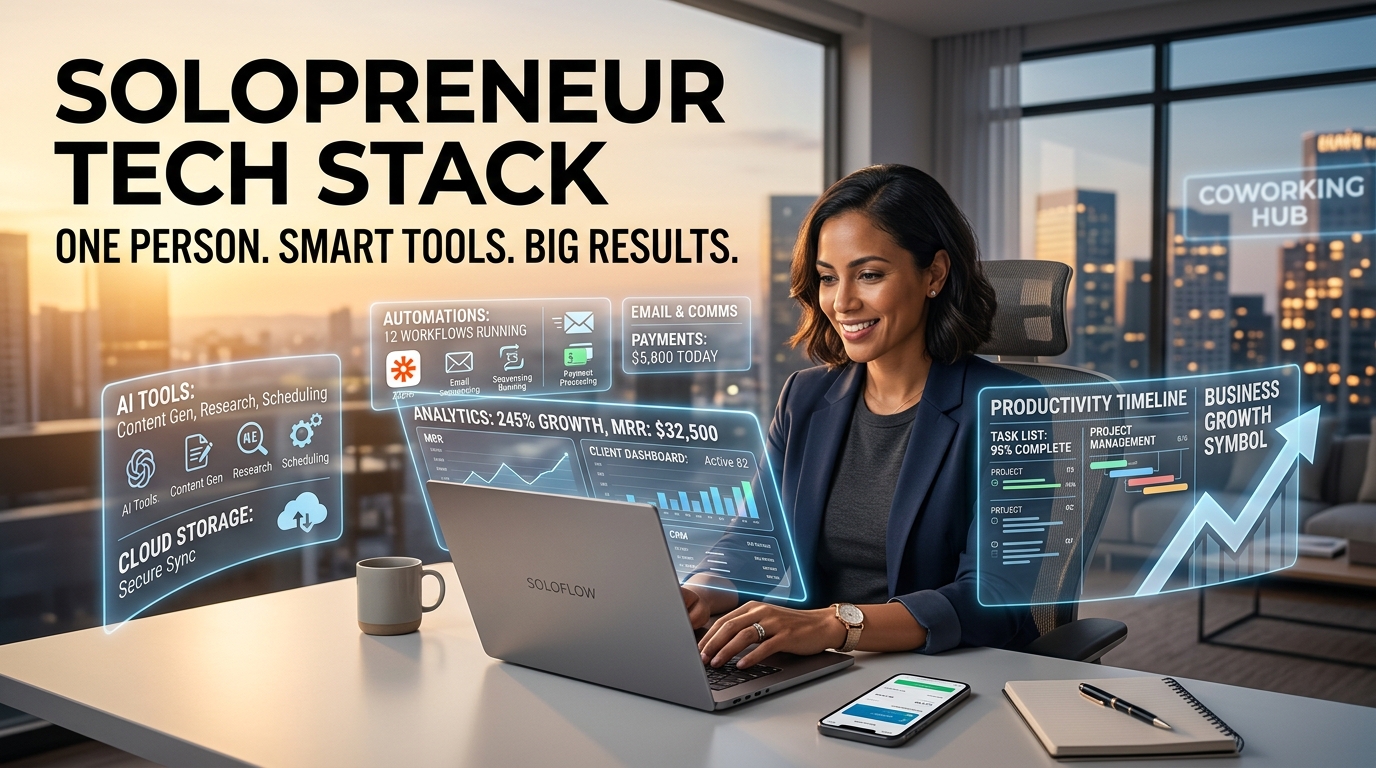
In 2026, many solopreneurs are running profitable businesses with a carefully selected collection of tools. Their tech stacks help them build products, manage customers, create content, automate repetitive work, track performance, and communicate with their audience.
The important thing is not to use the most tools.
It is to use the right tools for the right stage of your business.
A successful solopreneur does not need an enterprise-level technology stack. In fact, too many tools can create unnecessary costs, complexity, and distractions.
This article explains what a practical solopreneur tech stack can look like and how you can choose the right tools for your own business.
What Is a Solopreneur Tech Stack?
A tech stack is the collection of software, platforms, and technologies used to operate a business.
For a solopreneur, this can include tools for:
- Building a website
- Developing a product
- Managing customers
- Processing payments
- Creating content
- Sending emails
- Automating workflows
- Tracking analytics
- Managing projects
- Providing customer support
The exact stack depends on the business.
A freelance writer does not need the same tools as a Micro SaaS founder. An e-commerce seller has different needs from a consultant or content creator.
That is why successful solopreneurs usually avoid copying someone else’s entire setup.
Instead, they build a stack around their actual workflow.
The Core Principle: Keep the Stack Lean
One of the biggest mistakes new solopreneurs make is signing up for too many tools.
A typical founder might pay for:
- A project management platform
- A CRM
- An email platform
- An automation tool
- An AI subscription
- Analytics software
- Social media software
- Customer support software
- Design software
Individually, each tool may seem useful.
Together, they can create a large monthly expense.
A lean tech stack has three advantages:
Lower Costs
You spend money only on tools that provide real value.
Less Complexity
Fewer dashboards mean fewer systems to learn and manage.
Better Focus
You spend more time building your business instead of constantly testing new software.
The objective isn’t to discover an ideal tool.
The goal is to create a system that works.
1. Website and Online Presence
For most solopreneurs, the website remains the central part of the business.
A website can serve as:
- A portfolio
- A sales page
- A blog
- A product landing page
- A lead generation system
- A customer information hub
Depending on your technical skills, you can use a content management system, website builder, or custom-built site.
The most important elements are not complicated animations or advanced effects.
Your website should clearly answer:
- What do you offer?
- Who is it for?
- What problem do you solve?
- Why should someone trust you?
- What should they do next?
A simple website with a strong message can outperform a complicated website with no clear purpose.
2. AI Tools for Daily Work
AI has become part of the modern solopreneur workflow.
Successful founders use AI to speed up tasks such as:
- Brainstorming ideas
- Research organization
- Writing first drafts
- Creating content outlines
- Summarizing information
- Generating code
- Debugging
- Creating customer support responses
- Analyzing data
However, successful solopreneurs do not simply automate their entire business and hope for results.
AI works best as an assistant.
For example, it can help you create ten possible marketing ideas quickly. But you still need to decide which idea fits your audience.
It can help generate code, but you still need to test security and functionality.
The founder remains responsible for strategy and decision-making.
3. A Simple Content Creation System
Content can be a powerful long-term asset for solopreneurs.
A simple content stack may include tools for:
- Writing
- Editing
- Keyword research
- Graphic design
- Content planning
- Publishing
The most successful approach is usually not publishing everywhere.
Instead, choose one or two channels where your audience is already active.
For example:
- Search-focused articles
- LinkedIn posts
- A newsletter
- YouTube videos
- Short educational content
Then create a repeatable process.
A basic workflow might look like this:
Research -> Outline -> Create -> Edit -> Publish -> Repurpose -> Measure
A repeatable system is more valuable than constantly searching for new content tools.
4. A CRM for Managing Customers
Customer relationships can quickly become difficult to manage when everything is stored across emails, messages, and spreadsheets.
A CRM helps solopreneurs organize:
- Leads
- Customers
- Sales conversations
- Follow-ups
- Important notes
- Opportunities
However, you do not necessarily need expensive enterprise CRM software.
At an early stage, a simple database or workspace can be enough.
A basic workflow could be:
New Lead -> Contacted -> Interested -> Proposal Sent -> Customer -> Follow-Up
The goal is to avoid losing opportunities because you forgot to follow up.
As the business grows, the CRM system can become more advanced.
5. Automation for Repetitive Tasks
Time is one of the most valuable resources for a solopreneur.
That is why automation is becoming a major part of modern tech stacks.
Tasks that can often be automated include:
- Sending welcome emails
- Updating customer records
- Creating notifications
- Scheduling content
- Sending follow-up messages
- Organizing form submissions
- Moving information between tools
However, automation should be implemented only after you fully understand the process.
Do the task manually first.
Once you know exactly what should happen, automate the repetitive parts.
This reduces the risk of creating a complicated automation system for a workflow that does not actually work.
6. Cloud Storage and File Management
Solopreneurs deal with many files:
- Client documents
- Images
- Videos
- Contracts
- Content drafts
- Business records
- Product assets
A reliable cloud storage system makes it easier to access important files from different devices.
The key is organization.
Create a simple folder structure.
For example:
Business
- Finance
- Marketing
- Content
- Clients
- Products
- Legal
- Archive
You do not need a complicated system.
You simply need to know where everything is.
7. Communication and Email
Email continues to be one of the most essential tools for business communication.
A solopreneur may use email for:
- Customer communication
- Sales
- Newsletters
- Product updates
- Support
- Partnerships
A professional system should keep personal and business communication organized.
You can also create templates for common messages.
For example:
- New customer welcome
- Proposal follow-up
- Partnership request
- Support response
- Meeting confirmation
Templates can save significant time without making communication feel robotic.
8. Payment and Subscription Management

If you sell a product, service, or subscription, your tech stack needs a reliable way to handle payments.
The payment system should make it easy to:
- Accept payments
- Track transactions
- Manage subscriptions
- Handle invoices
- Process refunds when necessary
For solopreneurs building recurring-revenue businesses, subscription management becomes especially important.
A reliable payment workflow allows the founder to spend less time manually tracking transactions.
Always consider factors such as:
- Availability in your country
- Transaction fees
- Customer payment preferences
- Subscription support
- Integration options
The best payment system is the one that fits both your business model and your customers.
9. Analytics Without Dashboard Overload
Successful solopreneurs measure important results.
But they do not necessarily track everything.
The most useful metrics depend on the business.
For a content business, you might track:
- Organic traffic
- Search visibility
- Newsletter sign-ups
- Conversions
For a SaaS product, you might track:
- New sign-ups
- Active users
- Customer retention
- Monthly recurring revenue
- Churn
For a service business, you might track:
- New leads
- Conversion rates
- Average client value
- Repeat customers
Choose a few metrics connected to your goals.
Checking dozens of numbers every day does not automatically improve the business.
Use data to make decisions.
10. Project Management Without Overcomplication
A solopreneur still needs a way to manage tasks.
The system can be extremely simple.
For example:
This Week
Tasks that must be completed soon.
Next
Important tasks that can wait.
Later
Ideas and projects for the future.
You can use a dedicated project management tool, a digital workspace, or even a simple document.
The system matters less than consistency.
The most effective task management system is the one you consistently utilize.
11. A Customer Support System
Even a one-person business needs a way to handle customer questions.
At the beginning, email may be enough.
As the business grows, you can add:
- A knowledge base
- Frequently asked questions
- Automated responses
- Chat support
- Ticket management
The goal is not to remove human communication completely.
The goal is to make support manageable.
Pay attention to repeated questions.
If customers repeatedly ask the same thing, consider:
- Improving your onboarding
- Adding clearer instructions
- Creating an FAQ
- Automating the answer
Better documentation can reduce support workload.
12. Development Tools for Software-Based Businesses
For solopreneurs building software products, the development stack is another important decision.
A typical setup may include:
- A code editor
- Version control
- A front-end framework
- A back-end environment
- A database
- Authentication
- Hosting
- Monitoring tools
The best stack depends on what you already know.
Do not spend six months learning a completely new technology simply because someone online calls it the best.
If you can build and launch faster using technology you already understand, that may be the better choice.
The first version of your product does not need to be perfect.
It needs to work well enough to help you learn from real users.
13. Security Should Be Part of the Stack
Solopreneurs often focus on growth while ignoring security.
That can become expensive later.
Basic security practices include:
- Using strong, unique passwords
- Enabling multi-factor authentication
- Keeping important software updated
- Backing up critical data
- Limiting unnecessary access
- Reviewing connected applications
You do not need to become a cybersecurity expert.
But protecting customer and business data should be part of your normal workflow.
14. How Successful Solopreneurs Choose Tools
Before adding a new tool, ask five questions:
Does It Solve a Real Problem?
Do not buy software because it looks impressive.
Will I Use It Regularly?
A tool used once a month may not justify a monthly subscription.
Can an Existing Tool Already Do This?
Avoid paying for duplicate functionality.
Does It Save Enough Time?
Calculate whether the time saved is worth the cost.
Can I Export My Data?
Avoid becoming completely dependent on a platform without understanding your options.
These questions can prevent unnecessary spending.
15. A Sample Solopreneur Tech Stack for 2026
Here is what a lean stack might look like:
| Business Need | Simple Solution |
| Website | CMS, website builder, or custom site |
| Writing | Document editor and AI assistant |
| Design | Simple graphic design tool |
| Code | Code editor and version control |
| Database | Managed database service |
| File Storage | Cloud storage |
| CRM | Lightweight CRM or workspace |
| Professional email and newsletter platform | |
| Automation | Workflow automation tool |
| Payments | Trusted payment processor |
| Analytics | Website and product analytics |
| Support | Email, knowledge base, and help desk |
| Security | Password manager, MFA, and backups |
This is only an example.
You do not need every category immediately.
Start with what your business needs today.
16. The Biggest Tech Stack Mistakes to Avoid
Tool Collecting
Do not sign up for every new platform you see online.
Paying Before Validating
Do not build a $500-per-month stack before making your first sale.
Over-Automating
Automation should simplify your work, not create another system that requires constant maintenance.
Ignoring Integrations
Consider whether your important tools can work together.
Forgetting About Data
Backups and data export options are easy to ignore until something goes wrong.
Constantly Switching Tools
Changing platforms every few months can destroy momentum.
Choose a practical solution and focus on building the business.
How to Build Your Own Solopreneur Tech Stack
You can create your stack using this simple process.
Step 1: List Your Core Business Activities
Write down everything you need to do.
For example:
- Find customers
- Manage leads
- Deliver your product
- Communicate with customers
- Receive payments
- Track performance
Step 2: Identify the Biggest Bottlenecks
Which tasks consume the most time?
Which tasks create mistakes?
Which tasks could be simplified?
Step 3: Choose One Tool for Each Important Job
Avoid using multiple tools for the same purpose unless necessary.
Step 4: Start With Free or Affordable Options
Upgrade only when your business outgrows the current solution.
Step 5: Review Your Stack Regularly
Every few months, ask:
- Which tools do I actually use?
- Which subscriptions can I cancel?
- What is slowing me down?
- Where could automation help?
This keeps your technology stack efficient.
The Future of Solopreneur Tech Stacks
In 2026, the biggest change is not simply that there are more tools.
It is that one person can now combine AI, automation, cloud services, and software platforms to operate a business that previously might have required several employees.
This creates new opportunities, but it also creates more competition.
Because technology is easier to access, the real advantage often comes from:
- Understanding customers
- Solving meaningful problems
- Building trust
- Creating useful products
- Developing strong distribution channels
- Delivering consistent value
Technology can help you operate faster.
But your customers are still the center of the business.
Final Thoughts
Successful solopreneurs in 2026 are not necessarily using the biggest or most expensive tech stacks.
They are using lean, connected systems that save time and support growth.
Start with the basics.
Choose tools that solve real problems.
Avoid unnecessary subscriptions.
Automate repetitive work only after understanding the process.
Most importantly, do not let your search for the perfect tech stack delay your business.
The right stack is not the one with the most impressive collection of tools.
It is the one that helps you spend less time managing technology and more time building, selling, and improving something people genuinely value.