

How to Build a Marketing System That Works While You Sleep
Most small business owners and solopreneurs are stuck in a version of marketing that feels like running on a treadmill. When you’re actively posting, emailing, and following up, leads come in. The moment you stop, because you’re sick, overwhelmed, or just trying to take a weekend, everything dries up. There’s no pipeline. There’s just a direct correlation between your effort today and your revenue next week.
That’s not a marketing strategy. That’s a second job you gave yourself.
A marketing system that runs without your constant involvement is not just a nice idea reserved for big companies with large teams. It’s achievable for a solo consultant, a small e-commerce brand, a local service business, or a creator. What it requires is not more effort, it requires a different way of thinking about where your marketing energy goes, and a willingness to build infrastructure instead of just executing tactics.
The Difference Between Marketing Activity and a Marketing System
This distinction matters more than anything else in this article, so it’s worth being precise.
Marketing activity is anything you do to attract customers that requires your active presence to produce a result. Posting on social media. Attending networking events. Running a sales call. Sending a cold email. These activities work, but only while you’re doing them. Stop the activity, stop the result.
A marketing system is infrastructure. It’s a set of processes, automations, and assets that work together to attract, educate, and convert prospects with minimal ongoing intervention from you. A blog post published two years ago that ranks on page one of Google is part of a marketing system. An email sequence that automatically nurtures every new subscriber over 30 days is part of a marketing system. A referral mechanism that incentivizes happy customers to bring you new ones is part of a marketing system.
The goal isn’t to eliminate all marketing activity, it’s to shift as much of your marketing output as possible from perishable activity to durable infrastructure.
The simplest way to test whether something is a system or an activity is to ask: if I did nothing in my business for the next two weeks, would this still be working? If the answer is yes, it’s part of a system.
The Foundation: Understanding Your Customer Journey
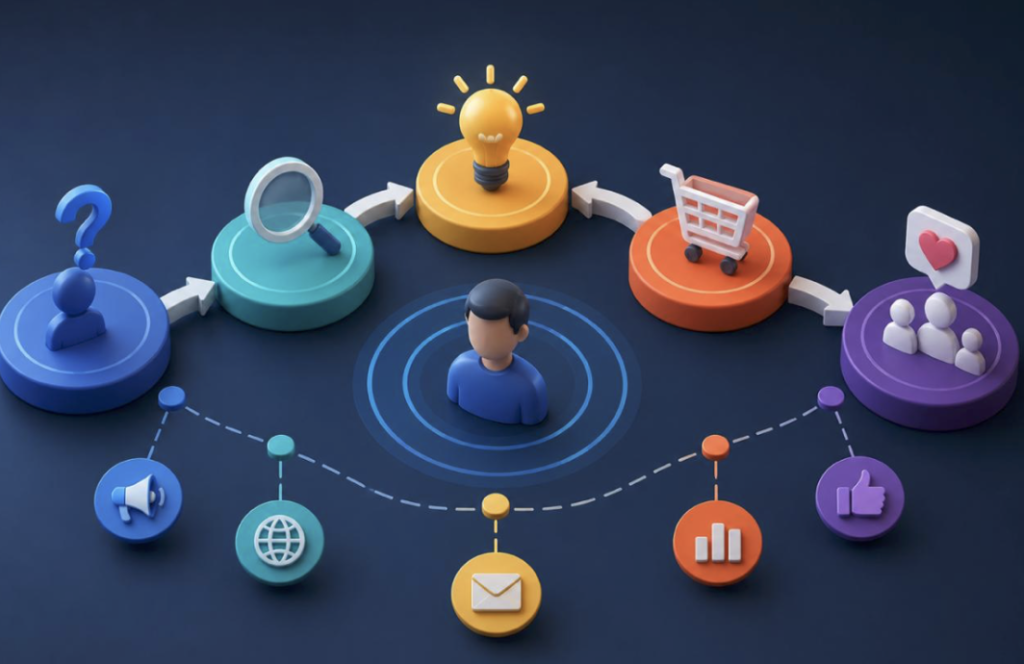
Before building any system, you need a clear picture of how someone moves from not knowing you exist to becoming a paying customer. This journey, usually described as awareness, consideration, and decision, is the skeleton on which your marketing system hangs.
Awareness is when someone first encounters your brand. This might happen through a Google search, a social media post, a podcast interview, or a referral from a friend. They don’t know much about you yet. They’re not ready to buy. They’re just discovering that you exist.
Consideration is when that person starts engaging with your content, your emails, or your offers more deliberately. They’re comparing options, building trust, learning whether you understand their problem and whether your solution is credible.
Decision is when they’re ready to act, to book a call, make a purchase, or start a trial. At this stage, the question is whether you make it easy enough for them and whether you’ve built enough trust.
A properly built marketing system has mechanisms at each stage. Without something capturing awareness, you’re invisible. Without something nurturing consideration, people drift away and buy from someone else. Without a clear, frictionless path to the decision, you lose sales that should have been yours.
Pillar One: Content That Attracts Without Your Involvement
The most durable piece of any automated marketing system is content that lives on the internet and keeps working long after you created it. Blog posts, YouTube videos, podcast episodes, and optimized landing pages are the primary vehicles for this.
Search-optimized content is the clearest example. When you write an article that ranks on page one of Google for a query your ideal customer types, that article is working for you every day, at 2am, on weekends, during your vacation. It doesn’t need to be refreshed constantly (though periodic updates help maintain rankings). It just needs to exist, be genuinely useful, and be findable.
The strategic question isn’t whether to create content, it’s what kind of content serves your customer journey and where that content lives. For a B2B consultant, long-form blog articles and a LinkedIn presence might be the right vehicles. For a product-based business, YouTube tutorials showing the product in action might drive far more traffic and trust than written content. For a local service business, Google Business Profile content and local SEO might be the highest-leverage channel.
Choose one or two content channels and commit to building depth in them before spreading across every platform. A hundred articles on a well-organized blog will do more for your marketing system than ten articles spread across ten different platforms.
Pillar Two: Email Automation That Nurtures Trust Over Time
If content is how strangers find you, email is how you deepen the relationship until they’re ready to buy.
An email list is the only audience you truly own. Social media followers can evaporate if a platform changes its algorithm or disappears. Search rankings can shift. But an email subscriber who gave you permission to contact them is a durable relationship, and a properly built email automation sequence does the nurturing work without you writing a new email every day.
Here’s how a basic automated email sequence works in practice. When someone subscribes, usually in exchange for a free resource, a guide, or a course, they enter an automated sequence that delivers a series of emails over days or weeks. The first email delivers what you promised. The second might share a relevant piece of content that helps them understand their problem better. The third might tell a story that illustrates your approach. The fourth might address common objections. The fifth might make a gentle offer.
This sequence runs for every new subscriber, automatically, on whatever timeline you set. Someone who subscribes today gets email one. In three days, they get email two. Next week, email three. You wrote these emails once. They do the work indefinitely.
The important thing is that this sequence shouldn’t feel like a sales funnel, it should feel like a helpful, intelligent conversation. The emails that convert best are the ones that give genuine value, demonstrate real understanding of the reader’s situation, and earn the right to make an offer rather than demanding it on day two.
Pillar Three: A Lead Magnet That Earns the Email Address
The email system doesn’t work without a reliable way to grow the list. That’s where a lead magnet comes in, a free resource valuable enough that someone is willing to exchange their email address for it.
What makes a good lead magnet? Specificity and immediate usefulness. A generic “ultimate guide to X” rarely converts as well as something that solves a very particular problem in a very short time. A template someone can use immediately. A checklist that takes five minutes to apply. A short calculator that helps someone answer a specific question. A mini-email course that teaches one concrete skill over five days.
The lead magnet has to deliver genuine value, not a teaser that holds back the real answer to get someone on a call. When someone uses your free resource and it actually helps them, they trust you before you’ve ever spoken to them. That’s the point. You’re demonstrating competence before asking for anything.
Once you have a lead magnet and the email sequence built, the whole thing runs on its own. A visitor lands on your site, sees the lead magnet offer, signs up, receives the sequence automatically, and either buys or doesn’t, without you intervening at any point. That’s a system.
Pillar Four: Referral and Word-of-Mouth Mechanisms
The most underleveraged piece of most small business marketing systems is a structured approach to referrals.
Word of mouth happens naturally when you do good work. But “naturally” means inconsistently, sometimes a happy client tells five people, sometimes they tell nobody despite being genuinely satisfied, because it never occurred to them to do so. A referral system doesn’t rely on spontaneity.
The simplest referral mechanism is just asking at the right moment. After a client gets a meaningful result, sends a thank-you message, or completes a project, that’s the moment to ask. Not a generic “if you know anyone…” but a specific, personal request: “This kind of project is what I do best. If you know one or two other people in a similar situation, I’d really appreciate an introduction.”
More structured approaches include referral incentives (discounts, commissions, or credits for clients who refer), formal affiliate programs for business partners, or even just a dedicated email sequence that automatically sends to clients after project completion asking for testimonials and referrals.
The mechanism doesn’t have to be complex. It just has to exist consistently rather than only when you remember to ask.
Pillar Five: Retargeting and Paid Amplification (When You’re Ready)
Organic content, email, and referrals build a marketing system that’s genuinely self-sustaining. When you want to accelerate it, paid advertising can amplify what’s already working without replacing it.
The key word is amplify. Running ads to a landing page or lead magnet that already converts organically is a smart use of budget, you’re pouring fuel on a fire that’s already lit. Running ads cold without a working organic funnel underneath is expensive guesswork.
Retargeting is particularly efficient in this context. By placing a pixel on your website, you can show ads specifically to people who already visited your site, people already in the consideration phase who simply didn’t take action yet. These ads are inexpensive relative to cold traffic ads and tend to convert at dramatically higher rates because you’re talking to people who already know who you are.
This doesn’t need to be a major budget line. Even a small retargeting campaign running in the background, showing a relevant offer to recent site visitors, can meaningfully lift conversion rates from all your organic work.
Putting It Together: What the System Actually Looks Like
Let’s make this concrete. Here’s what a functioning automated marketing system looks like for, say, a freelance graphic designer:
A blog on their site publishes articles targeting searches their ideal clients make, things like “how to brief a logo designer” or “what to expect from a brand identity project.” These articles bring in organic traffic from business owners in the market for design services.
Those articles include prominent offers for a free resource, “Download: The 10 Questions to Answer Before Starting a Brand Project.” Visitors who want the guide enter their email.
That email triggers an automated sequence: day one delivers the guide, day three shares a case study of a recent brand project, day five addresses the most common concern clients have about working with a designer, day eight makes a clear, low-pressure offer for a free 20-minute consultation.
Clients who complete projects receive an automated follow-up email three weeks after delivery asking for a review and a referral.
The designer runs a small retargeting campaign, $5 to $10 a day, showing a “Book a free consultation” ad to anyone who visited the portfolio page but didn’t book.
None of this requires daily involvement. The designer can spend their marketing time creating one new blog article per month and occasionally updating the email sequence based on what questions they hear most from clients. Everything else runs.
Where People Go Wrong
The most common failure mode is building pieces of a system that don’t connect. An email list with no traffic source feeding it. A content strategy with no email capture mechanism. A lead magnet with no nurture sequence. Each piece feels like progress, but disconnected components don’t create the compounding effect of a real system.
Another mistake is perfectionism at the setup stage. A lead magnet that exists and is moderately useful beats a perfect one that’s still being refined six months from now. Email sequences get refined over time based on what people actually respond to. Start with functional, then optimize.
And the mistake that undermines everything is abandoning the system before it matures. Most automated marketing systems need three to six months before they generate consistent, meaningful results, because content takes time to rank, email lists take time to grow, and referral networks take time to develop. Entrepreneurs who switch strategies every eight weeks never build anything that compounds.
Practical Takeaways
Map your customer journey before building anything. Know what awareness, consideration, and decision look like for your specific buyer, then build one mechanism for each stage.
Start with one content channel and one lead magnet. Not five channels. Not three different free resources. One of each, done well, before expanding.
Write your email sequence before launching the lead magnet. The sequence is what gives the list value. A growing list with no nurture sequence is just a database.
Audit your system quarterly. Look at where subscribers are dropping off in your email sequence. Look at which content pieces are driving the most organic traffic and leads. Optimize based on real data, not intuition.
Conclusion
Building a marketing system that works while you sleep isn’t about finding a magic automation tool or outsourcing everything to a VA. It’s about making a deliberate shift from marketing as daily activity to marketing as infrastructure, building assets and automations that do the repetitive work of attraction, education, and follow-up without requiring your presence.
The shift takes time and focused effort upfront. But there’s a specific moment every business owner who builds a real system describes: the first morning they wake up to find a new lead in their inbox from content they wrote months ago, nurtured by a sequence they built once and haven’t touched since. That moment makes the investment undeniable.
You don’t need a huge team or a huge budget to get there. You need a clear customer journey, a few well-built components, and the patience to let the system mature before judging it. Start with one piece. Connect it to the next. Let it run.
Frequently Asked Questions
1. How long does it take to build a marketing system?
The core components, a lead magnet, a basic email sequence, and one content channel, can be built in four to eight weeks with focused effort. The system then matures over three to six months as content ranks, the list grows, and the sequence gets refined. Expect results to build gradually rather than arriving all at once.
2. Do I need expensive tools to automate my marketing?
No. Tools like Mailchimp, ConvertKit, or MailerLite handle email automation at low or no cost for small lists. A WordPress blog handles SEO content. A simple Canva template can produce a functional lead magnet. The strategy matters far more than the tool stack.
3. What’s the most important part of a marketing system to build first?
The email capture mechanism and nurture sequence. Traffic without a way to capture leads is wasted. If someone visits your site and leaves, they’re gone. A lead magnet and email sequence let you maintain the relationship even after they’ve closed the browser tab.
4. Can a local business use automated marketing?
Absolutely. Local businesses can automate review request emails after a service, use Google Business Profile content to attract organic local searches, set up lead magnet offers for location-based service inquiries, and run small retargeting campaigns to recent website visitors. The principles apply regardless of whether customers are local or global.
5. How do I know if my marketing system is working?
Track email list growth month over month, the open and click rates in your automated sequence, organic search traffic to your content, and the source of incoming leads (especially how many say they found you through content or were referred). These indicators tell you whether the system is generating awareness and nurturing it effectively.
6. What if I don’t have time to create content regularly?
Consistency matters more than frequency. One well-researched, genuinely useful blog post per month compounds over time more reliably than sporadic bursts of five posts followed by three months of silence. Start with a pace you can sustain indefinitely, even if it feels slow.