

What Rich Investors Know About Risk That Beginners Don’t
Ask most beginner investors what separates wealthy investors from everyone else, and you’ll hear answers like luck, capital, or insider access. The real answer is less exciting and far more useful: it comes down to how they think about risk.
Most new investors obsess over potential returns. Experienced investors think first about protecting what they already have, and returns follow from there. That single difference in priority quietly shapes almost every decision that follows. Successful investors treat risk as something to be managed, not feared, and during periods of market stress, that mindset tends to produce far more rational decisions than chasing short-term gains.
Wealthy investors don’t get rich by taking bigger risks than everyone else. They get rich by understanding risk more precisely.
Why Beginners Get Risk Wrong From the Start
Many new investors treat risk as a binary, safe versus risky, and assume the goal is to minimize it as much as possible. This instinct, ironically, often produces the opposite of financial security.
Investors who avoid risk altogether tend to park too much money in low-yield accounts, miss long-term growth, and slowly lose purchasing power to inflation even while their account balance looks stable. Research into investor psychology consistently shows that emotional decision-making erodes returns, people buy when markets feel comfortable and sell when things get uncomfortable, which is exactly backwards. The problem was never risk itself. The problem is misunderstanding what risk actually is.
The Mindset Shift: Managing Risk Instead of Avoiding It
Wealthy investors understand that avoiding all risk is impossible. They ask how to manage it while still capturing opportunity. Every asset carries some form of risk, stocks carry market risk, bonds carry interest-rate risk, real estate carries liquidity risk, even cash quietly loses value to inflation.
Since risk can’t be eliminated, sophisticated investors instead focus on the probability of loss, the size of that potential loss, and the expected reward relative to what’s being risked. This turns decisions into something based on evidence rather than gut feeling, and it’s exactly why the idea of “zero-risk investing” doesn’t really exist. Cash in a savings account feels safe, but inflation erodes its value steadily, a hidden risk that’s easy to overlook precisely because nothing dramatic seems to be happening.
Calculated Risk vs. Emotional Risk
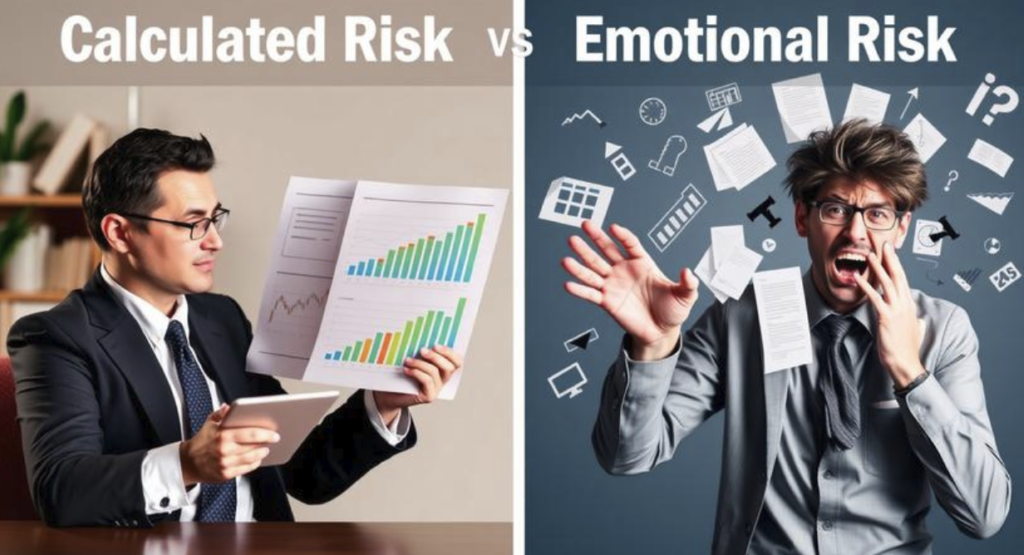
Not all risk-taking looks the same. Calculated risk comes from research, probability analysis, proper position sizing, and a clear exit plan, it’s grounded in logic. Emotional risk comes from fear of missing out, panic selling, hype, and greed during a rising market, it’s grounded in impulse. Warren Buffett captured this well when he noted that danger comes from not understanding what you’re actually doing. Wealthy investors take calculated risks regularly. What they work hard to avoid is the emotional kind.
Protecting Capital Comes Before Growing It
Before entering any position, experienced investors ask a few blunt questions: What’s the maximum loss I can tolerate? How does this affect my overall portfolio? What’s my exit plan if things go wrong?
This isn’t pessimism, it’s math. A portfolio that drops 50% needs a 100% gain just to break even; a 20% loss needs a 25% gain to recover. This imbalance is precisely why safeguarding your capital should come before pursuing higher returns. Remaining invested long enough for compounding to take effect is more important than any individual big win. That’s also why seasoned investors plan for potential losses in advance, setting their maximum acceptable loss and exit criteria before making a purchase.
Having a plan eliminates much of the emotional response that leads people to panic during volatility, transforming market downturns from disasters into a normal and anticipated part of the cycle.
Diversification Beyond the Obvious
Beginner portfolios often concentrate heavily in one category. Wealthy investors diversify their capital among public equities, real estate, private businesses, bonds, cash, and alternative assets to minimize reliance on any one market result.
The same logic extends to income. Relying on one income source creates concentration risk; if that source weakens, financial stability suffers with it. Dividends, rental income, business profits, interest, and capital appreciation working together create a resilience that a single paycheck or single asset class can’t match.
Thinking in Decades, Not Days
Perhaps the clearest divide between beginners and wealthy investors is time horizon. New investors often judge success by what happens this week. Seasoned investors focus on years and decades, which fundamentally alters their reaction to short-term fluctuations.
Compounding is the reason this matters so much. A $10,000 investment earning a 10% average annual return grows to roughly $174,000 over 30 years with no additional contributions, but only if the money stays invested, something beginners frequently interrupt by trading in and out based on short-term price swings.
Consistently staying in the market outperforms attempting to time it perfectly. Patience matters more here than raw intelligence: investors who stay invested through downturns and avoid emotional reactions are the ones who actually benefit from decades of compounding.
Separating Emotion From Decision-Making
Fear and greed are the two emotions that do the most damage. Fear pushes people to sell quality assets during downturns. Greed pushes them to chase trends after prices have already climbed. Behavioral research consistently shows people feel losses more intensely than equivalent gains, a bias that quietly leads many investors to buy high and sell low without realizing the pattern.
Wealthy investors counter this by leaning on evidence instead of headlines, evaluating revenue growth, profitability, debt levels, and valuation before committing capital. A written investment plan, created before volatility hits, becomes the anchor that prevents emotional reactions when markets get uncomfortable. Financial education plays the same role over time: investors who continuously study businesses, market history, and financial statements make more disciplined decisions and panic less during downturns, because they understand what they actually own and why.
Volatility Is Not the Same as Risk
One of the most common and costly mistakes beginners make is treating volatility and risk as interchangeable. They’re not. Volatility measures how much a price moves. Risk measures the chance of permanently losing capital. A highly volatile asset can still be a strong long-term holding, while a stable-looking asset can quietly carry serious long-term risk.
This confusion also drives the predictable cycle of chasing hype, excitement builds, prices rise, more people pile in, expectations stretch beyond reality, and a correction eventually follows. The investors who entered late are usually hurt the worst. Sticking to fundamentals rather than popularity keeps a portfolio out of that trap.
A Practical Risk Framework Worth Borrowing
Before committing capital, experienced investors typically run through a short mental checklist: Why am I making this investment, and where does the return actually come from? What’s the maximum loss I’m willing to accept? How does this affect my overall portfolio concentration? Under what conditions would I sell? And honestly, do I understand this investment well enough to own it?
Pairing that checklist with genuine diversification and reviewing the portfolio regularly, usually quarterly, keeps decisions grounded in strategy rather than reaction.
The Real Takeaway
Successful investing was never about eliminating risk. It’s about understanding it clearly enough to manage it deliberately. The investors who build lasting wealth tend to follow the same core habits: they manage risk instead of fearing it, protect capital before chasing returns, plan for losses in advance, diversify meaningfully, think in long time horizons, and rely on evidence over emotion.
None of this requires exceptional talent. It requires preparation, patience, and a fundamentally healthier relationship with risk than most beginners start out with which, fortunately, is something anyone can build over time.
Frequently Asked Questions
1. What’s the biggest risk management mistake beginners make?
Confusing volatility with permanent loss. Many beginners panic-sell quality investments during short-term dips without a clear exit strategy to guide that decision calmly.
2. How do wealthy investors decide how much risk to take?
They weigh their financial goals, time horizon, liquidity needs, and overall diversification, not just potential returns. The key question is how a potential loss would affect their broader financial position.
3. Is diversification alone enough to protect a portfolio?
No. It helps significantly, but broad downturns can hit multiple asset classes at once. Diversification works best paired with position sizing, cash reserves, and regular reviews.
4. What’s the actual difference between volatility and risk?
Volatility is how much a price moves. Risk is the chance of permanently losing capital. An asset can be volatile and still be a strong long-term holding.
5. Can beginners use the same risk strategies as wealthy investors?
Yes. Diversification, position sizing, written plans, and regular reviews work at any investment size. Consistency matters more than wealth.