What Is Zero Click Marketing and Why It Is Growing in 2026
Here’s something that would have sounded absurd to a digital marketer ten years ago: your content can be consumed by millions of people who never visit your website. No click. No session. No page view in your analytics. And yet, your brand grows, your audience trusts you more, and your business benefits.
That’s the reality of zero click marketing in 2026, and if you haven’t wrapped your head around it yet, you’re likely frustrated watching your traffic numbers stagnate while wondering why your reach feels so disconnected from your results.
The old playbook said: create content, drive traffic, convert visitors. That loop is breaking down. Not because content marketing stopped working, but because the platforms where people spend their time have fundamentally changed how information is delivered, and they have very little interest in sending their users somewhere else.
What Zero Click Marketing Actually Means
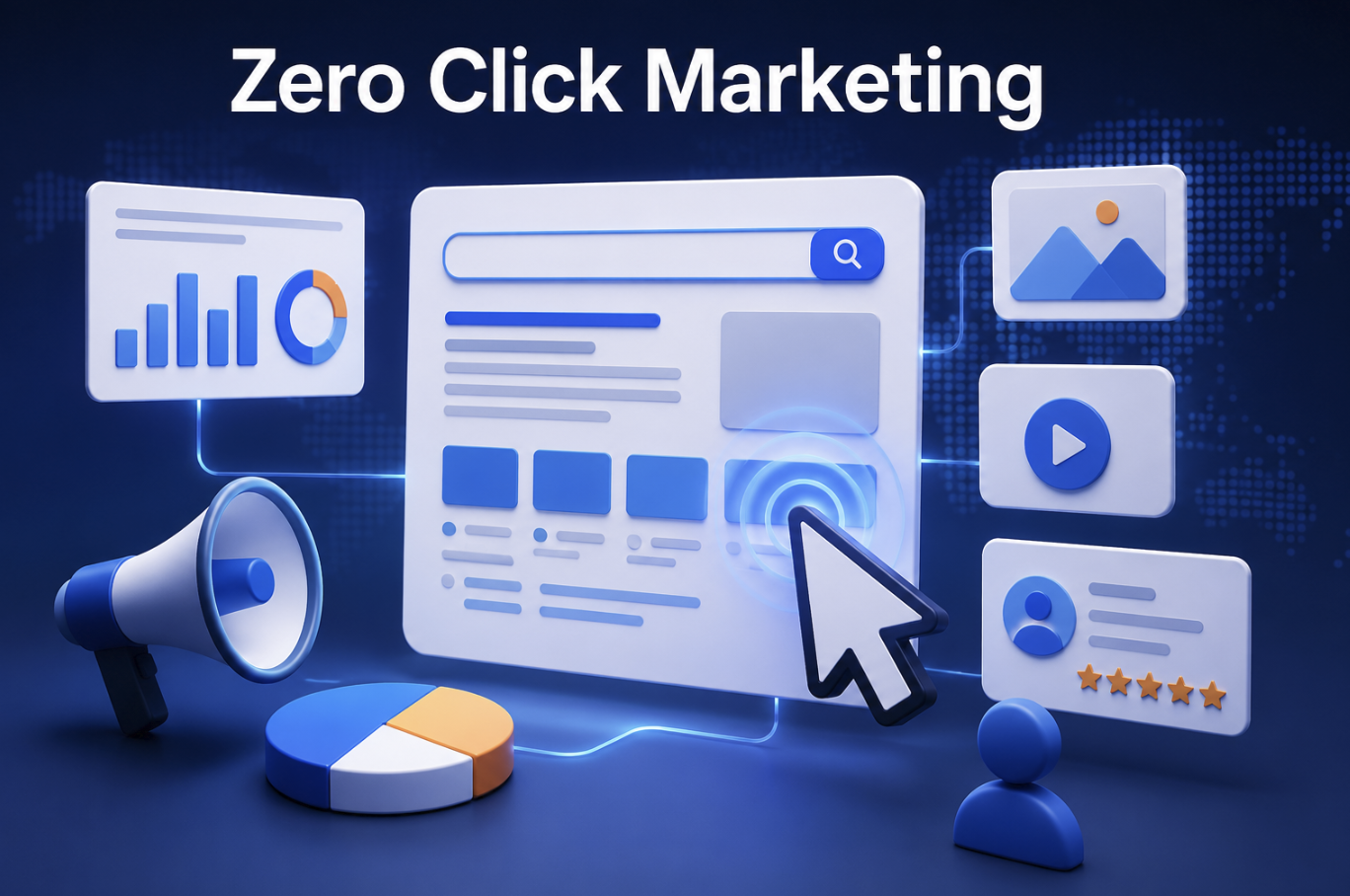
Zero click marketing refers to any strategy where your audience gets value from your content without clicking through to your website or any external page. The interaction happens entirely within the platform, whether that’s a Google search results page, a LinkedIn post, a TikTok video, an Instagram carousel, or an AI-generated answer.
The term “zero click” originally came from SEO research. Studies by SparkToro and others found that a significant portion of Google searches end without the user clicking any result, Google answers the question directly through featured snippets, knowledge panels, or AI-generated summaries. In 2024 and into 2025, that number climbed even higher as Google rolled out AI Overviews, which synthesize answers at the top of the page before the user ever sees an organic result.
But zero click isn’t just a search phenomenon anymore. It’s the dominant behavior across almost every major platform:
- LinkedIn users scroll through long-form posts and carousels without clicking any link
- Instagram Reels and TikTok deliver complete ideas, tutorials, and stories in 60 to 90 seconds
- Podcasts provide full value in audio form with no URL required
- Email newsletters are consumed entirely in the inbox
- YouTube Shorts get millions of views from people who never visit a channel page
The implication is uncomfortable but clear: if your marketing strategy depends entirely on driving people to your website, you’re putting your brand’s visibility in the hands of a behavior that’s becoming less common every year.
Why This Shift Is Accelerating in 2026
Several forces are colliding at once, and together they’re making zero click behavior the norm rather than the exception.
AI search is the most significant accelerant. Google’s AI Overviews, Perplexity, ChatGPT’s Browse mode, and similar tools synthesize answers from multiple sources and present them directly. A user asks a detailed question and gets a thorough, well-structured answer, often without seeing a single link from a specific website. The source might get a citation buried below the answer, but the click often never comes.
For certain categories of queries, factual questions, how-to guides, definitions, comparisons, this is already the default experience for a large portion of users. The websites whose content was being used to train those answers and generate those summaries are getting the exposure without the traffic. That’s not entirely bad, but it requires rethinking what “success” looks like.
Platform algorithm changes are the second major driver. LinkedIn, Instagram, and TikTok have all moved toward prioritizing content that keeps users on-platform. External links get reduced distribution. Posts that ask people to “click the link in bio” perform worse than posts that deliver the full idea right there in the caption or the video. Platforms are transparent about this: they want engagement, not exits.
The third factor is audience behavior itself. People are more selective about what they click on than they used to be. Ad fatigue, pop-up anxiety, slow-loading sites, paywalls, there are enough friction points that many users simply decide not to bother if they can get enough value from the preview. You’ve probably done this yourself. You see a headline in your feed, the caption tells you enough, and you scroll on. You got the value; the publisher got nothing.
Why Most Marketers Are Struggling to Adapt

The core problem is that most marketing measurement systems were built for the click economy. Analytics platforms track sessions, pageviews, bounce rates, and conversions, all of which require someone to actually land on your website. If your brand is building awareness and trust through LinkedIn posts that get ten thousand impressions and zero link clicks, your analytics dashboard tells you nothing happened. So you conclude the content isn’t working.
That’s a measurement problem, not a marketing problem.
The other struggle is psychological. There’s something uncomfortable about publishing your best ideas publicly, on a platform you don’t own, without a clear mechanism to capture leads, and just, letting people take the value and leave. It feels like giving something away for nothing.
But that framing misunderstands how awareness and trust actually build. When someone sees your content consistently over weeks and months, gets genuine value from it, and comes to associate your name with smart thinking on a particular topic, that’s brand equity. When they eventually have a problem you can solve, or someone asks them for a recommendation, you’re the person who comes to mind. The click didn’t happen at step one. It happens at step ten. Or it doesn’t happen at all, and they mention you to someone else who does click.
Zero click marketing asks you to play a longer game than most dashboards are built to measure.
What Zero Click Marketing Looks Like in Practice
Let’s get concrete. Here are the formats and approaches that characterize effective zero click strategy right now.
Native long-form content on LinkedIn. The posts that perform best on LinkedIn in 2026 are not “read my article” posts. They’re posts that tell a complete story, share a genuine insight, or walk through a practical framework, right there in the post body. No link needed. The engagement (comments, reposts, follows) builds visibility and authority over time. The link to your website, if it exists at all, goes in the comments or at the very end.
Fully-produced short video. TikTok, Instagram Reels, and YouTube Shorts reward content that delivers complete value in under two minutes. A financial advisor explaining one concept about tax-loss harvesting in 90 seconds, with no call to action, reaches vastly more people than a three-paragraph blog post that never gets shared. The awareness that creates is real and measurable in follower growth and DMs, even if not in website sessions.
Optimizing for AI answer engines. This is one of the more interesting frontiers. Brands that get cited by AI tools like Perplexity or appear in Google’s AI Overviews gain significant exposure without a corresponding click. Optimizing for this means writing clear, well-structured, factually accurate content, especially content that answers specific questions in a direct, quotable way. It’s less about keyword density and more about being the clearest, most trustworthy source on a given topic.
Newsletters designed for the inbox. Email newsletters have had a remarkable resurgence precisely because they don’t depend on anyone’s algorithm, and the best ones are designed to be read entirely in the email, not to funnel subscribers to a blog post. Readers who find consistent value in your newsletter are among your most loyal audiences, and they tend to act when you eventually ask them to.
Podcast and audio content. A well-produced podcast that runs for an hour doesn’t need anyone to click anything. Listeners engage deeply, develop strong parasocial connections with hosts, and often become extremely loyal, converting at high rates when they finally do take action, even months after first listening.
The Trade-offs and Honest Challenges
Zero click marketing isn’t without its complications, and anyone telling you it’s purely a win needs to reckon with a few real tensions.
You don’t own the platforms. Your LinkedIn audience, your TikTok followers, your presence in AI-generated answers, none of that is truly yours. Platforms change algorithms, restrict reach, get acquired, or disappear. The risk of building entirely on rented land is real, which is why most seasoned marketers treat zero click channels as awareness and trust builders, with email lists and owned communities as the foundation they’re ultimately trying to grow.
Attribution becomes genuinely difficult. When someone buys from you six months after seeing your LinkedIn content consistently, nothing in your CRM connects those dots. You’ll need qualitative data, customer surveys asking “how did you hear about us,” sales call notes, community feedback, to understand what’s actually working. This requires a cultural shift in how marketing performance is discussed internally.
Not every business benefits equally. If you sell something with a very long sales cycle in a niche B2B market, zero click awareness might compound slowly enough that it feels invisible. If you sell to consumers in a high-volume category, the reach that zero click content provides can be transformational. Know your context before committing your strategy.
How to Build a Zero Click Marketing Strategy
Start by auditing where your audience actually spends time. Not where you think they should be, but where they demonstrably are. If your customers are executives who live on LinkedIn, that’s your zero click priority. If they’re younger consumers on Instagram and TikTok, that’s where you build.
Next, commit to creating content that is complete. The hardest mindset shift is giving away the good stuff, the actual insight, the specific framework, the real answer, without making people go somewhere to get it. If your LinkedIn post ends with “click the link to find out the rest,” you’ve already lost the zero click game.
Think in series, not in individual posts. One-off pieces rarely build the kind of familiarity that converts. A weekly LinkedIn post series on a specific topic, a consistent podcast, a newsletter that arrives on the same day each week, these build patterns of expectation that compound into authority.
Finally, build a bridge back to something you own. Zero click channels build awareness; your email list or community is where that awareness eventually converts. The ask doesn’t have to be aggressive, it can be as simple as consistently mentioning that your newsletter goes deeper, or that you have a free resource that’s worth signing up for. Let the zero click content do the trust-building, and let your owned channel do the converting.
Final Thoughts
The shift toward zero click behavior isn’t reversible. AI search will keep answering more queries directly. Platforms will keep suppressing external links. Audiences will keep preferring content that doesn’t require them to navigate away. Fighting this is a losing battle.
What works is leaning into it strategically: be the source that AI tools cite, be the creator whose content is so complete that sharing it becomes valuable, be the brand whose name people associate with clear thinking on a topic, even if they never clicked a single link to get there.
Measure what matters in this environment. Track follower growth, content reach, share rates, comment quality, newsletter growth, and importantly, ask your customers how they heard about you. The click-through rate tells you less than it used to.
And remember: zero click doesn’t mean zero return. It means the return shows up differently, and often later, than a dashboard built for 2015 can capture.
Frequently Asked Questions
1. Is zero click marketing bad for SEO?
It’s a shift more than a threat. Traditional traffic-focused SEO is harder as AI search grows, but optimizing for AI citations and featured snippets is its own emerging discipline. Brands that focus on clear, authoritative, well-structured content are actually well-positioned for both.
2. How do you measure zero click marketing success?
Look at reach, impressions, follower growth, newsletter subscriber growth, brand mention volume, and qualitative customer feedback. Ask buyers how they found you. These signals replace click-through rate as the primary indicators.
3. Does zero click marketing work for B2B?
Yes, particularly well on LinkedIn, in email newsletters, and in podcast format. B2B buyers are increasingly doing research independently before engaging a sales team, which means the awareness built through zero click content often precedes and influences the eventual purchase decision.
4. Should I stop trying to drive website traffic?
No. Website traffic still matters for conversions, product demos, and direct sales. The point is not to abandon traffic generation but to stop treating it as your only metric of marketing success. Use zero click channels for awareness, your website for conversion.
5. What’s the biggest mistake brands make with zero click content?
Holding back. The instinct to tease rather than deliver, to offer a taste and then ask for a click, actively undermines zero click strategy. Audiences reward generosity. Give the full answer. Trust compounds from there.