
What Is Customer Acquisition Cost and How to Lower It for Any Business
Customer acquisition is the lifeblood of every business. Without new customers, growth eventually slows. But there’s an important question many business owners overlook:
How much does it actually cost to gain each new customer?
Some companies invest heavily in advertising, sales teams, and marketing campaigns without knowing whether those efforts are profitable. Others assume they’re growing because sales are increasing, only to discover later that acquiring customers costs more than those customers are worth.
This is where Customer Acquisition Cost (CAC) becomes one of the most valuable metrics in business.
Whether you’re running an eCommerce store, SaaS company, local service business, startup, or enterprise, understanding Customer Acquisition Cost helps you make smarter marketing decisions, allocate budgets effectively, and increase long-term profitability.
In this guide, you’ll learn what Customer Acquisition Cost is, how to calculate it, why it matters, common mistakes businesses make, and practical strategies to reduce CAC without sacrificing growth.
What Is Customer Acquisition Cost (CAC)?
Customer Acquisition Cost, or CAC, indicates the total expenses a company incurs to gain a single new customer.
It includes all the expenses involved in convincing someone to become a paying customer, not just advertising costs.
In simple terms:
Customer Acquisition Cost tells you how much money your business spends to gain one customer.
If you spend £10,000 on marketing and sales during a month and acquire 200 new customers, your CAC is:
CAC = £10,000 ÷ 200 = £50
That means each customer costs your business £50 to acquire.
Understanding this number allows businesses to evaluate whether their marketing investments are sustainable.
Why Customer Acquisition Cost Matters
Many businesses focus only on increasing sales.
Smart businesses focus on profitable growth.
A business may double its customers while losing money on every sale if acquisition costs are too high.
Customer Acquisition Cost helps answer questions like:
- Is our advertising profitable?
- Which marketing channels perform best?
- Should we increase marketing spend?
- Are we pricing our products correctly?
- Is our sales process efficient?
Instead of relying on guesswork, CAC provides measurable data for better decision-making.
Reducing Customer Acquisition Cost can improve profitability and free up more capital for future expansion. Once your business generates consistent profits, you can explore 5 Simple Investment Strategies for Long Term Growth to make the most of those earnings.
The Customer Acquisition Cost Formula
The standard formula is straightforward:
Customer Acquisition Cost = Total Sales and Marketing Costs ÷ Number of New Customers Acquired
Costs typically included
- Paid advertising
- Marketing software
- Sales salaries
- Marketing team salaries
- Agency fees
- Content production
- SEO expenses
- Social media management
- Sales commissions
- CRM software
- Promotional campaigns
Example
Imagine an online clothing retailer spends during one month:
- Google Ads: £4,000
- Facebook Ads: £3,000
- Marketing salaries: £5,000
- Design and content: £2,000
- Email software: £500
Total marketing cost:
£14,500
New customers:
290
CAC:
£14,500 ÷ 290 = £50
Every new customer costs approximately £50 to acquire.
Customer Acquisition Cost vs Customer Lifetime Value
Customer Acquisition Cost becomes far more meaningful when compared with Customer Lifetime Value (LTV).
Lifetime Value estimates how much revenue, or preferably profit, a customer generates throughout their relationship with your business.
For example:
- CAC: £80
- Lifetime Value: £800
This is generally a healthy relationship because the customer generates significantly more value than they cost to acquire.
Now imagine:
- CAC: £250
- Lifetime Value: £180
The business loses money with every new customer.
A commonly used benchmark is aiming for an LTV:CAC ratio of around 3:1, meaning a customer generates roughly three times the value of the acquisition cost. While this isn’t a universal rule, it’s a useful starting point for many businesses. For guidance on customer economics, see the Small Business Administration (SBA).
What Is Considered a Good Customer Acquisition Cost?
There isn’t a universal number.
A “good” CAC depends on factors like:
- Industry
- Average order value
- Profit margins
- Customer retention
- Purchase frequency
- Business model
For example:
SaaS
Software companies often accept a higher CAC because customers usually subscribe for months or years.
eCommerce
Online retailers generally need lower CAC because profit margins are often smaller.
Local Service Businesses
Plumbers, dentists, consultants, and legal firms can justify higher acquisition costs because each customer may generate substantial long-term revenue.
The important question isn’t:
“Is my CAC high?”
Instead ask:
“Is my CAC profitable?”
What Drives Customer Acquisition Cost Up?
Several factors can quietly increase acquisition costs over time.
Rising advertising competition
As more businesses compete for the same audience, advertising platforms become more expensive.
This is especially noticeable in industries like insurance, finance, software, and legal services.
Poor website conversion rates
Imagine paying £2 for every website visitor.
If only one in 100 visitors converts, your acquisition cost becomes expensive.
Improving conversion rates often reduces CAC without increasing traffic.
Weak targeting
Showing advertisements to the wrong audience wastes marketing budgets.
Even excellent ads fail if they reach people with little interest in the product.
Long sales cycles
Businesses with lengthy sales processes often spend more on follow-ups, meetings, demonstrations, and nurturing prospects.
Low customer retention
If customers leave quickly after their first purchase, acquisition costs become harder to recover.
Real-World Example: Lowering CAC Without Spending Less
Consider a small online fitness coaching business.
Initially:
- Monthly ad spend: £5,000
- Website visitors: 5,000
- Customers: 50
CAC:
£100
Rather than reducing advertising, the business improved:
- Landing page design
- Testimonials
- Booking process
- Mobile experience
- Email follow-up
Three months later:
- Same advertising budget
- Same traffic
- Customers increased to 100
New CAC:
£50
Nothing changed in advertising costs.
The business simply converted more visitors into customers.
This illustrates an important lesson:
Lower CAC doesn’t always require spending less—it often requires converting better.
Practical Strategies to Lower Customer Acquisition Cost
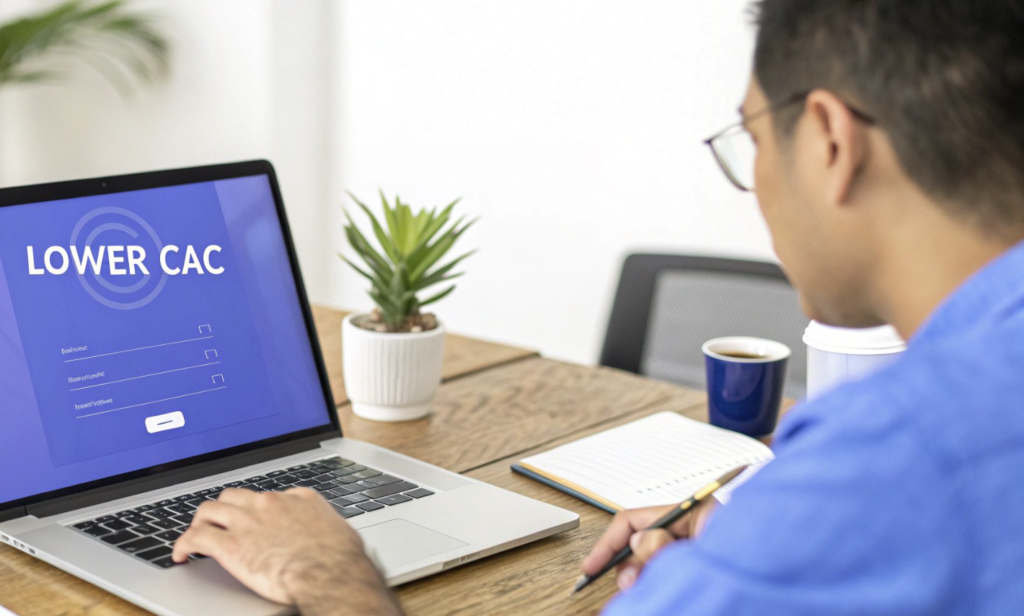
Reducing CAC is rarely about cutting budgets. It’s about making every pound work harder.
Improve conversion rates
A small improvement in conversion rate can dramatically lower acquisition costs.
Focus on:
- Faster website loading
- Clear calls to action
- Better product pages
- Trust badges
- Customer reviews
- Simplified checkout
Even a modest increase in conversions can significantly improve profitability.
Invest in SEO
Unlike paid ads, search engine optimization keeps attracting visitors for months or even years after the content goes live.
High-quality blog posts, landing pages, and educational resources attract customers without paying for every click.
SEO typically requires patience, but it often delivers one of the lowest long-term acquisition costs.
Build referral programmes
Satisfied customers are often your best marketers.
Referral programs motivate current customers to promote your brand to others.
Since trust already exists, referred customers often convert at higher rates.
For example:
A software company offers existing customers one free month of service for every successful referral.
The result?
Lower advertising spend and lower CAC.
Strengthen email marketing
Email remains one of the highest-return marketing channels.
Instead of constantly finding new visitors, businesses can nurture existing prospects through:
- Educational newsletters
- Product updates
- Exclusive offers
- Helpful guides
- Automated follow-up sequences
A well-planned email strategy increases conversions without significantly increasing costs.
Optimise paid advertising
Paid campaigns should never run on autopilot.
Regularly review:
- Keywords
- Audience targeting
- Ad creatives
- Landing pages
- Device performance
- Geographic targeting
- Bid strategies
Small adjustments often improve return on ad spend and reduce acquisition costs.
Focus on customer retention
Many businesses obsess over acquiring new customers while overlooking existing ones.
Retaining customers often costs far less than acquiring new ones.
Loyal customers may:
- Buy more frequently
- Spend more over time
- Refer others
- Leave positive reviews
- Increase lifetime value
Improved retention makes a higher CAC more sustainable because each customer becomes more valuable.
Common Mistakes When Measuring Customer Acquisition Cost
Even experienced businesses can miscalculate CAC.
Ignoring hidden costs
Advertising isn’t the only expense.
Businesses frequently forget to include:
- Staff salaries
- Software subscriptions
- Agency retainers
- Freelancers
- Creative production
- Sales commissions
Leaving these out creates an artificially low CAC.
Looking only at averages
Suppose your average CAC is £70.
That doesn’t mean every marketing channel performs equally.
For example:
- Organic search: £18
- Email marketing: £25
- Google Ads: £65
- LinkedIn Ads: £190
Breaking CAC down by channel helps identify where to invest and where to improve.
Chasing cheap customers
The lowest acquisition cost isn’t always the best outcome.
Imagine:
Campaign A
- CAC: £20
- Average customer spends £30 once
Campaign B
- CAC: £90
- Customer spends £1,200 over three years
The second campaign delivers far greater long-term value despite the higher upfront cost.
How Different Businesses Can Reduce CAC
eCommerce
Focus on:
- Product page optimisation
- Upselling
- User-generated reviews
- Faster checkout
- Cart abandonment emails
SaaS
Prioritise:
- Free trials
- Educational content
- Product demonstrations
- Customer onboarding
- Product-led growth
Local businesses
Improve:
- Local SEO
- Online reviews
- Google Business Profile
- Community partnerships
- Referral incentives
B2B companies
Invest in:
- Thought leadership
- Webinars
- Case studies
- Account-based marketing
- Relationship building
Each business type has different customer journeys, so the most effective way to lower CAC will vary accordingly.
A Simple Framework for Lowering Customer Acquisition Cost
If you’re looking for a practical starting point, follow this process:
- Calculate your current CAC accurately.
- Break CAC down by marketing channel.
- Compare CAC with Customer Lifetime Value.
- Identify your highest-performing channels.
- Improve website conversion rates before increasing advertising spend.
- Invest in long-term channels like SEO and content marketing.
- Measure results consistently and refine your strategy over time.
Making steady, incremental enhancements can lead to more sustainable success than implementing large-scale overhauls.
Final Thoughts
Customer Acquisition Cost is much more than a marketing metric. It’s a measure of how efficiently your business turns investment into growth.
Understanding your CAC helps you avoid overspending, identify profitable marketing channels, and build a business that grows sustainably rather than simply growing quickly.
The most successful companies don’t just spend more to acquire customers, they spend smarter. They optimise every stage of the customer journey, improve conversion rates, retain customers longer, and continually test new ideas.
For startups and small businesses working with limited budgets, understanding how to manage acquisition costs is especially important. If you’re building a business without relying on outside funding, learn more in our guide on What Is Bootstrapping and Why Most Successful Companies Did It.
If you make CAC a regular part of your decision-making, you’ll gain a clearer picture of what drives profitable growth and where your next opportunities lie.
Frequently Asked Questions
1. What is Customer Acquisition Cost?
Customer Acquisition Cost (CAC) is the total cost of acquiring a new customer, including marketing, advertising, sales, and related expenses, divided by the number of new customers gained during a specific period.
2. How do you calculate Customer Acquisition Cost?
Use this formula:
CAC = Total Sales and Marketing Costs ÷ Number of New Customers
For example, if your business spends £20,000 on sales and marketing and acquires 400 customers, your CAC is £50.
3. Why is Customer Acquisition Cost important?
CAC helps businesses understand whether their marketing efforts are profitable, compare the performance of different acquisition channels, allocate budgets more effectively, and plan sustainable growth.
4. What is a good Customer Acquisition Cost?
There is no universal benchmark. A good CAC depends on your industry, pricing, profit margins, customer retention, and Customer Lifetime Value. A commonly cited goal is an LTV:CAC ratio of around 3:1.
5. How can I reduce Customer Acquisition Cost?
You can lower CAC by improving website conversion rates, investing in SEO, optimising paid advertising, building referral programmes, strengthening email marketing, enhancing customer retention, and continuously analysing marketing performance.
6. Should every marketing channel have the same CAC?
No. Different channels naturally produce different acquisition costs. Instead of aiming for identical CAC across channels, compare each channel’s cost against the quality and lifetime value of the customers it generates.
7. Is lowering Customer Acquisition Cost always the right goal?
Not necessarily. Sometimes paying more to acquire high-value, loyal customers leads to better long-term profitability than acquiring low-cost customers who make only one purchase. The goal is profitable acquisition, not simply the lowest possible CAC.