AI Tools: The Smart Guide to Choosing, Comparing, and Using the Right AI
Artificial intelligence is no longer a futuristic idea hidden inside research labs. Today, AI tools influence how people write, code, design, research, communicate, and work. However, choosing the right AI solution has become surprisingly difficult. New platforms appear constantly, while existing tools continue adding powerful features. One tool may excel at writing, while another may handle research better. Meanwhile, specialized platforms can outperform general assistants in specific professional tasks.
That creates a new challenge: how do you compare AI tools without wasting time, money, and effort?
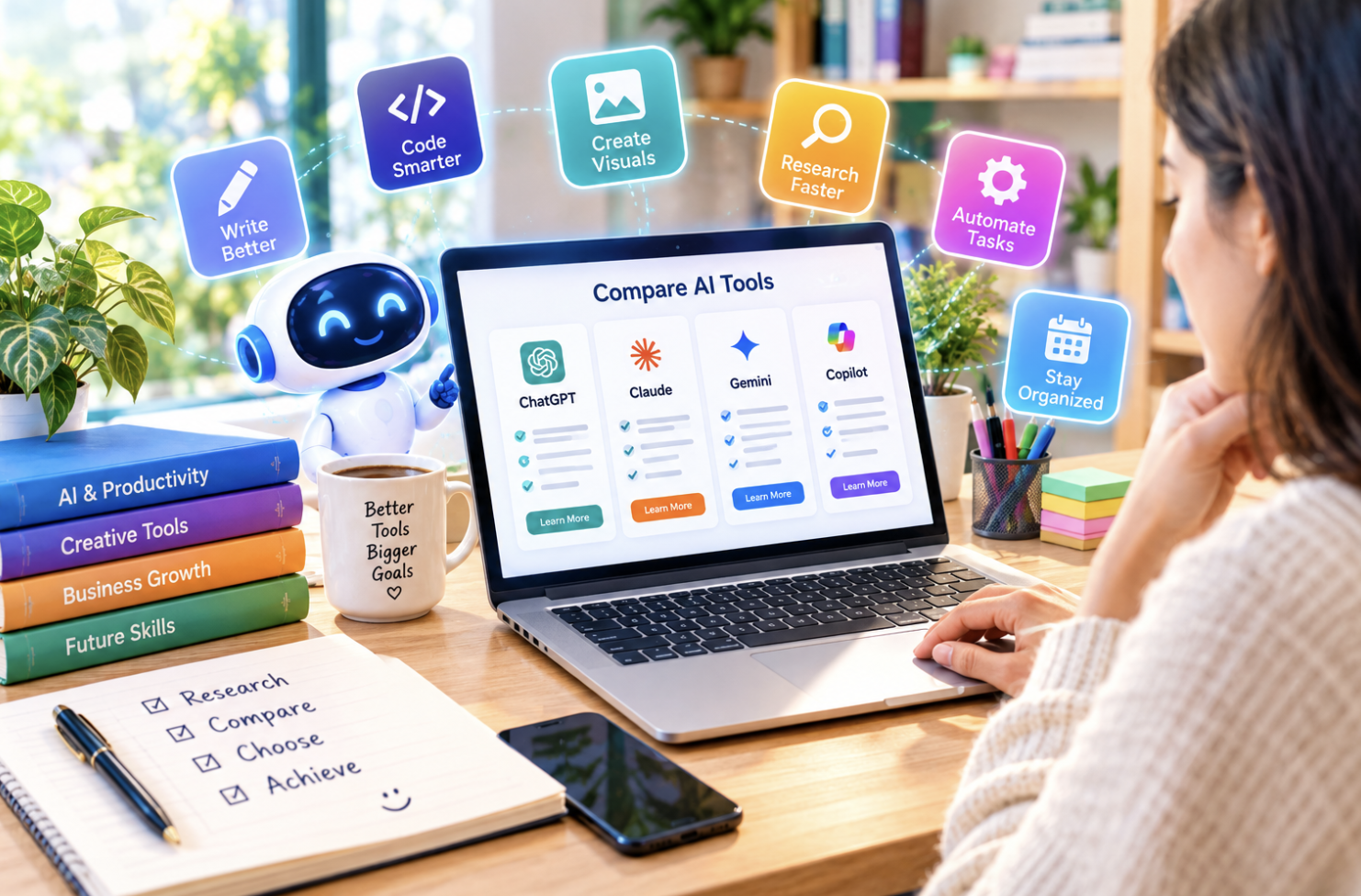
This guide explores the modern AI landscape, explains important comparison factors, and highlights the areas transforming how people use artificial intelligence.
Why the AI Tools Market Is Growing So Quickly
The AI ecosystem has expanded far beyond basic chatbots. Users can now find specialized solutions for almost every digital workflow.
For example, AI platforms can support writing, coding, image creation, video production, research, customer service, data analysis, scheduling, and automation. Moreover, many platforms combine several capabilities within one interface. This makes AI more convenient, but it also makes comparisons harder.
A feature list alone cannot reveal which tool provides better results. Instead, users should consider performance, reliability, workflow compatibility, privacy, pricing, and learning requirements. Therefore, comparing AI tools requires a practical approach rather than simply following popularity.
The Biggest AI Tool Categories to Explore
AI software now covers a wide range of everyday and professional activities.
AI Writing and Content Creation Tools
Writing assistants can generate outlines, drafts, summaries, marketing copy, product descriptions, and creative content.
They can also improve grammar, rewrite sentences, and adjust writing styles. However, users should still review important content for accuracy and originality. The strongest writing workflow usually combines AI assistance with human editing.
AI Coding and Development Tools
Coding assistants can generate functions, explain unfamiliar code, identify bugs, and suggest improvements.
Furthermore, agent-based coding systems can handle multiple development steps instead of completing only individual prompts.
This development could significantly change software workflows. Yet, developers still need to review generated code, security implications, and architecture decisions.
AI Image and Video Generators
Visual AI has also transformed creative production. Modern tools can generate images, edit existing visuals, create concepts, and support video production.
Consequently, marketers and designers can experiment with ideas faster than traditional workflows allow.
However, licensing, consistency, brand requirements, and intellectual property considerations remain important.
AI Research and Search Platforms
Research-focused AI tools help users locate information, summarize sources, compare ideas, and organize findings.
These platforms can reduce research time considerably. Still, users should verify important claims against reliable sources. After all, faster research does not automatically mean more accurate research.
AI Automation and Productivity Platforms
Automation tools connect AI capabilities with existing applications and workflows.
They can help manage emails, organize information, update records, summarize meetings, and trigger repetitive processes.
As a result, businesses can reduce manual work while employees concentrate on higher-value responsibilities.
General-Purpose AI Versus Specialized AI
One of the most important decisions involves choosing between general and specialized AI. General-purpose platforms offer flexibility across many tasks. They can help with writing, brainstorming, analysis, coding, learning, and everyday questions.
Specialized platforms, however, focus on particular workflows. A coding platform may provide deeper developer integrations than a general chatbot.
Similarly, an enterprise search platform may work better with internal company knowledge. Therefore, the best AI tool is not always the most popular one. It is the platform that fits the user’s actual objective.
What Makes an AI Tool Worth Using?
A polished interface does not necessarily indicate a powerful AI product. Instead, several factors should influence your evaluation.
Accuracy and Output Quality
Accuracy should remain one of the first evaluation criteria.
An impressive response is useless if it contains incorrect information. Therefore, test tools using realistic tasks from your actual workflow. Compare their answers against trusted references whenever accuracy matters.
Speed and Reliability
Fast responses can improve productivity, especially when users depend on AI throughout the day.
However, reliability matters just as much. Frequent errors, outages, or inconsistent results can undermine productivity. A slightly slower platform may deliver better long-term value if it performs consistently.
Ease of Use
An advanced AI tool becomes less useful when its interface creates unnecessary complexity.
New users should understand basic functions quickly. At the same time, experienced users should have enough controls for advanced workflows. Therefore, usability should remain part of every serious AI comparison.
Integrations and Compatibility
AI becomes more useful when it works with existing software.
For example, integrations with document systems, communication platforms, development environments, databases, or business applications can reduce repetitive work.
Consequently, integration capabilities can matter more than having dozens of standalone features.
Privacy and Security Should Never Be an Afterthought
AI tools often process sensitive information. That makes privacy an essential part of the selection process. Before adopting a platform, users should understand how their information is stored and processed.
Businesses should also examine access controls, data retention, compliance requirements, and administrative features.
Additionally, organizations should establish clear rules for employees using AI with confidential information. A powerful tool becomes a liability when users ignore data security.
AI Agents Are Changing the Meaning of Automation
Traditional AI assistants generally respond to instructions. AI agents aim to take that concept further. An agent can potentially plan multiple steps, use external tools, interact with software, and complete longer workflows.
For example, an agent might research information, organize findings, create a draft, and prepare a final report. This shift could make AI more useful for complex professional tasks.
Nevertheless, greater autonomy also introduces new risks. Organizations need monitoring, permissions, human oversight, and clear boundaries. The future of AI therefore depends on both capability and control.

How to Compare AI Tools Without Getting Overwhelmed
The easiest approach is to start with the task instead of the technology. First, identify the problem you want AI to solve. Then determine which features are genuinely necessary.
Next, select several relevant platforms and test them using identical tasks. Compare their output quality, speed, usability, integrations, pricing, and limitations. Afterward, calculate the actual value they provide.
For example, a subscription may seem expensive until it saves several hours each week. Conversely, a cheap platform may become costly if employees constantly correct its output. This approach turns AI comparison into a practical business decision.
The Hidden Cost of Choosing the Wrong AI Tool
The subscription price represents only one part of an AI tool’s total cost.
Users can also lose time learning unsuitable platforms. Teams may spend additional hours correcting poor outputs. Furthermore, switching systems can create workflow disruption and training costs.
For businesses, poor AI choices can also create security or compliance problems. Therefore, evaluating long-term value is more useful than comparing monthly prices alone.
Human Expertise Still Matters in an AI-Powered Workflow
AI can accelerate many tasks, but it does not eliminate the need for human judgment. People still provide context, creativity, priorities, ethical decisions, and quality control.
Moreover, experienced professionals can recognize mistakes that automated systems may overlook.
The strongest approach combines machine speed with human expertise. Instead of asking whether AI will replace people, organizations should ask how people can use AI more effectively.
The Future of AI Tools Looks More Connected
AI platforms are gradually moving from isolated applications toward connected digital ecosystems.
Future workflows may combine AI assistants, specialized agents, business databases, automation systems, and creative tools. As these technologies become more integrated, users may spend less time switching between applications.
At the same time, interoperability and security will become increasingly important. Companies that adopt AI strategically can therefore build faster and more adaptable workflows.
Final Thoughts: Choose AI Based on Results, Not Hype
The AI tools market will continue changing rapidly. New platforms will appear, existing products will evolve, and today’s leaders may face unexpected competition.
Therefore, users should avoid choosing tools simply because they are trending. Instead, focus on measurable performance, practical features, security, integration, reliability, and overall value.
The right AI tool should solve a genuine problem and improve your workflow. Ultimately, smart AI adoption is not about using the most tools. It is about using the right tools in the right way.
FAQ’s
1. What are AI tools?
AI tools are software applications that use artificial intelligence to perform tasks requiring human-like capabilities.
2. Why should I compare AI tools?
Comparing AI tools helps you identify better options for your specific requirements, workflow, and budget.
3. Which AI tool is best for everyone?
No single AI tool is best for everyone because different users have different goals and workflows.
4. Are specialized AI tools better than general AI?
Specialized tools can perform better for specific tasks, while general AI usually offers greater versatility.
5. How should businesses evaluate AI tools?
Businesses should evaluate accuracy, security, integrations, scalability, usability, pricing, and measurable productivity gains.
6. Can AI tools replace human workers?
AI can automate many tasks, but human judgment, creativity, oversight, and decision-making remain essential.
7. Are free AI tools worth using?
Free AI tools can be valuable, although they may provide fewer features, lower limits, or fewer business controls.
8. What are AI agents?
AI agents are systems designed to plan and perform multiple tasks with greater independence than traditional assistants.
9. Is AI-generated content always accurate?
No, AI-generated content can contain factual errors and should receive appropriate human verification.
10. What is the future of AI tools?
AI tools will likely become more specialized, connected, autonomous, personalized, and deeply integrated into everyday workflows.