
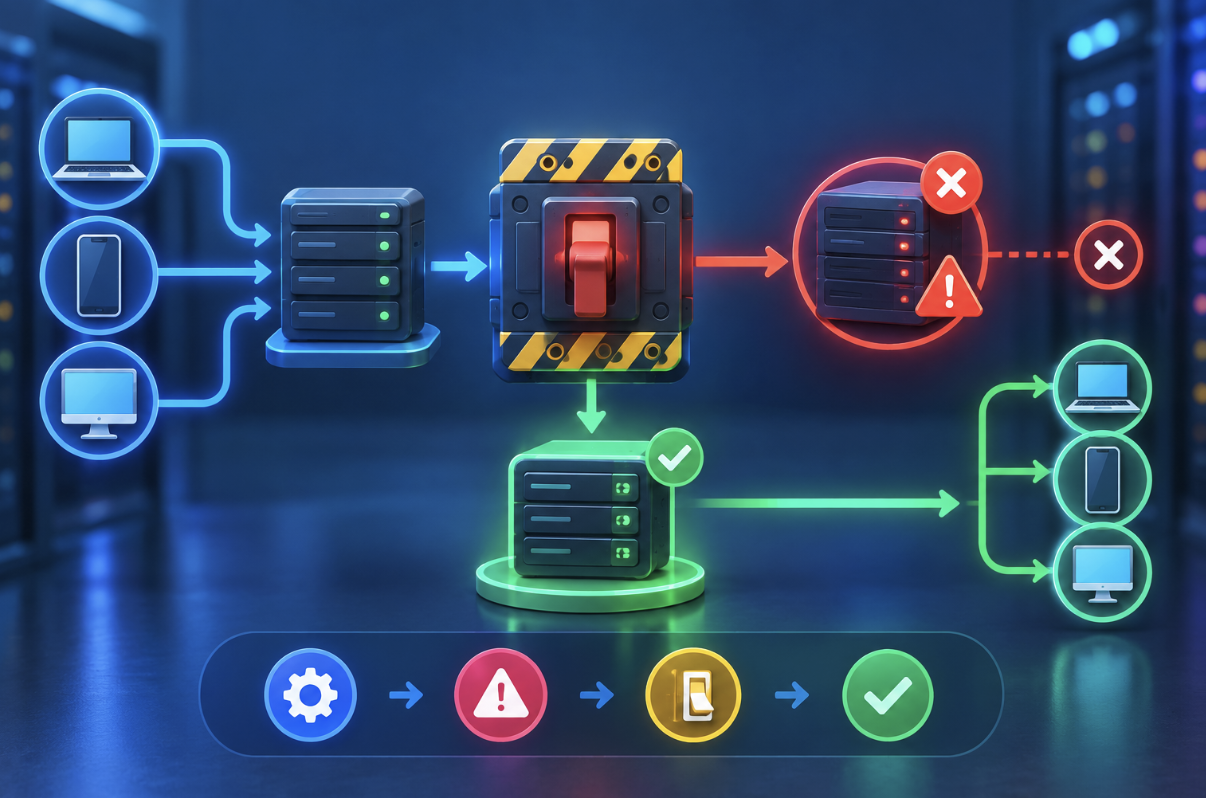
What Is a Circuit Breaker Pattern in Software Architecture?
Distributed software systems, where different services depend on communicating with each other, face a genuine, significant risk that failures within one specific service could cascade and affect the entire broader system’s reliability.
The circuit breaker pattern specifically addresses this risk, and understanding what this software design pattern actually involves, and how it prevents these cascading failures, provides valuable insight into an important resilience technique within modern software architecture.
What the Circuit Breaker Pattern Actually Means
The circuit breaker pattern is a software design approach that monitors calls between different services, automatically stopping requests to a specific service that appears to be failing, rather than continuing to send requests that will likely also fail. This pattern draws its name from electrical circuit breakers, which similarly interrupt electrical flow when detecting a problem, preventing more serious, cascading damage to the broader electrical system.
This protective, preventive function matters, since it explains why this pattern has become such a standard practice within distributed systems architecture, given that without this protection, a single failing service could cause cascading problems throughout an entire interconnected system, as other services continue sending requests to the already-struggling component, potentially overwhelming it further and spreading the original problem more broadly.
Why Cascading Failures Present Such a Significant Risk
The mechanism by which a single service failure can actually cascade into a much broader, more significant system problem helps clarify why the circuit breaker pattern addresses such an important, practical concern.
- A struggling service responds slowly or fails to properly respond to incoming requests
- Other services continue sending requests, unaware of this struggling service’s difficulty
- This continued request volume can worsen the struggling service’s condition, extending the original problem
- This cascading mechanism helps clarify the genuine, significant risk circuit breakers specifically address
This continued request burden deserves particular emphasis, since without circuit breaker protection, other services within a distributed system have no automatic mechanism preventing them from continuing to send requests toward an already struggling, failing service, meaning this continued traffic can exacerbate the original problem, potentially consuming the struggling service’s limited remaining resources and preventing recovery, while simultaneously causing the requesting services themselves to also experience delays or failures as they wait for responses that may never actually arrive.
Operational States Within Circuit Breaker Implementation
The specific operational states a circuit breaker typically moves through helps clarify how this pattern actually manages the transition between normal operation and protective intervention.
- The closed state represents normal operation, with requests flowing through to the monitored service normally
- The open state activates when failures exceed a defined threshold, blocking further requests temporarily
- The half-open state allows limited test requests to check whether the struggling service has actually recovered
- These states helps clarify how circuit breakers balance protection against allowing eventual recovery
This half-open testing state deserves particular emphasis, since this thoughtful design element allows the circuit breaker to periodically test whether the previously struggling service has actually recovered, without simply resuming full request volume immediately, given that sending a small number of genuine test requests during this half-open state allows the system to verify actual recovery before returning to normal, full operation, providing a considerably more measured, safer approach compared to either permanently blocking requests or immediately resuming full traffic without this verification step.
How Circuit Breakers Improve Overall System Resilience
The ways implementing circuit breaker patterns improves a distributed system’s overall resilience helps clarify this pattern’s practical, significant value beyond simply preventing the immediate cascading failure scenario alone.
- Circuit breakers allow struggling services time to recover without continued overwhelming request pressure
- This pattern prevents resource exhaustion in requesting services waiting for responses that may never arrive
- Systems implementing circuit breakers generally demonstrate better overall reliability during partial system failures
- These resilience benefits helps clarify why this pattern has become such standard, recommended architectural practice
How Circuit Breakers Provide Fallback Behaviour
How circuit breaker implementations often incorporate fallback behaviour, providing some functionality even when a specific service remains unavailable, helps clarify this pattern’s practical user experience benefits.
- Well-implemented circuit breakers can trigger fallback responses when the primary service remains unavailable
- This fallback behaviour might include cached data, simplified functionality, or clear error messaging
- This approach provides a better user experience compared to simply failing without any graceful alternative
- This fallback capability helps clarify circuit breakers’ contribution to overall application user experience
This graceful degradation deserves particular emphasis, since rather than simply allowing an entire application to fail or hang indefinitely when a specific dependent service becomes unavailable, well-implemented circuit breakers allow applications to provide some reasonable alternative experience, whether displaying previously cached data, offering simplified functionality that does not depend on the struggling service, or at minimum providing clear, immediate feedback about the temporary issue, representing a considerably better user experience compared to applications that simply hang or fail without this thoughtful fallback consideration.
Common Practical Implementation Considerations for Circuit Breakers
The practical considerations development teams need to address when actually implementing circuit breaker patterns within their specific systems helps clarify this pattern’s real-world application requirements.
- Teams need to determine appropriate failure thresholds triggering the circuit breaker’s protective response
- Configuring appropriate timing for how long the circuit remains open before attempting recovery testing matters significantly
- Different services within a system may warrant different specific circuit breaker configuration based on their particular characteristics
- These implementation considerations helps clarify the genuine, thoughtful configuration this pattern actually requires
How Circuit Breakers Complement Other Resilience Patterns
How circuit breakers work alongside other software resilience patterns helps clarify this pattern’s place within a broader, comprehensive approach to building reliable distributed systems.
- Circuit breakers often combine with retry logic, timeout configuration, and other complementary resilience techniques
- This combination provides more comprehensive protection than any single resilience pattern could achieve alone
- This complementary relationship helps clarify why circuit breakers represent one important component within broader system design
- This broader context helps position circuit breakers appropriately within comprehensive distributed systems architecture planning
Why Monitoring and Observability Matter for Circuit Breaker Effectiveness
Why comprehensive monitoring is an essential complement to circuit breaker implementation helps clarify an important practical operational consideration for effectively using this pattern.
- Teams need visibility into when and why circuit breakers actually activate to understand system health
- This monitoring helps distinguish between temporary issues and more significant, ongoing problems requiring deeper investigation
- Actual circuit breaker activation patterns helps inform genuine system improvement priorities
- This monitoring dependency helps clarify why circuit breaker implementation should include appropriate observability investment
How Circuit Breakers Interact With Microservices Architecture
Why circuit breakers have become particularly associated with microservices architecture helps clarify this pattern’s especially strong relevance within this specific, increasingly common architectural approach.
- Microservices architecture involves numerous independent services communicating extensively with each other
- This extensive inter-service communication creates considerable opportunity for cascading failure scenarios
- Circuit breakers address this specific vulnerability inherent to highly distributed, microservices-based systems
- This relationship helps clarify why circuit breaker adoption has grown alongside broader microservices adoption trends
Testing Considerations for Circuit Breaker Implementation
Why thoroughly testing circuit breaker behaviour matters before relying on this pattern in production helps clarify an important practical implementation consideration.
- Teams benefit from deliberately testing how their system behaves when circuit breakers actually activate
- This testing helps verify that fallback behaviour functions correctly during actual failure scenarios
- Without this testing, teams risk discovering configuration problems only during a genuine, live production incident
- This testing importance helps clarify why circuit breaker implementation requires this careful verification step
Final Thoughts
The circuit breaker pattern provides important protection against cascading failures within distributed software systems, automatically detecting struggling services and temporarily preventing additional requests while allowing measured, tested recovery verification before resuming normal operation.
Both this pattern’s genuine resilience benefits and its practical implementation considerations helps development teams build more reliable, resilient distributed systems capable of gracefully handling the inevitable partial failures complex, interconnected software architectures eventually encounter.
Frequently Asked Questions
1. Do all distributed software systems need to implement circuit breaker patterns?
While particularly valuable for systems with service-to-service dependencies, the specific need varies by system complexity and criticality, with systems involving numerous interdependent services typically benefiting most significantly from this protective pattern’s implementation.
2. How does a team determine appropriate failure thresholds for circuit breaker configuration?
This typically involves analysing normal system behaviour and failure patterns, often requiring some iterative adjustment based on actual observed system performance to identify thresholds that distinguish between normal variation and actual, significant service problems.
3. Can circuit breaker patterns be implemented without specialised software libraries?
While possible to implement custom circuit breaker logic, most teams choose to use established, tested libraries specifically designed for this pattern, since these provide reliable, well-tested implementations rather than requiring teams to build this resilience logic entirely from scratch.
4. Does implementing circuit breakers guarantee a system will never experience failures?
No, circuit breakers specifically help prevent cascading failures and provide more graceful handling of individual service problems, but cannot prevent all possible system failures, making this pattern one important component within broader, comprehensive reliability engineering practices.
5. How quickly do circuit breakers detect and respond to a struggling service?
This depends on the specific configuration, including the failure threshold and monitoring frequency, with well-configured circuit breakers generally detecting significant problems within moments, allowing relatively quick protective intervention compared to allowing problems to continue unaddressed.
6. Is the circuit breaker pattern relevant only for very large, complex distributed systems?
While particularly valuable for complex systems with numerous service dependencies, even moderately complex systems with some service-to-service communication can benefit from this pattern’s protective capability, making it relevant beyond simply the largest, most complex distributed architectures alone.