Elon Musk Predicts Neocloud Companies Could Fail as SpaceX Uses Debt to Finance GPU Purchases
AI is reshaping the technology sector faster than ever before. But the rush to build AI infrastructure is bringing serious financial risks with it. Elon Musk’s comments about potential market corrections have intensified discussions about the future of neocloud companies.
These cloud companies rent out high-performance GPUs used to train AI models and run them. Meanwhile, companies such as SpaceX operate in a technology environment that increasingly depends on advanced computing resources.
The big question is whether the AI infrastructure boom can keep growing at its current pace. Understanding neocloud financing, GPU demand, and debt exposure helps explain the growing concerns.
What Is Elon Musk’s Neocloud Wipeout Prediction?
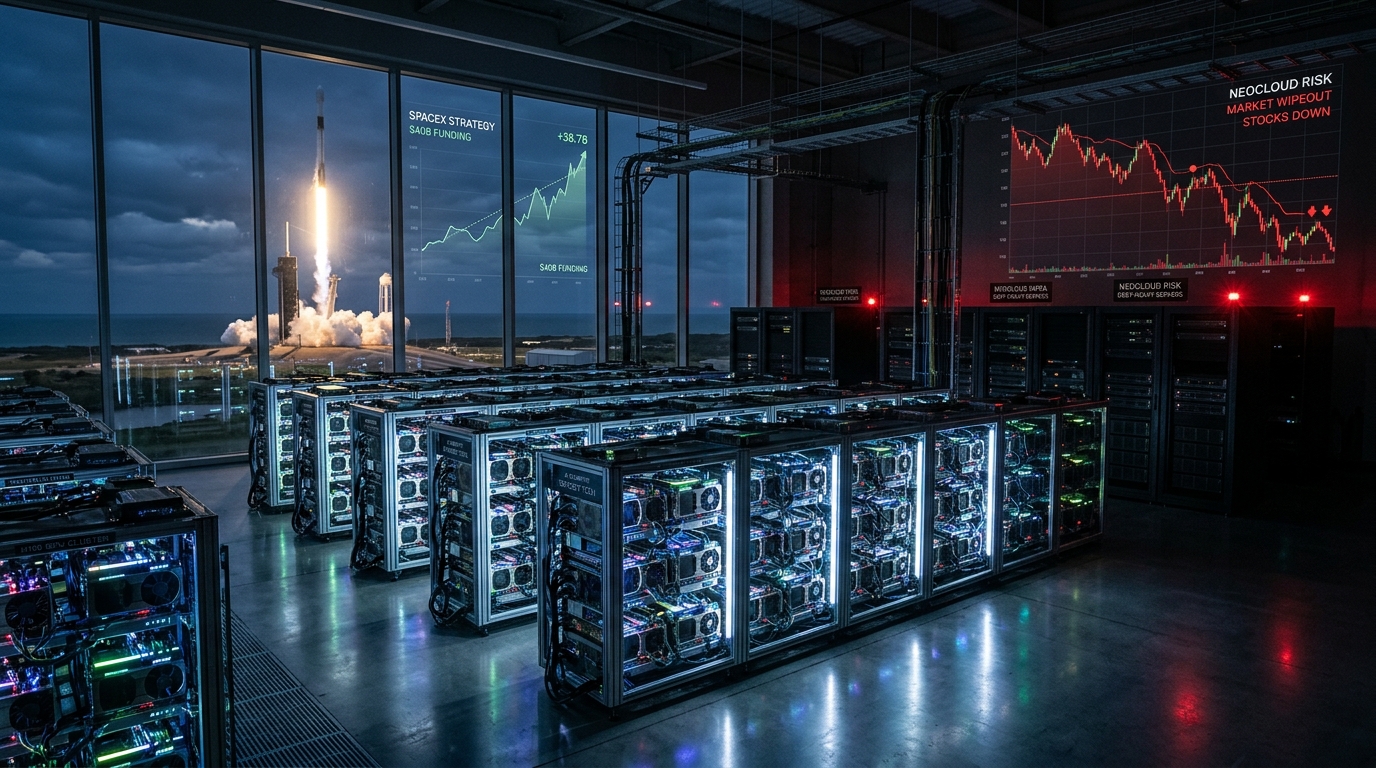
On October 25, 2026, Elon Musk warned that more than 200 neocloud companies could face widespread failures and consolidation. He warned that companies relying heavily on AI data centers could be vulnerable as borrowing becomes harder, especially if they lack other major sources of income.
Put simply, a company’s ability to secure financing may shape whether it can stay in business. Neocloud providers frequently take on large loans to buy GPUs and construct data centers. Consequently, rising financing costs can put pressure on their business models.
Musk suggested that only a limited number of these companies might survive. Still, his warning is a prediction, not a certainty.
How Neocloud Companies Make Money
Neocloud firms supply computing resources designed specifically for AI workloads. Instead of developing every component themselves, AI businesses can rent GPU capacity from these providers.
This arrangement helps customers access expensive hardware without purchasing entire computing systems. These providers make money by leasing their computing capacity to customers.
CoreWeave and Nebius are among the companies competing in this expanding sector. Their services support AI training, inference, and other demanding workloads.
Nevertheless, the business model carries considerable financial risks. Operators must invest heavily before generating sufficient returns from their infrastructure.
As more providers enter the market, customers may gain leverage to push prices down. If rental income falls while financing expenses rise, profitability can deteriorate quickly.
Why GPU Debt Is Becoming a Major Concern
Modern AI systems depend on GPUs both to learn from data and to perform tasks. However, advanced processors and supporting infrastructure require substantial upfront investment.
Neocloud companies frequently use borrowed money or equipment financing to expand their capacity. This strategy can accelerate growth when demand remains strong.
However, it becomes risky when financing conditions change. Lenders may demand stronger financial performance before approving additional funding.
Consequently, companies that depend on continuous borrowing could struggle to purchase new hardware. They could also struggle to keep up with their loan payments and other commitments.
Additionally, AI hardware can lose commercial value as newer generations arrive. Providers have to weigh the cost of equipment against customer demand and the timing of debt payments.
Why SpaceX Secured $40 Billion in GPU Financing
SpaceX announced a binding commitment for approximately $40 billion in GPU financing on October 26, 2026. The deal includes an entity overseen by Apollo Global Management.
Under the agreement, Apollo’s managed entity will finance GPUs and related equipment through a master finance lease. SpaceX intends to put the equipment to work as it grows its computing capacity.
The deal is expected to support its AI ambitions, including computing capacity for Grok. However, the agreement remains subject to specified closing conditions.
SpaceX says the first equipment deliveries are expected in the first half of 2027. Lease schedules are expected to commence as the equipment arrives.
Importantly, the arrangement is a financing commitment rather than proof that all equipment has already been delivered. Its final financial impact will depend on the agreement’s implementation and operating performance.
How SpaceX Differs From Neocloud Startups
Musk pointed to SpaceX’s investment-grade credit rating and income from Starlink and rocket launches as financial strengths. These businesses provide income beyond AI computing.
Having several sources of income can make it easier for a company to obtain financing, making this difference important. Lenders can assess several sources of income instead of relying exclusively on AI infrastructure.
By contrast, some neocloud providers depend heavily on renting GPU capacity. If demand falls or lenders become more cautious, these companies may find it harder to grow.
Nevertheless, SpaceX’s financing also carries risks. A large equipment commitment requires sustained demand, effective infrastructure deployment, and sufficient cash flow.
Diversified revenue can reduce dependence on one market. It does not eliminate financial risk entirely.
Could the AI Infrastructure Boom Face a Wipeout?
Musk’s prediction reflects growing concerns about excessive investment and limited returns across the AI infrastructure market.
Several factors could contribute to consolidation:
- Tighter credit: Lenders may become more selective about financing AI infrastructure.
- Rising expenses: Electricity, cooling, hardware, and construction increase operating costs.
- Stronger competition: Established cloud providers can compete through scale and existing customer relationships.
- Changing technology: New GPU generations could reduce the attractiveness of older equipment.
- Uncertain demand: Companies may build more capacity than customers ultimately need.
Less competitive providers may respond by selling equipment, joining forces with rivals, or scaling back their growth plans.
A downturn in the market would not automatically signal that AI demand is fading. Stronger companies may keep expanding even as weaker rivals face difficulties.
What Musk’s Prediction Means for the AI Industry
The warning highlights an important distinction between technological growth and financial sustainability.
Demand for AI computing can continue to rise even while some infrastructure providers run into financial trouble. Strong demand alone does not guarantee profitable operations.
Moreover, the companies with the strongest financing, reliable customers, and efficient infrastructure may gain an advantage.
SpaceX’s GPU financing demonstrates how major technology companies are securing resources for their AI ambitions. Smaller companies, in particular, need to be cautious about debt and spending on hardware.
In the long run, the sector’s success will depend on whether providers can turn their computing resources into reliable, lasting income.
Conclusion: Will Neocloud Companies Survive the Shakeout?
Elon Musk’s warning about a possible neocloud shakeout draws attention to the financial strain confronting AI infrastructure firms. His warning centers on restricted credit, expensive GPUs, and dependence on AI data center revenue.
SpaceX’s reported $40 billion financing commitment shows another way to fund major computing projects. Its established businesses also bring in revenue that could help support its access to financing.
Nevertheless, neither strategy guarantees success. The decisive factors will include customer demand, financing costs, infrastructure efficiency, and long-term profitability.
As the AI industry evolves, financially disciplined companies may be better positioned to survive. The predicted shakeout remains uncertain, but financing has become a critical competitive advantage.