
Scala in 2026: The JVM Language Powering Scalable, Functional, Data-Driven Applications
Modern software needs more than speed. It needs flexibility, reliability, scalability, and maintainability. That is where Scala continues to attract developers who want more expressive code without leaving the Java ecosystem. Although Scala has been around for years, its combination of object-oriented and functional programming remains highly relevant.
Unlike languages that force developers into one programming style, Scala gives them room to choose. Therefore, teams can build applications using familiar object-oriented techniques while adopting functional concepts where they provide better results. Moreover, Scala runs on the Java Virtual Machine, which gives developers access to a massive collection of existing libraries and tools.
But Scala offers much more than Java compatibility. Its type system, pattern matching, immutable collections, concise syntax, asynchronous programming capabilities, and functional features make it a distinctive language. As a result, Scala can be especially useful for backend systems, distributed applications, data engineering, and large-scale platforms.
What Is Scala Programming Language?
Scala is a general-purpose programming language developed by Martin Odersky, with a strong focus on static typing. The name combines the ideas of “scalable” and “language.” This concept reflects its ability to support different programming styles and application sizes. Scala blends object-oriented programming with functional programming. Consequently, developers can represent application components through classes and objects while using functions as first-class values.
The language compiles into Java bytecode and runs on the JVM. Therefore, Scala applications can work alongside Java applications and libraries. This compatibility also reduces the difficulty of introducing Scala into organizations that already use Java. Scala also supports type inference. The compiler can often determine a value’s type without requiring developers to write it explicitly.
For example:
val greeting = "Hello, Scala!"Scala understands that greeting contains a String. Therefore, developers receive static type safety without unnecessary declarations.
Why Scala Stands Out Among Modern Programming Languages
Scala occupies an interesting position in software development. It provides the structure associated with Java while introducing powerful functional programming capabilities. Furthermore, Scala encourages developers to write compact and expressive code. Fewer repetitive statements can make complex logic easier to understand. Its functional features also encourage immutable data and predictable transformations. This approach can reduce unintended changes within applications.
However, Scala is not simply a shorter version of Java. Its programming model introduces concepts that can fundamentally change how developers design software.
For experienced developers, this flexibility can improve productivity. Meanwhile, beginners may need additional time to understand Scala’s type system and functional concepts.
Scala and the Java Virtual Machine
One of Scala’s strongest advantages is its relationship with the JVM. Instead of creating an isolated ecosystem, Scala works within an established technology environment. Developers can access numerous Java libraries directly from Scala applications. They can also integrate Scala components with existing Java systems.
This capability is valuable for companies modernizing older software. Instead of replacing an entire Java platform, teams can gradually introduce Scala into selected services.
Additionally, JVM tooling provides mature monitoring, profiling, debugging, and deployment options. Therefore, Scala applications can benefit from technologies already familiar to enterprise development teams.
Functional Programming Makes Scala Different
Functional programming represents one of Scala’s defining characteristics. Instead of constantly changing shared data, functional programming emphasizes transformations and predictable operations.
Scala treats functions as first-class values. Developers can store functions in variables, pass them to other functions, and return them from functions. For example, collection operations can transform data without requiring lengthy loops.
val numbers = List(1, 2, 3, 4)
val doubled = numbers.map(number => number * 2)
The map operation transforms each value. Consequently, developers can express the intended operation clearly. Scala also supports concepts such as higher-order functions, closures, pattern matching, and immutable data structures. Together, these features encourage a more declarative programming style.
Understanding Scala’s Static Type System
Scala uses static typing to identify many programming errors during compilation. This approach can improve reliability because developers receive feedback before applications reach production. However, Scala avoids forcing developers to specify every type manually. Type inference allows the compiler to determine many types automatically. Scala’s type system also includes advanced features such as generic types, traits, union types in Scala 3, and powerful abstractions.
These capabilities can help developers model complicated business rules more precisely. Nevertheless, advanced type features require careful use because excessive complexity can make code harder to understand.
Therefore, effective Scala development involves balancing type safety with practical readability.
Pattern Matching Simplifies Complex Logic
Pattern matching is another major Scala feature. It allows developers to handle different data structures and conditions in an expressive way. Instead of creating long chains of conditional statements, developers can describe possible cases directly.
Pattern matching works particularly well with algebraic data types and case classes. Consequently, it is useful for processing structured information, commands, events, and application states.
This feature also works naturally with Scala’s functional programming approach. Therefore, developers can create concise logic while keeping different cases clearly separated.
Case Classes and Cleaner Data Modeling
Scala case classes provide a convenient way to represent immutable data. They automatically provide useful functionality, including structural equality and convenient pattern matching support.
For example:
case class User(name: String, age: Int)Developers can create data models with significantly less boilerplate. Furthermore, case classes work naturally with pattern matching and functional transformations.
This makes them useful for representing application messages, database records, configuration objects, and domain models.
Scala Collections and Data Transformation
Scala provides a rich collections library for working with data. Developers can use operations such as map, filter, flatMap, fold, and reduce. These methods allow programmers to express data transformations directly.
For example, developers can filter a collection before transforming its remaining elements. They can then combine the results into another structure.
This style can make data-processing code easier to compose. Moreover, it reduces the need for repetitive iteration logic. Scala collections are particularly valuable when applications process large amounts of structured information.
Concurrency and Asynchronous Programming in Scala
Modern applications frequently handle thousands of simultaneous operations. Therefore, concurrency and asynchronous programming are important areas for Scala. Scala’s ecosystem includes several approaches for building concurrent systems. Futures provide a standard mechanism for representing asynchronous computations. Developers can combine futures to coordinate independent operations. Consequently, applications can perform network requests and other tasks without blocking every execution path.
The broader Scala ecosystem also includes technologies designed for reactive and distributed applications. These tools can help teams build systems that remain responsive under heavy workloads.
However, concurrency requires careful architecture. Scala does not automatically eliminate problems such as race conditions or poor resource management.
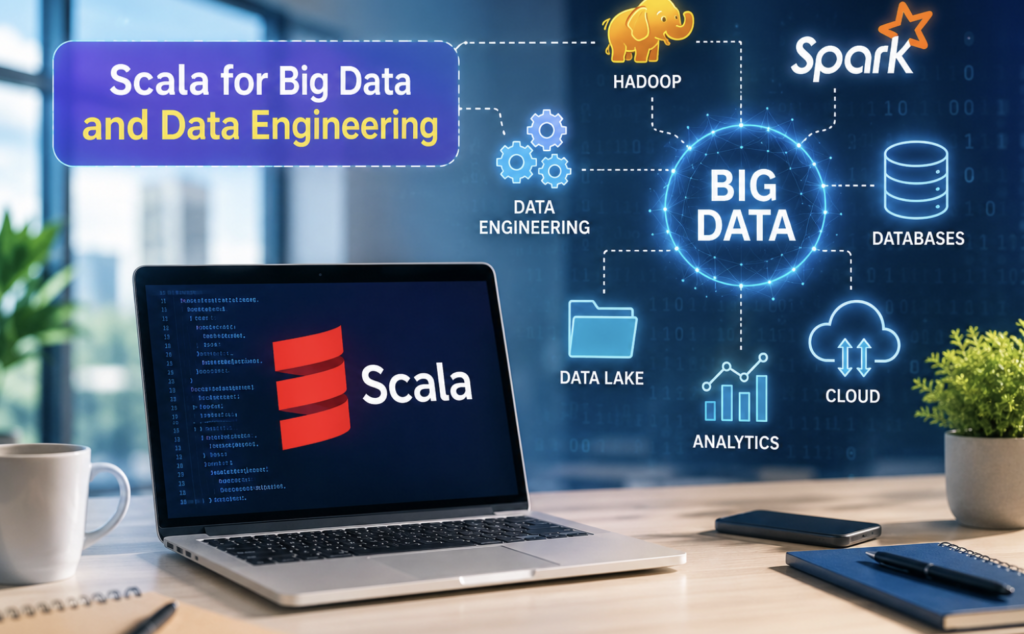
Scala for Big Data and Data Engineering
Scala became especially prominent through its connection with Apache Spark. Spark uses Scala heavily because its distributed processing model fits naturally with functional programming techniques. Data engineers can use Scala to transform, filter, aggregate, and analyze large datasets.
Furthermore, Scala can provide strong compile-time guarantees for complex data-processing pipelines. This can be valuable when applications process critical business information.
Although Spark supports multiple programming languages, Scala remains an important option for developers who want close integration with Spark’s native ecosystem.
Scala for Backend and Distributed Systems
Scala is also suitable for backend development. Developers can build APIs, microservices, data-processing services, and distributed applications using Scala-based frameworks and libraries. Its functional programming features can help teams create predictable application components. At the same time, running on the JVM gives developers access to a wide range of trusted server-side technologies.
Distributed systems also benefit from Scala’s emphasis on immutable data and composable operations. These concepts can simplify certain concurrency challenges.
Nevertheless, Scala should be selected according to project requirements rather than popularity alone.
Scala 3 and the Evolution of the Language
Scala 3 represents a significant evolution of the language. It introduces improvements to syntax, type-system capabilities, meta programming, and language consistency. Features such as union types and improved contextual abstractions expand Scala’s expressive power. At the same time, the language aims to make advanced concepts easier to use.
Scala 3 also modernizes several older language mechanisms. Therefore, developers starting new projects should understand the differences between Scala 2 and Scala 3.
Migration strategies vary depending on application size, dependencies, and framework compatibility. Consequently, teams should evaluate their ecosystem before upgrading.
Advantages of Learning Scala
Learning Scala can provide several practical benefits for developers. First, it teaches concepts that extend beyond Scala itself. Functional programming, immutability, type systems, and composability can improve programming skills across other languages. Second, Scala provides access to JVM development without limiting developers to traditional Java syntax.
Third, Scala can be useful for data engineering and distributed computing. Its relationship with Spark makes it particularly relevant for certain large-scale data workloads.
Finally, Scala encourages developers to think carefully about data and program behavior. This mindset can support cleaner application architecture.
Challenges Developers Should Know Before Learning Scala
Scala also has a learning curve. Beginners may initially find functional programming concepts unfamiliar. Its advanced type system can also appear complicated. Furthermore, different programming styles can lead to inconsistent code when teams lack clear conventions.
Build times, dependency management, and framework compatibility can also require attention in larger projects.
Therefore, developers should learn Scala progressively. Start with basic syntax, collections, functions, pattern matching, and immutable data. Then move toward advanced type-system concepts and concurrency.
Where Is Scala Used Today?
Scala remains relevant in several technical areas. These include:
- Backend application development
- Data engineering
- Distributed systems
- Big data processing
- Cloud services
- Financial technology
- High-volume data platforms
- Enterprise software
- Concurrent applications
Its usefulness depends heavily on the project’s architecture and the team’s existing expertise. However, its JVM foundation keeps Scala connected to a mature software ecosystem.
Scala vs Java: Which One Should You Choose?
Java is still one of the most popular and widely used programming languages in the world. Scala, however, offers additional functional programming capabilities and more expressive abstractions.
Java can be easier for beginners and teams that prefer conventional object-oriented development. Scala may appeal more to developers who value concise syntax and functional programming.
Therefore, neither language is universally better. The right choice depends on project requirements, developer experience, ecosystem needs, and long-term maintenance goals.
How to Start Learning Scala
New learners should begin with Scala’s fundamental syntax. Focus first on variables, functions, collections, classes, objects, and pattern matching.
Next, practice immutable programming and common collection operations. These concepts form the foundation of effective Scala development.
Afterward, explore traits, generics, error handling, Futures, and Scala 3 features. Finally, build practical projects. A small REST API, data-processing application, or command-line tool can reinforce concepts far better than theory alone.
Conclusion
Scala remains a distinctive programming language for developers who want flexibility without leaving the JVM ecosystem. Its combination of object-oriented and functional programming creates a powerful development model. Moreover, static typing, type inference, pattern matching, immutable collections, and concise syntax can improve how developers structure complex applications. Scala also has strong connections with big data and distributed computing. Its role in the Apache Spark ecosystem further expands its practical value.
However, Scala requires thoughtful learning because its advanced features can introduce complexity. Developers who understand its core principles can use that complexity effectively.
Ultimately, Scala is more than a programming language. It represents a different approach to designing software, managing data, and building scalable systems.
FAQ’s
1. What is Scala mainly used for?
Scala is mainly used for backend development, data engineering, distributed systems, and large-scale applications.
2. Is Scala better than Java?
Scala is not universally better than Java because each language serves different project requirements and development preferences.
3. Is Scala difficult to learn?
Scala can be challenging initially, especially when learning functional programming and its advanced type-system features.
4. Does Scala run on the JVM?
Yes, Scala compiles to Java bytecode and runs on the Java Virtual Machine.
5. Can Scala use Java libraries?
Yes, Scala provides strong interoperability with Java libraries, frameworks, and existing JVM applications.
6. What is Scala 3?
Scala 3 is the modern major version of Scala with improved syntax, type-system features, and metaprogramming capabilities.
7. Is Scala useful for big data?
Yes, Scala is widely associated with Apache Spark and remains useful for large-scale data processing.
8. What makes Scala different from Java?
Scala combines object-oriented and functional programming while offering more concise syntax and advanced language abstractions.
9. Does Scala support functional programming?
Yes, functional programming is one of Scala’s central design principles and includes functions, immutability, and higher-order operations.
10. Should beginners learn Scala in 2026?
Beginners should consider Scala when they want JVM development, functional programming skills, or careers involving data and distributed systems.