What Is a Backdoor Roth IRA and Who Should Consider Using It?
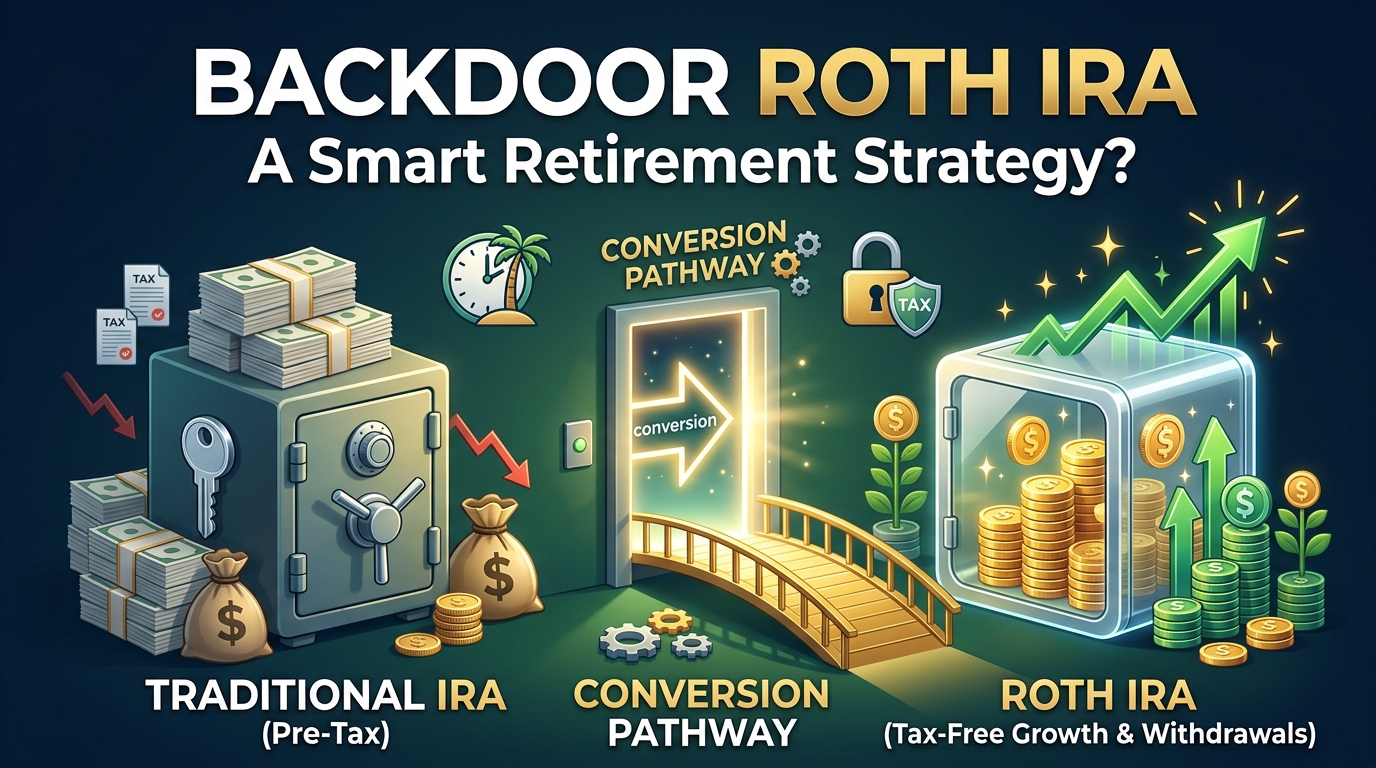
A Backdoor Roth IRA is a strategy that may allow people with income above the limits for direct Roth IRA contributions to move money into a Roth IRA legally. The basic process usually involves making a non-deductible contribution to a traditional IRA and then converting that amount to a Roth IRA.
It sounds simple, but important tax rules, especially the pro-rata rule, can make the strategy more complicated. The article below explains how it works, who may benefit, and what mistakes to avoid.
What Is a Backdoor Roth IRA?
A Backdoor Roth IRA isn’t a distinct or separate category of retirement savings account; rather, it’s a strategy used to fund a Roth IRA indirectly.
Instead, it is an IRA contribution and conversion strategy. It is commonly used by people whose income is too high to make a direct contribution to a Roth IRA.
The strategy generally follows two steps:
- Contribute money to a traditional IRA.
- Convert some or all of that money to a Roth IRA.
If the traditional IRA contribution is non-deductible and little or no investment growth occurs before the conversion, the additional tax from the conversion may be limited. However, the result can be very different if you already have pre-tax money in traditional, SEP, or SIMPLE IRAs.
That is why understanding the tax rules is essential before using a Backdoor Roth IRA.
Why Do People Want to Contribute to a Roth IRA?
A Roth IRA can be attractive because qualified withdrawals are generally tax-free.
Unlike a traditional IRA, Roth IRA contributions are generally made with money that has already been taxed.
Potential benefits include:
- Tax-free qualified withdrawals
- Tax-free growth within the account
- No required minimum distributions for the original Roth IRA owner during their lifetime
- Flexibility in retirement planning
- The ability to contribute indirectly through a conversion strategy when direct contributions are limited by income
However, eligibility and tax rules can change, so it is important to check current IRS guidance before making a contribution or conversion.
Why Can’t Everyone Make a Direct Roth IRA Contribution?
The IRS sets income limits for direct Roth IRA contributions.
If your modified adjusted gross income is above the applicable limit, you may be unable to contribute directly to a Roth IRA or may only be able to make a reduced contribution.
This is where the Backdoor Roth IRA strategy may become relevant.
A person who cannot directly contribute to a Roth IRA may still be able to:
- Make a non-deductible contribution to a traditional IRA, if eligible.
- Convert eligible traditional IRA funds to a Roth IRA.
- Pay any applicable taxes on the conversion.
The strategy does not eliminate taxes. Instead, it uses the existing rules governing traditional IRA contributions and Roth IRA conversions.
How Does a Backdoor Roth IRA Work?
The process is often described as simple, but the tax details deserve careful attention.
Step 1: Open a Traditional IRA
If you do not already have one, you can open a traditional IRA with a financial institution that offers IRA accounts.
You may already have a traditional IRA, which can affect the tax consequences of the strategy.
Step 2: Make a Non-Deductible Contribution
You contribute money to the traditional IRA.
Depending on your income and retirement plan situation, the contribution may be non-deductible.
A non-deductible contribution means you generally do not receive a tax deduction for the contribution.
The money you contribute becomes part of your IRA basis.
Step 3: Convert the Money to a Roth IRA
After making the contribution, you can request a conversion of the traditional IRA funds to a Roth IRA.
The conversion itself may create a tax liability.
For example, if your contribution has earned investment income before the conversion, that growth may generally be taxable when converted.
Step 4: Report the Transaction Correctly
A Backdoor Roth IRA involves tax reporting.
Non-deductible traditional IRA contributions are generally reported using IRS Form 8606. Roth conversions are also reported as part of your tax filing.
Incorrect reporting can create confusion later, especially when calculating your IRA basis and taxable income.
Keeping accurate records is important.
A Simple Backdoor Roth IRA Example
Imagine that Alex earns too much to make a direct Roth IRA contribution.
Alex:
- You deposit $7,000 of money that you’ve already paid taxes on into a traditional IRA account.
- The contribution is non-deductible.
- Before the money earns significant investment growth, Alex converts the $7,000 to a Roth IRA.
If Alex has no other pre-tax traditional, SEP, or SIMPLE IRA balances that trigger the pro-rata rule, the taxable amount of the conversion may be minimal or zero.
However, this example is simplified.
The exact tax treatment depends on the person’s complete IRA situation.
The Pro-Rata Rule: The Biggest Issue to Understand
The pro-rata rule is one of the most important considerations when using a Backdoor Roth IRA.
You generally cannot simply choose to convert only your after-tax IRA contribution while ignoring your existing pre-tax IRA money.
For tax purposes, the IRS generally looks at your traditional, SEP, and SIMPLE IRA balances together when determining the taxable and non-taxable portions of a conversion.
Example of the Pro-Rata Rule
Suppose you have:
- $7,000 in non-deductible IRA contributions
- $93,000 in pre-tax traditional IRA funds
Your total IRA balance is $100,000.
If you convert $7,000, the IRS generally treats the conversion as containing both after-tax and pre-tax money proportionally.
This means a significant portion of the conversion could be taxable.
The calculation can become complicated, especially when multiple IRA accounts and prior contributions are involved.
A 401(k) or similar employer plan is generally not included in the IRA aggregation used for this rule, but transfers and rollovers should be evaluated carefully.
Who Should Consider a Backdoor Roth IRA?
A Backdoor Roth IRA may be worth considering for certain people.
High-Income Earners
The strategy is most commonly associated with people whose income exceeds the limit for direct Roth IRA contributions.
If you want Roth tax treatment but cannot contribute directly, a Backdoor Roth may provide a possible path.
People With Few or No Pre-Tax IRA Balances
The strategy may be simpler for someone who does not have significant pre-tax money in traditional, SEP, or SIMPLE IRAs.
Without large pre-tax IRA balances, the pro-rata rule may have less impact.
Long-Term Investors
A Backdoor Roth IRA may be more attractive to people with a long investment horizon.
The potential value of tax-free qualified withdrawals may become more meaningful over many years of growth.
People Who Want More Tax Diversification
Retirement planning does not have to rely entirely on one type of account.
Some people hold a mix of:
- Taxable investment accounts
- Traditional retirement accounts
- Roth retirement accounts
This can create greater flexibility when managing taxable income in retirement.
Who May Want to Avoid or Reconsider It?
A Backdoor Roth IRA is not automatically the right choice for everyone.
People With Large Pre-Tax IRA Balances
The pro-rata rule might result in an unforeseen tax obligation when converting or withdrawing funds from retirement accounts.
Before converting money, calculate how existing IRA balances may affect the transaction.
People Who Need the Money Soon
Roth conversions can involve special timing rules, including separate five-year considerations in certain situations.
If you expect to withdraw converted funds quickly, you should understand the potential tax and penalty consequences.
People in a Complex Tax Situation
If you have multiple IRAs, business retirement plans, rollover accounts, or complicated income sources, professional tax advice may be valuable.
A small mistake in planning can create unnecessary taxes.
Backdoor Roth IRA vs. Direct Roth IRA
| Feature | Direct Roth IRA | Backdoor Roth IRA |
| Special account type | Roth IRA | Roth IRA after conversion |
| Direct contribution income limits | Yes | Conversion strategy may be available |
| Traditional IRA required | No | Usually part of the process |
| Tax complexity | Usually simpler | Can be more complex |
| Pro-rata rule concerns | No | Often important |
| Tax reporting | Standard contribution reporting | May require additional reporting |
The main difference is the route used to get money into the Roth IRA.
The final destination is still a Roth IRA.
Backdoor Roth IRA vs. Traditional IRA
A traditional IRA may offer a tax deduction for eligible contributors, while a Roth IRA generally offers the potential for tax-free qualified withdrawals.
A Backdoor Roth IRA begins with a traditional IRA contribution but uses a conversion to move money into a Roth IRA.
This means the strategy is different from simply opening and keeping a traditional IRA.
What Are the Main Benefits?
Potential for Tax-Free Qualified Withdrawals
Once money is in a Roth IRA, qualified withdrawals can generally be tax-free under IRS rules.
No Lifetime RMDs for the Original Owner
Traditional IRAs are generally subject to required minimum distribution rules, while the original owner of a Roth IRA does not have to take lifetime RMDs.
This can provide additional flexibility.
Long-Term Growth Potential
The longer money remains invested, the more valuable tax-free qualified growth could potentially become.
Of course, investments can lose value, and returns are never guaranteed.
Tax Planning Flexibility
Having both traditional and Roth retirement savings may provide more choices when managing taxable income in retirement.
Common Backdoor Roth IRA Mistakes
Ignoring the Pro-Rata Rule
This is one of the biggest mistakes.
Always consider all relevant traditional, SEP, and SIMPLE IRA balances before completing a conversion.
Forgetting About Investment Gains
If the money grows before conversion, the gain may create taxable income.
Incorrect Tax Reporting
Failing to properly report a non-deductible contribution can make it difficult to prove your after-tax basis later.
Keep accurate records and review Form 8606 requirements.
Assuming the Strategy Is Tax-Free
A conversion is not automatically tax-free.
The taxable amount depends on the composition of your IRA funds.
Missing Contribution Rules
Traditional IRA contributions and Roth IRA conversions have different rules.
Check the applicable contribution limits, deadlines, and eligibility requirements.
Can You Do a Backdoor Roth IRA Every Year?
Potentially, yes.
If you remain eligible to make a traditional IRA contribution and the relevant conversion rules continue to allow the strategy, you may be able to repeat the process.
However, annual contribution limits apply.
You also need to consider your existing IRA balances each year because the pro-rata calculation can change.
Tax laws can also change, so it is wise to review the current rules annually.
Is a Backdoor Roth IRA Legal?
A Backdoor Roth IRA generally uses existing rules that allow eligible traditional IRA contributions and Roth IRA conversions.
However, the strategy must be completed and reported correctly.
Tax rules are detailed, and individual circumstances can significantly change the outcome.
For this reason, people with substantial IRA balances or complicated finances may want to speak with a qualified tax professional before proceeding.
How to Decide if a Backdoor Roth IRA Is Right for You
Ask yourself these questions:
- Is my income above the direct Roth IRA contribution limit?
- Do I have existing pre-tax traditional, SEP, or SIMPLE IRA balances?
- How would the pro-rata rule affect me?
- Can I leave the money invested for the long term?
- Am I comfortable with the tax reporting requirements?
- Do I already have enough retirement savings in traditional accounts?
- Would tax diversification benefit my retirement plan?
Your answers can help determine whether the strategy is worth exploring.
A Practical Backdoor Roth IRA Checklist
Before moving money, review the following:
- Check whether you qualify for a direct Roth IRA contribution.
- Review the current IRA contribution limit.
- Calculate all relevant traditional, SEP, and SIMPLE IRA balances.
- Estimate the potential impact of the pro-rata rule.
- Determine whether the traditional IRA contribution will be deductible or non-deductible.
- Understand the tax consequences of the conversion.
- Keep records of your after-tax IRA basis.
- Review the required tax forms.
- Consider speaking with a qualified tax professional.
- Keep your long-term retirement goals in mind.
Final Thoughts
A Backdoor Roth IRA can be a useful retirement strategy for high-income earners who cannot contribute directly to a Roth IRA.
The basic idea is straightforward: make an eligible contribution to a traditional IRA and then convert it to a Roth IRA.
But the details matter.
The pro-rata rule, existing IRA balances, taxable investment gains, contribution limits, and tax reporting can all affect the final result.
For someone with no significant pre-tax IRA balances, the strategy may be relatively straightforward. For someone with large traditional, SEP, or SIMPLE IRA balances, the tax consequences can be much more complicated.
Before using a Backdoor Roth IRA, calculate the potential tax impact and consider professional advice if your situation is complex.
When used correctly as part of a long-term retirement strategy, a Backdoor Roth IRA may provide another way to build tax-diversified retirement savings.