
MMSBRE Explained: The Hidden Digital Framework Transforming Modern Business Efficiency
Every day, businesses generate enormous amounts of information. Emails arrive every minute, customer requests keep increasing, projects grow more complex, and digital data expands faster than ever before. Without a structured system, valuable information quickly becomes scattered, productivity slows, and decision-making becomes difficult. This growing challenge has sparked interest in a term that many people have recently started searching for MMSBRE.
Although the keyword appears across various online discussions, many websites offer only limited or confusing explanations. Some describe it as a digital framework, while others connect it with business management, workflow optimization, or information organization. The truth is that MMSBRE represents a structured approach that helps organizations manage information more efficiently while improving communication, collaboration, and operational performance.
Whether you are a business owner looking to streamline daily operations, a student researching emerging digital concepts, an IT professional managing complex systems, or simply someone curious about the latest business terminology, understanding MMSBRE can provide valuable insights. This guide explains everything you need to know in a simple, practical, and SEO-friendly way.
What Is MMSBRE?
MMSBRE is commonly understood as a structured methodology designed to improve how organizations collect, organize, analyze, and manage information. Rather than representing a single software application, MMSBRE serves as a flexible framework that supports better workflow management and smarter operational decisions. Its exact interpretation may vary depending on the industry or organization using the term.
However, the central objective remains the same: creating organized systems that transform scattered information into valuable business intelligence. In today’s digital environment, companies rely on accurate information to remain competitive.
MMSBRE helps establish a systematic process that reduces confusion, improves accessibility, and supports long-term organizational growth. Simply put, MMSBRE provides businesses with a smarter way to organize information while improving productivity across multiple departments.
Why MMSBRE Is Becoming Increasingly Important
Organizations now process significantly more digital information than ever before. Customer records, financial reports, project documents, communication logs, and performance metrics continue growing every day. Without proper organization, businesses often experience:
- Slower decision-making
- Duplicate work
- Communication breakdowns
- Lost information
- Reduced employee productivity
- Increased operational costs
MMSBRE addresses these challenges by creating a structured environment where information remains organized, accessible, and useful. Instead of allowing departments to work independently with disconnected systems, MMSBRE encourages collaboration through centralized information management.
Consequently, organizations spend less time searching for data and more time making informed decisions.
Understanding the Core Principles Behind MMSBRE
Every successful management framework follows several foundational principles. MMSBRE builds upon these same concepts to improve organizational performance.
Information Organization
Information forms the backbone of every modern organization. Customer details, reports, research findings, contracts, and operational records all require proper management. MMSBRE emphasizes logical categorization, standardized storage, and easy retrieval.
As a result, employees locate information faster and reduce unnecessary delays.
Workflow Optimization
MMSBRE encourages organizations to evaluate existing workflows, remove unnecessary steps, and automate repetitive activities whenever possible. This structured approach increases consistency while reducing human error.
Performance Evaluation
Monitoring organizational performance remains essential for continuous improvement. MMSBRE promotes regular assessment of productivity, workflow efficiency, project completion, and resource utilization. Instead of relying on assumptions, organizations use measurable information to improve future performance.
Communication Improvement
Poor communication creates confusion throughout organizations. MMSBRE supports clear information sharing between departments, allowing employees to collaborate more effectively while reducing misunderstandings. Better communication naturally leads to stronger teamwork and improved customer service.
Resource Optimization
Every organization operates with limited resources. Whether managing employees, finances, technology, or time, MMSBRE encourages efficient resource allocation that minimizes waste while maximizing productivity.
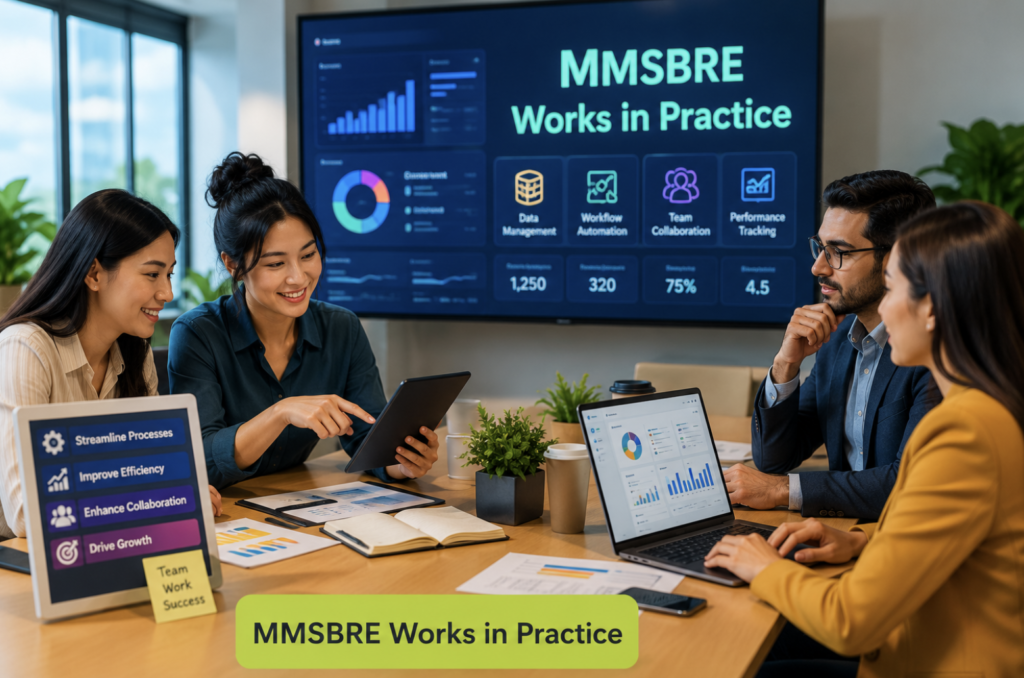
How MMSBRE Works in Practice
Although implementations differ between industries, most organizations follow a similar process when applying MMSBRE principles. The journey begins with collecting accurate information from multiple sources. Businesses gather customer feedback, operational reports, financial data, employee performance metrics, project documentation, and system records. After collection, information enters the organization stage.
During this phase, data becomes categorized, labeled, and stored according to predefined standards. Next comes analysis. Organizations examine collected information to identify trends, opportunities, inefficiencies, and potential risks. Instead of relying on guesswork, managers can make smarter decisions based on reliable data.
The implementation phase follows analysis. Teams introduce process improvements, optimize workflows, automate repetitive tasks, or adjust operational strategies based on their findings. Finally, organizations regularly review performance to determine whether improvements achieved desired results. Continuous monitoring keeps systems effective while supporting long-term growth.
Major Benefits of Implementing MMSBRE
Organizations increasingly adopt structured management systems because the advantages extend across nearly every department.
Higher Operational Efficiency
Organized information eliminates unnecessary searching, duplicate work, and manual processes. Employees complete tasks faster because required information remains easily accessible.
Better Decision Making
Reliable information produces better decisions. Managers gain accurate insights through organized reporting, allowing them to respond quickly to business challenges.
Improved Collaboration
Departments frequently struggle when information remains isolated. MMSBRE encourages centralized information sharing, enabling teams to collaborate without unnecessary communication barriers.
Greater Transparency
Well-organized documentation creates transparency across the organization. Employees clearly understand responsibilities, workflows, and project progress. Stakeholders also gain better visibility into organizational performance.
Scalability for Growing Businesses
As businesses expand, managing information becomes increasingly challenging. MMSBRE provides a structured foundation capable of supporting long-term organizational growth without creating operational chaos.
Reduced Operational Costs
Efficient workflows reduce wasted time, duplicated effort, and unnecessary resource consumption. As these improvements add up, businesses often see noticeable savings over time.
Where MMSBRE Can Be Applied
One of MMSBRE’s greatest strengths lies in its flexibility. Rather than serving a single industry, its principles apply across numerous professional environments.
Business Operations
Organizations use MMSBRE to organize internal documents, customer records, financial reports, inventory management, project tracking, and operational planning. Improved organization leads to faster decision-making and stronger customer satisfaction.
Educational Institutions
Schools, colleges, and universities manage enormous amounts of academic information. MMSBRE supports student record management, curriculum planning, digital learning resources, administrative documentation, and institutional reporting.
Technology Companies
Software developers and IT departments rely heavily on structured documentation. MMSBRE helps organize technical documentation, software development workflows, system monitoring reports, cybersecurity records, and maintenance schedules.
Healthcare Organizations
Medical facilities generate sensitive patient information daily. Structured information management improves patient record accessibility, treatment coordination, compliance, and healthcare administration.
Research Organizations
Researchers handle extensive data throughout every project. MMSBRE simplifies information organization while improving collaboration between research teams and supporting more accurate reporting.
A Real World Example of MMSBRE in Action
Imagine a rapidly growing customer support company receiving hundreds of inquiries every day. Initially, customer requests arrive through multiple channels. Employees manually track conversations using spreadsheets, emails, and handwritten notes.
Soon, several problems appear. Some customers receive duplicate responses. Others wait several days for assistance. Important requests become lost. Managers struggle to monitor employee performance. Customer satisfaction begins declining. Now consider the same organization after implementing MMSBRE principles. Every request automatically enters a centralized system. Customer information remains organized under individual profiles. Support agents instantly view previous conversations. Managers monitor response times through performance dashboards. Departments communicate using shared information instead of isolated records.
As a result, response times improve dramatically, customer satisfaction increases, and employees work more efficiently. This example demonstrates how structured information management transforms everyday business operations.
Common Challenges Organizations Face
Although MMSBRE offers significant advantages, implementation still requires careful planning. One frequent mistake involves poor-quality information. Even the most advanced system cannot produce accurate insights from inaccurate data. Another challenge occurs when organizations adopt new frameworks without defining measurable objectives. Without clear goals, success becomes difficult to evaluate.
Some businesses also create overly complicated workflows. Instead of simplifying operations, unnecessary complexity discourages employee adoption. Limited staff training creates another obstacle. Employees must understand new procedures before organizations experience meaningful improvements.
Finally, organizations sometimes fail to review results regularly. Continuous monitoring ensures systems remain effective as business needs evolve.
Best Practices for Successful MMSBRE Implementation
Organizations achieve the strongest results by following several proven strategies. Keep workflows simple whenever possible. Focus heavily on maintaining accurate, consistent information. Encourage collaboration between departments throughout implementation. Provide employees with ongoing training to improve adoption. Monitor performance using measurable indicators instead of assumptions.
Review workflows regularly and make continuous improvements. Document every important process to maintain consistency across the organization. By following these practices, businesses create sustainable improvements rather than temporary solutions.
The Future of MMSBRE in the Digital Age
Digital transformation continues accelerating across every industry. Artificial intelligence, cloud computing, automation, predictive analytics, and machine learning generate enormous volumes of information every day. Consequently, structured information management frameworks like MMSBRE will become even more valuable. Future developments will likely include deeper artificial intelligence integration that automatically organizes information with minimal human involvement.
Advanced analytics will provide faster insights, helping organizations identify opportunities before competitors. Automation will eliminate additional repetitive tasks while improving workflow consistency. Cloud-based collaboration will connect teams regardless of geographic location.
Cybersecurity will also become a higher priority as organizations protect increasingly valuable digital assets. Businesses adopting structured methodologies today will remain better prepared for tomorrow’s evolving digital landscape.
Why MMSBRE Matters More Than Ever
Modern organizations cannot rely on scattered information and disconnected systems. Success increasingly depends on organized data, efficient workflows, informed decision-making, and seamless collaboration.
MMSBRE addresses these needs by providing a structured approach that supports productivity while reducing operational inefficiencies. Whether applied within small businesses, multinational corporations, educational institutions, healthcare providers, research organizations, or technology companies, the underlying principles remain remarkably consistent. Organizations that invest in structured information management often achieve greater efficiency, stronger communication, improved transparency, better customer experiences, and sustainable long-term growth.
As digital ecosystems continue expanding, frameworks like MMSBRE will play an increasingly important role in helping organizations transform information into meaningful results.
Conclusion
MMSBRE has emerged as an increasingly recognized concept because it reflects the growing need for structured information management in today’s digital world. Instead of viewing it as a single technology, it is more accurate to understand MMSBRE as a practical framework that improves organization, workflow efficiency, collaboration, and decision-making.
By collecting reliable information, organizing it systematically, analyzing valuable insights, and continuously refining business processes, organizations can build stronger operational foundations. Businesses that embrace these principles position themselves for improved productivity, smarter growth, and greater adaptability in an increasingly data-driven future.
Frequently Asked Questions
1. What does MMSBRE stand for?
MMSBRE generally refers to a structured framework for improving information management and operational efficiency.
2. Is MMSBRE a software application?
No, it is commonly viewed as a methodology or organizational framework rather than a specific software product.
3. Which industries benefit from MMSBRE?
Business, education, healthcare, technology, research, and administrative sectors can all benefit from MMSBRE principles.
4. How does MMSBRE improve productivity?
It organizes information, streamlines workflows, and reduces unnecessary manual effort.
5. Can small businesses use MMSBRE?
Yes, businesses of every size can implement its structured management principles.
6. Does MMSBRE support better decision-making?
Yes, organized and accurate information enables faster and more informed decisions.
7. What is the biggest advantage of MMSBRE?
Its ability to improve efficiency while enhancing collaboration and information accessibility.
8. Is employee training necessary for MMSBRE?
Yes, proper training ensures successful implementation and long-term adoption.
9. Does MMSBRE require continuous monitoring?
Yes, regular evaluation helps maintain performance and identify improvement opportunities.
10. Why is MMSBRE becoming more popular?
Growing digital transformation has increased the demand for structured information and workflow management systems.