Scala Programming Guide 2026: The Hidden Power Behind Modern High-Performance Applications
Technology evolves rapidly, yet only a few programming languages continue gaining momentum across enterprise software, cloud computing, and big data platforms. Scala stands among those elite languages. It delivers remarkable flexibility, exceptional performance, and elegant code while maintaining complete compatibility with Java. Developers worldwide increasingly rely on Scala to create scalable systems that process millions of requests without sacrificing maintainability.
Unlike traditional programming languages, Scala combines object-oriented programming with functional programming in one unified environment. This unique combination allows developers to build secure, efficient, and highly readable applications. Consequently, businesses adopt Scala for projects requiring speed, reliability, and long-term scalability. Whether you are a beginner exploring modern programming languages or an experienced developer seeking better productivity, Scala offers an impressive collection of features. Moreover, its concise syntax reduces unnecessary code while improving software quality.
This comprehensive guide explores Scala basics, advanced capabilities, practical applications, development tools, and career opportunities. By the end, you will understand why Scala remains one of the smartest programming languages to learn in 2026.
What Is Scala Programming Language?
Scala is a statically typed, high-level, multi-paradigm programming language developed to simplify software development while increasing code reliability. Martin Odersky introduced Scala in 2004 after years of research into programming language design. The word Scala comes from Scalable Language, reflecting its ability to grow from small applications to massive enterprise systems. Unlike many programming languages that force developers into one programming style, Scala supports both:
- Object-Oriented Programming (OOP)
- Functional Programming (FP)
As a result, programmers can select the best programming approach according to project requirements. Additionally, Scala runs on the Java Virtual Machine (JVM). Therefore, developers can use thousands of existing Java libraries without rewriting applications.
Why Scala Has Become Popular Worldwide
Many programming languages appear every year. However, very few survive enterprise adoption. Scala continues growing because it solves several challenges developers face daily. It offers:
- Cleaner syntax
- Reduced boilerplate code
- Strong compile-time checking
- Powerful concurrency support
- Excellent scalability
- High runtime performance
Furthermore, major technology companies continue using Scala for mission-critical software because of its stability and efficiency.
The History Behind Scala
Martin Odersky created Scala based on his experience working on Java’s generics and compiler technology, with the goal of making programming more expressive, scalable, and efficient. His goal was simple. He wanted a language that combined Java’s reliability with the expressive power of functional programming. Scala officially launched in 2004.
Since then, it has undergone continuous improvements, introducing better compiler performance, simplified syntax, and enhanced developer productivity. Today, Scala 3 offers cleaner language features while preserving compatibility with earlier versions.
Core Features of Scala Programming
Object-Oriented and Functional Programming Together
Scala treats every value as an object. At the same time, functions become first-class citizens. Developers can create reusable components using classes while writing elegant functional code through higher-order functions and immutable collections. Consequently, applications become easier to maintain.
Runs Perfectly on the Java Virtual Machine
Scala compiles directly into Java bytecode. Therefore, every operating system supporting the JVM can execute Scala applications. This compatibility offers several advantages. Developers can:
- Access existing Java frameworks
- Reuse Java libraries
- Integrate Java classes directly
- Gradually migrate Java projects
- Benefit from JVM performance optimizations
Many organizations adopt Scala without replacing their existing Java infrastructure.
Static Typing with Intelligent Type Inference
Scala detects many programming errors before execution. Its static type system catches mistakes during compilation. Meanwhile, intelligent type inference automatically determines variable types. For example:
val language = "Scala"The compiler instantly recognizes that language stores a String. Consequently, developers write shorter code without sacrificing safety.
Concise Yet Powerful Syntax
Scala removes unnecessary repetition. Developers often write significantly fewer lines compared to Java. Shorter code improves readability while reducing maintenance costs. Additionally, concise syntax minimizes human error.
Immutable Data Structures
Functional programming encourages immutability. Instead of modifying existing data, Scala creates new values. Therefore, applications become easier to debug and much safer for concurrent execution.
Pattern Matching
Pattern matching represents one of Scala’s most powerful capabilities. Instead of writing long conditional statements, developers can create elegant decision-making logic. Pattern matching improves readability while simplifying complex algorithms.
Higher-Order Functions
Functions can accept other functions as parameters. Likewise, functions can return other functions. This capability enables developers to write highly reusable software components.
Case Classes
Case classes automatically generate useful methods. These include:
- equals()
- hashCode()
- toString()
- copy()
Therefore, developers spend less time writing repetitive code.
Traits for Flexible Code Reuse
Traits provide reusable behavior across multiple classes. Unlike traditional inheritance, traits allow flexible composition. Consequently, applications become easier to organize.
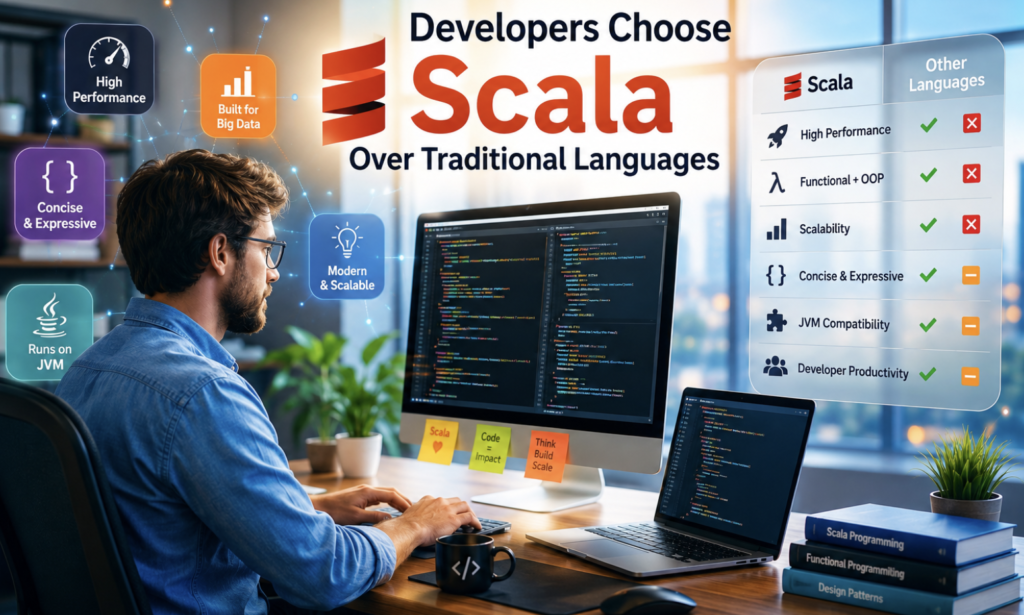
Why Developers Choose Scala Over Traditional Languages
Several programming languages solve similar problems. However, Scala delivers unique advantages. Its combination of concise syntax and powerful abstraction significantly increases productivity. Furthermore, developers spend less time maintaining repetitive code. Scala also excels at handling concurrency, making it ideal for distributed applications.
Scala vs Java
Although Scala and Java share the JVM, they differ considerably. Java emphasizes explicit structure. Meanwhile, Scala focuses on expressiveness. Scala requires fewer lines of code. Java offers broader beginner adoption. Scala introduces functional programming features unavailable in standard Java. Additionally, Scala developers often produce cleaner and more maintainable applications.
Scala vs Kotlin
Both languages modernize JVM development. However, Scala provides stronger functional programming capabilities. Kotlin primarily targets Android development. Conversely, Scala dominates big data and distributed computing. Therefore, choosing between them depends on project requirements.
Major Benefits of Learning Scala
Learning Scala provides numerous long-term advantages. Developers enjoy:
- Excellent code readability
- Strong compile-time safety
- Faster development cycles
- Reduced software bugs
- Better scalability
- Improved concurrency support
- Complete Java interoperability
- Powerful collection libraries
- Advanced functional programming tools
- Enterprise-grade performance
These benefits continue attracting software engineers worldwide.
Where Scala Is Used
Scala powers numerous modern applications. Popular use cases include:
Backend Development
Many REST APIs and web services rely on Scala because of its speed and maintainability.
Big Data Analytics
Apache Spark uses Scala extensively. Data engineers analyze massive datasets efficiently using Spark’s Scala APIs.
Cloud Computing
Cloud-native applications benefit from Scala’s scalability. Many microservices run efficiently on distributed cloud infrastructure.
Financial Technology
Banks require secure, high-performance software. Scala’s reliability makes it attractive for trading systems and financial analytics.
Artificial Intelligence
Although Python dominates AI research, Scala contributes significantly to data engineering pipelines supporting machine learning systems.
Streaming Platforms
Real-time event processing systems frequently utilize Scala for speed and concurrency.
Enterprise Software
Large organizations build internal platforms using Scala because it integrates seamlessly with existing Java environments.
Popular Scala Frameworks
Several mature frameworks strengthen Scala’s ecosystem.
Akka
Akka simplifies concurrent, distributed, and resilient applications.
Apache Spark
Spark performs large-scale data processing and machine learning.
Play Framework
Play enables fast development of scalable web applications.
ScalaTest
ScalaTest simplifies unit testing and software quality assurance.
Cats
Cats provides advanced functional programming libraries.
Development Tools for Scala
Developers commonly use:
- IntelliJ IDEA
- Visual Studio Code
- Metals
- sbt Build Tool
- Maven
- Gradle
These tools improve productivity throughout the software development lifecycle.
Learning Curve of Scala
Scala introduces concepts beyond traditional programming. Initially, beginners may find functional programming unfamiliar. However, consistent practice quickly improves understanding. Fortunately, developers with Java experience usually adapt faster.
Career Opportunities After Learning Scala
Scala expertise opens many professional opportunities. Popular job roles include:
- Scala Developer
- Backend Engineer
- Big Data Engineer
- Software Architect
- Cloud Engineer
- Platform Engineer
- Distributed Systems Developer
- Data Engineer
Moreover, experienced Scala developers often earn competitive salaries because demand exceeds supply.
Best Practices for Writing Scala Code
Professional developers follow several proven practices. Write immutable code whenever possible. Prefer meaningful variable names. Use pattern matching instead of lengthy conditional statements. Keep methods small and focused. Leverage type inference responsibly. Write comprehensive unit tests. Avoid unnecessary complexity. Follow Scala style guidelines consistently. These habits improve maintainability and collaboration.
Common Mistakes Beginners Should Avoid
Many newcomers repeat similar mistakes. Avoid mixing programming styles unnecessarily. Do not ignore functional programming concepts. Keep classes small. Reduce mutable variables. Write readable code instead of clever code. Practice using collections effectively. Understand recursion before replacing loops. Master error handling with functional techniques. These improvements significantly enhance code quality.
The Future of Scala
Scala continues evolving alongside cloud computing, artificial intelligence, and distributed systems. Scala 3 introduced cleaner syntax, improved compiler performance, and modern language enhancements. Furthermore, enterprise adoption remains strong because organizations value scalable and reliable software.
As data-intensive applications continue expanding, Scala will remain an important technology for years ahead.
Conclusion
Scala successfully combines the strengths of object-oriented programming and functional programming into one powerful language. Its concise syntax, robust static typing, seamless Java interoperability, and outstanding scalability make it an excellent choice for modern software development.
Whether developers build enterprise platforms, cloud-native applications, streaming systems, or big data solutions, Scala consistently delivers performance, reliability, and maintainability.
As technology continues evolving, Scala remains a valuable skill for developers seeking to create high-quality applications while expanding their career opportunities in the competitive software industry.
Frequently Asked Questions
1. What is Scala mainly used for?
Scala is mainly used for backend development, big data processing, cloud applications, and distributed systems.
2. Is Scala difficult to learn?
Scala becomes easier with regular practice, especially for developers familiar with Java.
3. Does Scala replace Java?
No, Scala complements Java and works seamlessly alongside existing Java applications.
4. Can Scala run Java libraries?
Yes, Scala fully supports Java libraries and frameworks through JVM compatibility.
5. Is Scala good for beginners?
Yes, beginners can learn Scala gradually while exploring both object-oriented and functional programming.
6. Why is Scala popular in big data?
Scala powers Apache Spark, making large-scale data processing faster and more efficient.
7. Is Scala faster than Java?
Scala offers performance comparable to Java because both run on the JVM.
8. What IDE is best for Scala development?
IntelliJ IDEA is widely considered the best IDE for professional Scala development.
9. Does Scala support functional programming?
Yes, Scala provides comprehensive support for functional programming concepts.
10. Can Scala be used for web development?
Yes, frameworks like Play enable developers to build scalable web applications.
11. Is Scala open source?
Yes, Scala is an open-source programming language with an active global community.
12. Which companies use Scala?
Many technology, finance, and data-driven companies use Scala for enterprise software and analytics.
13. What is Scala 3?
Scala 3 is the latest major version featuring cleaner syntax and improved language capabilities.
14. Should I learn Scala in 2026?
Yes, Scala remains an excellent choice for careers in backend development, cloud computing, and big data.
15. What makes Scala unique?
Scala uniquely combines object-oriented programming, functional programming, concise syntax, and complete Java interoperability in one language.