

How to Choose a Domain Name That People Remember, Trust, and Never Forget
Choosing a domain name can feel like a small task when you are preparing to launch a website. However, that short web address can become one of your most valuable digital assets. Your domain appears on search results, business cards, social profiles, advertisements, emails, and marketing campaigns. Therefore, the wrong choice can create confusion long after your website goes live.
A strong domain name does the opposite. It makes your business easier to discover, remember, recommend, and trust. Fortunately, you do not need a complicated formula to find one. You need a clear strategy, careful research, and a little patience.
This guide explains how to choose a domain name that supports your brand today while leaving enough room for future growth.
What Is a Domain Name?
A domain name is the human-readable address people enter to reach your website. Instead of remembering a complicated numerical IP address, visitors can type a simple name into their browser.
For example, a company might use a domain such as yourbrand.com for its online presence. Your domain is different from web hosting. The domain provides the website address, while hosting provides the server space where your website files live.
Understanding this difference helps you make better decisions when building your online presence.
Why Your Domain Name Matters More Than You Think
Your domain name often creates the first impression of your business online. A short and memorable name can make your company appear established and professional. Conversely, a confusing address can make visitors hesitate before clicking.
Furthermore, customers often share websites verbally. Someone might hear your domain during a conversation and type it later. Therefore, pronunciation and spelling matter almost as much as appearance.
Your domain can also influence your branding across social media, email addresses, advertising campaigns, and printed materials. Consequently, choosing one requires more thought than simply checking whether a name is available.
Start With Your Brand, Not a Domain Generator
Before searching for available domains, define what your brand represents. Think about your products, audience, personality, and future direction. A business selling one specific product today might offer several products later. For example, a domain built around one narrow product can become restrictive after expansion.
Instead, consider names that can grow with the company. A flexible brand name gives you more freedom to introduce new services, categories, or markets.
Write down several words connected with your business. Then combine concepts, sounds, and ideas until you discover potential names.
Choose a Brandable Domain Over a Keyword-Stuffed Name
Many beginners believe that putting keywords into a domain automatically creates strong SEO results. That approach is usually unnecessary. A domain such as bestcheapshoesonlineexample.com may describe a business, but it feels difficult to remember. Meanwhile, a distinctive brand name can become recognizable through consistent marketing.
Search engines evaluate many signals when ranking pages. Your content quality, relevance, technical performance, links, user experience, and overall authority matter far more than forcing keywords into your domain.
Therefore, prioritize branding first. If a relevant keyword fits naturally, that can help visitors understand your business. However, avoid sacrificing memorability just to include another search phrase.
Keep Your Domain Short and Easy to Remember
Short domains usually create less friction. People can type them faster and remember them more easily. They also fit better on business cards, advertisements, mobile screens, and social profiles.
There is no universal character limit that guarantees success. Nevertheless, keeping your name reasonably short is a useful practical goal. Read every candidate aloud before making a decision.
Ask someone else to remember it after hearing it once. If they immediately ask how to spell it, reconsider the name. A memorable domain should feel natural rather than requiring an explanation.
Make Spelling Extremely Simple
Complicated spelling can quietly cost your business visitors. Avoid unnecessary letters, unusual combinations, intentional misspellings, and confusing abbreviations. Although these ideas may look creative, they can create problems when customers search for you.
Double letters can also cause mistakes. The same applies to words that sound identical but have different spellings.
Imagine someone hearing your domain during a podcast or phone call. Could they type it correctly without seeing it? If the answer is no, look for a simpler alternative.
Be Careful With Numbers and Hyphens
Numbers can create unnecessary confusion. For instance, people may wonder whether your domain uses the number “7” or the word “seven.” That small uncertainty can lead to typing errors.
Hyphens create similar problems. Customers may forget them or leave them out completely.
As a result, another website could receive visitors who intended to reach you. For most brands, a clean domain without numbers or hyphens provides a smoother experience.
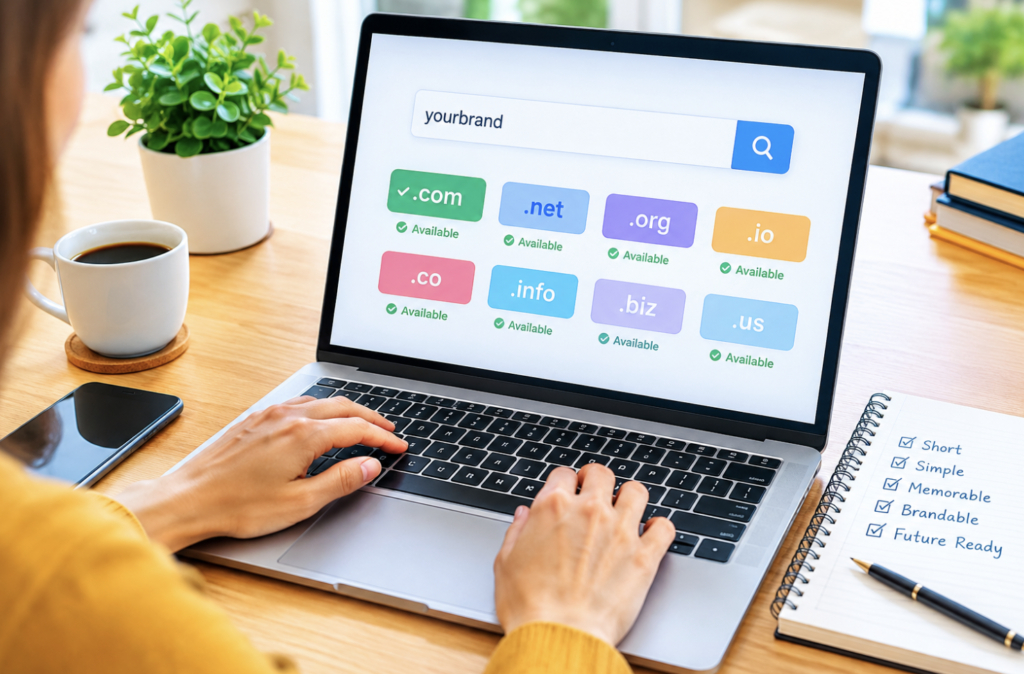
Select the Right Domain Extension
The extension is the ending of your domain, such as .com, .org, .net, or a country-specific extension. The .com extension remains widely recognized and familiar. Therefore, it is often the first option businesses consider.
However, you do not need to abandon a strong brand simply because its .com version is unavailable. Other extensions can work well when they match your audience or industry. Technology companies sometimes consider .io, while organizations may prefer .org.
Country-code extensions can also make sense for businesses focused on specific markets. The important point is consistency. Choose an extension that your audience can understand and remember.
Check the Domain’s History Before Buying
Domain availability does not always tell the complete story. A previously registered domain may have been used by another website. In some cases, it could have accumulated spam, misleading content, or questionable backlinks.
Therefore, investigate a domain’s history before purchasing an expired or previously used name.
Check whether the name appeared on older websites. Look for suspicious associations or a history that could damage your reputation. A clean domain gives you a much safer foundation for building your brand.
Research Trademarks Before Registering
Domain availability does not mean that a name is legally safe. Another company may already own trademark rights to a similar name. Registering the domain could still create a legal dispute.
Therefore, search relevant trademark databases before committing to your final choice. Also, examine businesses operating in your industry. A similar name can cause confusion even when the exact domain remains available.
When the brand matters significantly, professional legal advice can provide additional protection.
Check Social Media Availability
Your website should not exist in isolation. A consistent name across your domain and social platforms makes your brand easier to recognize. Therefore, check your preferred name on major social networks before purchasing it.
You do not necessarily need the exact username everywhere. However, major differences can make your branding less consistent.
If your first choice is unavailable, compare several alternatives before making the final decision.
Think About Email Addresses
Your domain will probably become part of your professional email address.
A complicated domain can make email addresses difficult to communicate. It may also create spelling mistakes when customers contact your business. Imagine saying your email address during a phone call.
A clean domain creates a cleaner email identity as well. For businesses, this small detail can influence perceived professionalism across everyday communication.
Check How the Domain Looks Without Spaces
A clever business name can sometimes create an awkward URL. Words that look harmless separately may form an unintended phrase when combined.
Therefore, write your potential domain exactly as it will appear online. Read it several times and ask other people what they see. This simple test can reveal problems before you invest in branding.
Consider Your Future Business Growth
One of the biggest domain mistakes involves choosing a name that is too narrow. Suppose your company currently sells one type of product. Later, you may introduce additional categories.
A domain tied tightly to the original product could then feel restrictive. Think five years ahead.
Ask whether the name could still represent your company after new products, services, locations, or audiences become part of the business. A flexible domain can save you from an expensive rebranding project later.
Avoid Trends That May Age Quickly
Internet trends change rapidly. A phrase that sounds exciting today may feel outdated within a few years. The same applies to trendy abbreviations, slang, and technology references.
Therefore, avoid choosing a domain simply because it sounds fashionable at the moment. Aim for something distinctive but durable. A timeless name gives your brand more room to evolve without constantly changing its identity.
Consider Local and International Audiences
Your target market should influence your domain strategy. A local business may benefit from a country-code domain that clearly identifies its market. Meanwhile, an international company may prefer a more globally recognizable extension. Also consider pronunciation across different languages.
A name that sounds excellent in one market might have an awkward meaning elsewhere. If international expansion matters, conduct basic linguistic checks before committing. This step becomes especially important for companies planning global advertising.
Check Domain Availability Carefully
Once you have a shortlist, check each domain through a reputable registrar. Do not immediately purchase the first available name. Instead, compare several options based on simplicity, branding, spelling, extension, legal considerations, and long-term flexibility.
You should also investigate whether similar domains are already being used by competitors.
Sometimes a technically available name can still create confusion because a nearly identical company already operates online.
Consider Buying Related Domains
Protecting your main domain can sometimes involve purchasing closely related variations.
For example, a business may consider common misspellings or alternative extensions when they are affordable and strategically useful.
These domains can redirect visitors toward the primary website. However, you do not need to purchase every possible variation. Focus on realistic mistakes or alternatives that could genuinely cause confusion.
Protect Your Domain Account
Buying a domain is only the beginning. Your registrar account should have strong security. Use a unique password and enable multi-factor authentication whenever available. Keep your registration information accurate as well. Losing access to your domain account can create serious business problems.
You should also understand your renewal settings. An expired domain can interrupt your website, email, and other online services.
Automatic renewal can help prevent accidental expiration, although you should still monitor renewal notices.
Do Not Choose a Domain Based Only on SEO
SEO should influence your strategy, but it should not control your entire decision. A domain name alone will not turn weak content into a high-ranking website.
Instead, focus on creating useful pages, logical site architecture, descriptive URLs, fast performance, strong internal linking, and valuable content.
Your domain should support your SEO strategy without becoming an SEO trick. A memorable brand with excellent content can build stronger long-term recognition than an awkward keyword-heavy domain.
Common Domain Name Mistakes to Avoid
Several mistakes repeatedly create problems for new website owners. Choosing a very long name can make typing difficult. Using unusual spellings can cause visitors to reach the wrong website.
Similarly, excessive numbers and hyphens can create communication problems. Ignoring trademarks can lead to expensive disputes. Choosing a narrow name can also become troublesome when your business expands.
Finally, waiting endlessly for the perfect domain can delay your launch. You should research carefully, but remember that a strong and available name can be more valuable than an imaginary perfect option.
A Simple Domain Name Selection Checklist
Before registering your final choice, review the name one last time. Make sure it is easy to pronounce and spell. Confirm that it sounds professional when spoken aloud. Check the extension and investigate competing businesses with similar names.
Review trademark databases and examine the domain’s previous history when appropriate. Check major social platforms for similar usernames.
Most importantly, ask whether the name still makes sense if your business grows significantly. If it passes these tests, you have a much stronger candidate.
Conclusion: Choose a Domain That Can Grow With Your Brand
A domain name is more than a website address. It becomes part of your brand identity, customer experience, marketing strategy, and professional reputation. Therefore, the best domain is not necessarily the cleverest or most keyword-rich option. Instead, it should be memorable, simple, trustworthy, flexible, and easy to communicate.
Start with your brand and understand your long-term direction. Then create several possibilities instead of becoming attached to one name immediately. Check spelling, pronunciation, trademarks, social availability, domain history, and suitable extensions.
Finally, choose a name that you can confidently build around for years. The right domain will not guarantee business success. However, it can remove unnecessary friction and give your brand a stronger foundation from day one.
Frequently Asked Questions
1. What makes a good domain name?
A good domain name is short, memorable, easy to spell, simple to pronounce, and suitable for your brand.
2. Is .com still the best domain extension?
Yes, .com remains highly familiar, although relevant alternatives can work when a strong .com is unavailable.
3. Should my domain contain keywords?
Keywords can fit naturally, but branding and memorability should usually receive greater priority.
4. How long should my domain name be?
Keep your domain as short as practical while ensuring it remains meaningful and easy to remember.
5. Are numbers bad for domain names?
Numbers are not automatically bad, but they can create confusion when people hear your domain verbally.
6. Should I use hyphens in my domain?
Most businesses should avoid hyphens because they can make domains harder to communicate and remember.
7. Can I change my domain name later?
Yes, but changing domains can create branding, redirect, email, and SEO complications.
8. Should I check trademarks before buying a domain?
Yes, checking trademarks can help you avoid choosing a name that conflicts with existing rights.
9. Should my domain match my social media username?
Matching usernames are helpful because they create stronger and more consistent brand recognition.
10. Can an old domain hurt my website?
A previously used domain can carry historical associations, so researching its background is sensible before purchase.
11. Should I buy multiple domain extensions?
You can purchase important variations when they provide meaningful brand protection or prevent likely confusion.
12. Does a keyword domain guarantee better SEO?
No, a keyword-rich domain does not guarantee higher rankings or replace quality content and sound SEO practices.
13. Can I use a country-code domain for my business?
Yes, country-code domains can work particularly well when your business primarily serves one national market.
14. Should I register my domain for several years?
A longer registration period can simplify management, but registration length itself is not a shortcut to better rankings.
15. What should I do after buying my domain?
Connect it to your hosting, configure DNS, secure the account, create professional email, and begin building your website.