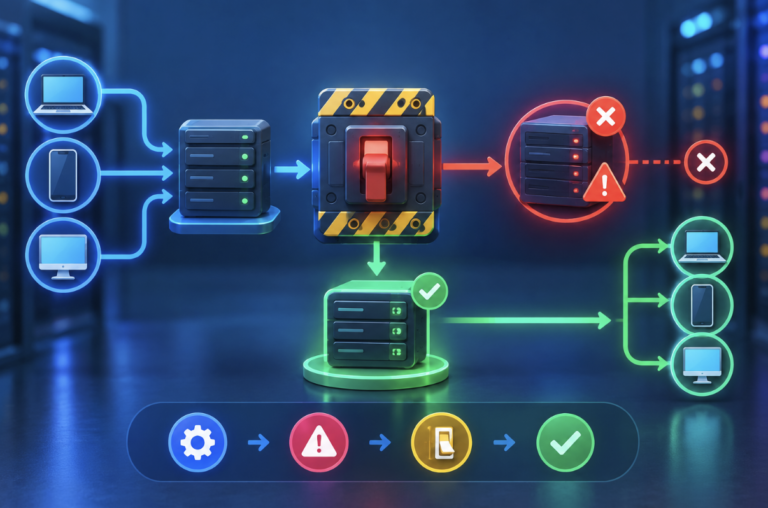

Zero Trust Security: A Framework for Modern Enterprises
In 2010, Google began a multi-year internal initiative called BeyondCorp after concluding that its own VPN-based perimeter security was no longer a reasonable defense against attackers who had already compromised an employee laptop or stolen credentials through phishing. The project’s core premise, that no user or device should be trusted by default, even when connected from inside the corporate network, has since become the industry’s reference implementation of zero trust security.
The shift it represents is significant: instead of building a hardened perimeter and assuming everything inside it is safe, zero trust assumes breach is already possible and verifies every request, every time, regardless of where it originates.
Core Principles Behind Zero Trust
Zero trust rests on a small number of principles that, taken together, replace the old “trusted network, untrusted internet” model. The first is explicit verification: every access request is authenticated and authorized based on all available signals, user identity, device health, location, and the sensitivity of the resource being accessed, rather than being granted implicitly because the request came from inside the corporate network or VPN. A request from an employee’s laptop on the office Wi-Fi gets no more automatic trust than the same request made from a coffee shop.
The second principle is least-privilege access, enforced continuously rather than granted once and forgotten. Traditional systems often provision broad access at onboarding and rarely revisit it; zero trust architectures aim to grant only the specific access needed for a specific task, often for a limited time window, and to re-evaluate that access on each request rather than relying on a session that was authorized hours or days earlier.
The third principle, and the one that gives the model its name, is assuming breach. Zero trust designs treat the network itself as hostile, on the theory that some device, credential, or service will eventually be compromised, and the architecture should limit the damage that compromise can do rather than relying entirely on preventing it. This shows up concretely as micro-segmentation, which restricts lateral movement so that a compromised web server cannot reach the internal database tier just because it happens to sit on the same network.
NIST formalized much of this thinking in Special Publication 800-207, which defines zero trust architecture in vendor-neutral terms centered on a policy engine, a policy administrator, and policy enforcement points that mediate every access decision. This standard has become the common reference point security teams cite when building a zero trust roadmap, giving CISOs a framework to communicate to auditors and boards not tied to any single vendor’s terminology.
Identity as the New Perimeter
If the network is no longer the trust boundary, identity has to take its place, and this is the single biggest architectural shift zero trust requires. Every user, service account, and even individual workload needs a strong, verifiable identity, and access decisions get made based on that identity plus contextual signals rather than network location. This is why identity providers like Okta, Azure Active Directory (now Microsoft Entra ID), and Google Workspace sit at the center of most zero trust rollouts, they become the system that every other component consults before granting access.
Multi-factor authentication is table stakes in this model, but zero trust pushes further into continuous, risk-based authentication. Rather than authenticating once at login and trusting the session for eight hours, a mature implementation evaluates signals throughout the session, has the device’s posture changed, is the request from an unusual location, is the user accessing a resource well outside their normal pattern, and can step up requirements or terminate the session mid-stream if the risk score crosses a threshold.
Device identity matters as much as user identity in this model. A user’s valid credentials on a jailbroken phone or an unpatched laptop represent a materially different risk than the same credentials on a managed, compliant device, and zero trust systems typically integrate with device management platforms (Jamf, Microsoft Intune, or a cloud endpoint agent like CrowdStrike) to factor device posture directly into access decisions.
Service-to-service identity is handled differently but with the same principle: workloads authenticate to each other using mutual TLS certificates or short-lived tokens rather than static API keys or shared network trust, which is one of the reasons service mesh technologies became common companions to zero trust rollouts in Kubernetes environments, they can enforce mutual TLS between services automatically without every application team implementing it individually.
Micro-Segmentation and Least-Privilege Access
Micro-segmentation divides a network into small, isolated zones so that access between them requires explicit policy rather than being permitted by default because two systems share a subnet. In a traditional flat network, once an attacker compromises one machine, they can often reach dozens of others because internal traffic is unrestricted; in a micro-segmented environment, that same compromised machine can reach only the specific systems it has an explicit, policy-defined reason to talk to.
Implementing this in a cloud environment typically means moving away from broad security groups that allow entire subnets to communicate, toward fine-grained rules scoped to specific services and even specific ports and protocols. In Kubernetes, this is implemented through NetworkPolicy resources, often backed by a CNI plugin like Cilium that can enforce policy at the identity level (which service is calling) rather than just the IP level, which matters because pod IPs are ephemeral and constantly changing.
Least-privilege access extends this same logic to permissions, not just network reachability. Cloud IAM policies scoped to the exact actions a role needs, rather than broad administrator access granted out of convenience, dramatically reduce the blast radius of a compromised credential. AWS’s IAM Access Analyzer and similar tools from other cloud providers help identify overly permissive policies by analyzing actual usage patterns and flagging permissions that have never been exercised, which is often the fastest way to find where an organization’s least-privilege intentions have drifted from reality over time.
The operational challenge with both micro-segmentation and least-privilege access is that they require detailed knowledge of legitimate traffic and access patterns before policies can be written safely, implementing overly restrictive segmentation without that groundwork breaks applications in ways that are hard to diagnose, which is why most successful rollouts start in observation or audit mode, logging what would be blocked before enforcing the policy.
Comparing Zero Trust to Perimeter-Based Security

Perimeter-based security, sometimes called the “castle and moat” model, concentrates defenses at the network boundary, firewalls, VPN concentrators, and intrusion detection systems, on the assumption that everything inside that boundary can be trusted more than everything outside it. This model worked reasonably well when most employees worked from a single office and most applications lived in an on-premises data center with a small number of well-defined entry points to defend.
That assumption breaks down for several reasons that map directly onto zero trust’s rise. Remote and hybrid work means there is no longer a single physical perimeter to defend, employees connect from home networks, coffee shops, and personal devices that the organization does not control.
Cloud adoption scatters applications across multiple providers and services, each with its own entry points, rather than concentrating them behind one firewall. And attackers have adapted: phishing and credential theft routinely give attackers a foothold that looks, from the network’s perspective, like a legitimate internal user, which perimeter defenses do nothing to stop once that foothold is established.
Zero trust does not eliminate the perimeter model’s tools, firewalls and VPNs still have roles to play, but it stops relying on them as the primary control. The practical difference shows up in incident response: in a perimeter model, a compromised credential inside the network often gives an attacker broad reach until detected, whereas in a well-implemented zero trust environment, that same compromised credential is still subject to per-request authorization, device posture checks, and micro-segmentation, which limits how far the attacker can move even after gaining initial access.
This is why zero trust is often described less as a replacement technology and more as a shift in default assumptions, from “trust, then verify occasionally” to “verify continuously, trust minimally.”
Implementation Challenges in Legacy Environments
Zero trust is far easier to design for a greenfield cloud-native application than to retrofit onto a decades-old enterprise environment, and this gap explains why so many zero trust initiatives stall in large organizations. Legacy applications often authenticate using protocols like Kerberos or NTLM that were never designed for per-request, risk-based authorization, and rewriting them to support modern identity protocols like OAuth 2.0 or SAML can be a multi-year undertaking involving vendors who no longer actively support the software.
Network segmentation runs into similar friction: many legacy systems were built assuming flat network access to talk to dependencies, sometimes using hardcoded IP addresses or protocols that do not tolerate the latency or connection resets that stricter segmentation and inspection can introduce. Mapping out what depends on what, in an environment built up over fifteen or twenty years by teams that have since moved on, is often the single largest time investment in a zero trust program, well before any policy gets written.
Organizational challenges compound the technical ones. Zero trust requires cooperation across identity, network, application, and security teams that may have historically operated with minimal coordination, and a program that touches how every employee authenticates and how every application communicates internally has enough blast radius that it needs executive sponsorship to survive the inevitable friction of early rollout, when overly strict policies briefly break legitimate workflows.
A pragmatic response to these challenges is phased implementation: starting with identity and device posture for user-facing access (often the easiest win, since modern identity providers support this well), then moving to segmentation for the highest-value or highest-risk systems first, rather than attempting to redesign the entire network at once. Legacy systems that cannot be modernized are often placed behind a policy enforcement proxy or gateway that mediates access on their behalf, giving them zero-trust-style protections without requiring the underlying application to change.
Tooling Landscape: Okta, BeyondCorp, and Istio
The zero trust tooling landscape spans several layers, and most enterprise implementations combine products from multiple vendors rather than adopting a single all-in-one platform. At the identity layer, Okta and Microsoft Entra ID dominate as the systems of record for who a user is and what they are allowed to access, integrating with thousands of downstream applications through SAML and OIDC.
Google’s Chrome Enterprise Premium (the commercialized descendant of the internal BeyondCorp project) and Cloudflare Access represent a different category: they act as an application-access proxy, replacing the traditional VPN by authenticating and authorizing each request to an internal application individually, based on identity and device signals, before it ever reaches the application.
At the network and workload layer, service mesh technologies like Istio and Linkerd enforce mutual TLS between services inside a Kubernetes cluster and can apply fine-grained authorization policies based on service identity rather than IP address, which is a natural fit for the assume-breach, verify-every-request philosophy at the infrastructure level. Cloud-native firewalls and micro-segmentation tools, AWS Security Groups combined with more granular tools like Illumio or Guardicore for on-premises and hybrid environments, extend the same logic to broader network traffic.
Endpoint and device posture is covered by tools like CrowdStrike Falcon, Microsoft Defender for Endpoint, and mobile device management platforms, which feed device health signals into the identity and access layer so that a compromised or non-compliant device can be denied access even with valid credentials.
Policy orchestration across all these layers increasingly runs through a centralized policy engine, Open Policy Agent (OPA) has become a common choice for expressing authorization logic in a vendor-neutral way that can be enforced consistently across services, APIs, and infrastructure. No single vendor covers this entire stack convincingly, which is why zero trust programs typically involve integrating several specialized tools rather than buying one product labeled “zero trust.”
Common Missteps in Zero Trust Rollouts
The most frequent misstep is treating zero trust as a product purchase rather than an architectural and organizational shift. Buying an identity-aware proxy or a segmentation tool without redesigning access policies, without mapping actual application dependencies, and without changing how teams think about default trust produces a system that has zero trust branding but perimeter-era assumptions baked into its configuration, broad policies that grant “engineering team” access to everything rather than scoped, task-specific permissions.
A second common error is enforcing strict policies before observation. Teams that jump straight to blocking traffic that does not match an explicit policy, without first running in log-only mode to observe real traffic patterns, reliably break production systems in ways that erode organizational trust and create pressure to grant broad exceptions that undermine the entire model.
Third, teams often neglect service-to-service authentication while focusing entirely on user-facing access. A zero trust program that adds strong identity verification for employees logging into SaaS applications but leaves internal microservices communicating over unauthenticated, unencrypted connections has closed only half the gap, and given that many real breaches involve lateral movement between internal services after an initial compromise, this is often the more consequential half to leave open.
Fourth, over-restrictive policies without a clear exception process frustrate legitimate users and push them toward workarounds, sharing credentials, requesting broad standing access “to avoid friction,” or finding unmonitored paths around the controls, which recreates exactly the uncontrolled access zero trust was meant to eliminate.
Finally, many programs fail to measure anything, rolling out extensive tooling without instrumenting how many access requests are denied, how many devices fail posture checks, or how access patterns change over time, leaving the security team unable to demonstrate the program’s value or identify where policies need adjustment.
Practical Steps to Start a Zero Trust Migration
A workable starting point is inventorying identity and access first: which users and service accounts exist, what they currently have access to, and where that access was granted without a clear, current justification. This audit alone often reveals the biggest quick wins, dormant accounts with standing access, service accounts with far broader permissions than they use, and groups whose membership has grown far past their original intent.
From there, strengthening identity itself, enforcing multi-factor authentication universally, consolidating identity providers where multiple ones have proliferated, and integrating device posture checks into the authentication flow, delivers meaningful risk reduction before any network segmentation work begins, and it is usually the fastest piece to implement with existing tooling like Okta or Entra ID.
Replacing VPN access to internal applications with an identity-aware proxy is a common and high-value second phase, since it directly addresses one of the clearest gaps in the old model: a VPN typically grants broad network access once connected, while an identity-aware proxy authorizes each application access individually. Segmentation work should follow, prioritized by the sensitivity of the systems involved, the database holding customer payment data deserves segmentation attention well before an internal wiki does.
Throughout the rollout, running new policies in observation mode before enforcement, building a clear exception and escalation process for legitimate edge cases, and instrumenting the system to measure denied requests and policy violations turns zero trust from a one-time project into an operating model the security team can continuously refine, which is closer to how the framework is meant to function in practice.
Final Thoughts
Zero trust is less a technology to install than a set of default assumptions to change: no implicit trust based on network location, continuous verification instead of one-time authentication, and architecture designed to limit damage from an assumed breach rather than relying solely on preventing one.
Organizations that succeed with it treat it as a multi-year program spanning identity, network, and culture, starting with high-leverage changes like universal multi-factor authentication and expanding into segmentation as maturity grows.
Frequently Asked Questions
Is zero trust a specific product or a set of principles?
It is a set of principles, formalized by frameworks like NIST SP 800-207, not a single product. Vendors sell tools that implement pieces of a zero trust architecture, identity providers, access proxies, segmentation tools, but no single purchase makes an organization “zero trust” without the underlying policy and architectural changes.
Does zero trust mean you no longer need a VPN?
In most modern implementations, yes for application access, an identity-aware proxy typically replaces VPN access to internal applications, authorizing each request individually rather than granting broad network access once connected. Some organizations retain VPNs for specific legacy use cases during a transition period.
How long does a zero trust rollout typically take?
For a large enterprise with legacy infrastructure, multi-year timelines are common, since dependency mapping, legacy application modernization, and organizational change management take far longer than deploying the tooling itself. Cloud-native organizations with modern identity infrastructure already in place can move substantially faster.
What is the difference between zero trust and micro-segmentation?
Micro-segmentation is one technique within a broader zero trust architecture, focused specifically on restricting network-level lateral movement. Zero trust is the broader framework that also includes identity verification, device posture, least-privilege access policy, and continuous risk evaluation across every access request.
Can small companies implement zero trust, or is it only for large enterprises?
Smaller companies can adopt zero trust principles more easily in some ways, since they have less legacy infrastructure and organizational complexity to navigate. Cloud-native tools like Google’s identity-aware proxy, Cloudflare Access, and modern IAM in AWS or GCP make core zero trust patterns accessible without enterprise-scale budgets.
Does zero trust slow down application performance?
Poorly implemented zero trust can add latency through excessive authentication checks or inefficient policy evaluation, but a well-designed implementation using short-lived tokens, cached policy decisions, and efficient mutual TLS adds overhead that is usually negligible compared to the security benefit, especially relative to typical network latency.