

Hack Organization Exposed: How Cybercrime Networks Really Operate
Every time you browse the internet, log into an account, or make an online purchase, you leave behind a digital footprint. While technology has made life easier, it has also opened new doors for organized cybercriminals.
Today, a hack organization is no longer a small group of skilled programmers working from hidden locations. Instead, many operate like multinational businesses with specialized teams, advanced technologies, and carefully planned strategies. These cybercrime networks target governments, multinational corporations, hospitals, financial institutions, and even ordinary internet users.
Moreover, they constantly evolve by adopting new attack methods that bypass traditional security systems.
Why Understanding Hack Organizations Matters Today
As digital transformation accelerates worldwide, understanding how these organizations operate has become more important than ever. Whether their goal is financial profit, political influence, espionage, or disruption, organized hacking groups continue reshaping the cybersecurity landscape.
Therefore, learning about their structure, tactics, and objectives helps individuals and businesses strengthen their digital defenses before becoming the next victim.
What Is a Hack Organization?
A hack organization is a coordinated network of individuals who work together to conduct cyberattacks for specific objectives. Unlike independent hackers, these groups function with defined responsibilities, structured leadership, and long-term operational plans. Each member usually specializes in a particular task. Some develop malicious software, while others search for network vulnerabilities.
Meanwhile, additional members manage phishing campaigns, negotiate ransom payments, or sell stolen information on underground marketplaces. Because of this organized structure, these groups can launch highly sophisticated attacks against multiple targets simultaneously.
Why Hack Organizations Continue to Grow
Cybercrime has become one of the world’s fastest-growing illegal industries. As a result, hack organizations continue expanding because digital attacks often generate enormous financial rewards with relatively low operational costs. Several factors contribute to their rapid growth.
- Increased dependence on cloud computing
- Growing use of digital banking
- Expansion of cryptocurrency transactions
- Weak cybersecurity practices
- Global internet connectivity
- Availability of hacking tools on underground markets
As a result, cybercriminal groups continue finding new ways to exploit security gaps across different industries.
How Hack Organizations Operate Like Modern Businesses
Many people imagine cybercriminals working alone in dark rooms. However, reality tells a different story. Today’s hack organizations resemble legitimate companies. They assign specialized roles, establish internal communication systems, and create long-term business models. A typical organization may include malware developers, penetration specialists, phishing experts, infrastructure managers, financial operators, cryptocurrency specialists, negotiators, and technical support teams.
Furthermore, many groups recruit talented programmers worldwide. Some even advertise opportunities on hidden online forums where applicants must demonstrate technical skills before joining. This professional approach allows cybercriminal networks to increase efficiency while minimizing operational risks.
The Different Types of Hack Organizations
Not every hack organization pursues identical objectives. Instead, different groups focus on unique missions depending on their motivations.
Financially Motivated Cybercrime Syndicates
These organizations primarily seek financial gain. They target sensitive information such as bank details, payment card data, login credentials, and personal information. Additionally, they frequently conduct ransomware attacks that force victims to pay substantial sums for data recovery.
State-Sponsored Hacking Groups
Some organizations receive direct or indirect government support. Their missions often involve intelligence gathering, military surveillance, election interference, and strategic cyber espionage. These groups usually possess significant technical resources and highly trained cybersecurity professionals.
Corporate Espionage Networks
Rather than stealing money, these organizations focus on confidential business information. They target trade secrets, product designs, customer databases, research documents, and proprietary technologies that provide competitive advantages.
Hacktivist Organizations
Hacktivists launch attacks to promote political, environmental, or social causes. Instead of financial profit, they seek public attention by disrupting websites, exposing confidential documents, or spreading ideological messages.
Cyberterrorist Groups
Cyberterrorist organizations attempt to create fear by targeting critical infrastructure, communication systems, transportation networks, healthcare facilities, or government institutions. Although these attacks are less common, they can have devastating consequences.
Primary Objectives Behind Organized Cyber Attacks
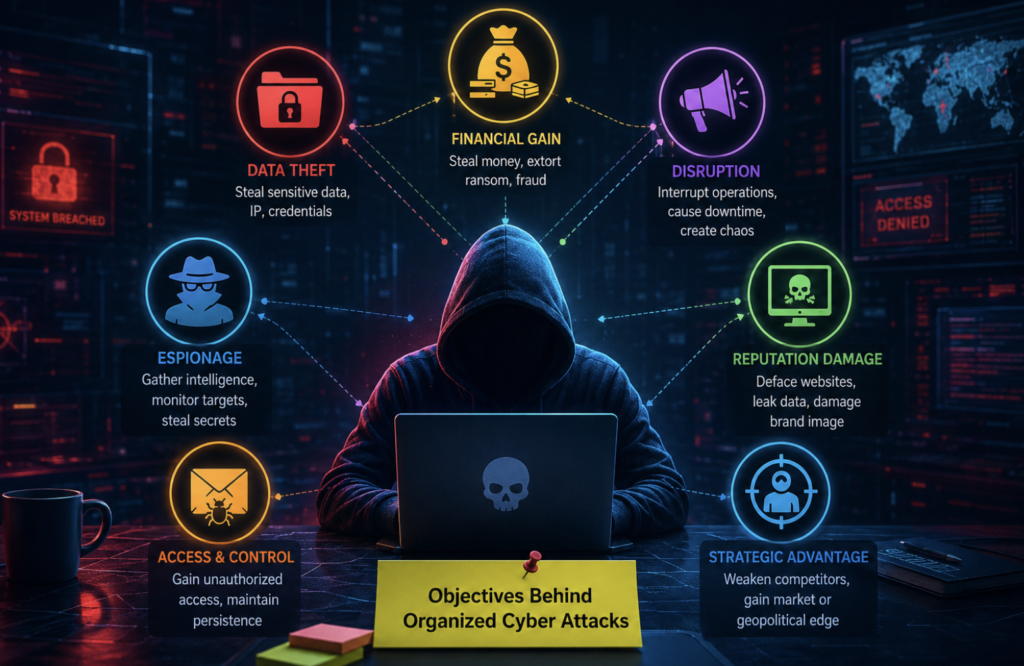
Every hack organization operates with carefully defined goals. While financial profit remains the leading motivation, many groups pursue broader strategic objectives. Their common objectives include stealing sensitive financial information, accessing confidential corporate records, conducting industrial espionage, collecting government intelligence, disrupting essential infrastructure, damaging competitors, manipulating political events, and generating revenue through ransomware campaigns. Therefore, cyberattacks often serve multiple purposes rather than a single criminal objective.
Most Common Attack Techniques Used by Hack Organizations
Organized cybercriminals rely on numerous attack methods to penetrate networks successfully.
Phishing Campaigns
Phishing continues to be one of the most effective tactics used by cybercriminals. Criminals create convincing emails or messages that trick users into revealing passwords, financial details, or authentication codes. Because these messages closely resemble legitimate communications, many victims unknowingly provide sensitive information.
Malware Deployment
Hack organizations frequently distribute malicious software capable of stealing data, monitoring activity, damaging systems, or creating unauthorized access points. Once installed, malware often operates silently while collecting valuable information.
Ransomware Attacks
Ransomware encrypts important files and prevents access until victims pay a demanded ransom. Today, many organizations also steal confidential information before encryption. Consequently, victims face both operational disruption and public data exposure.
Credential Theft
Cybercriminals aggressively target usernames and passwords through phishing, malware, password spraying, and leaked database exploitation. Stolen credentials often provide direct access to sensitive business systems.
Social Engineering
Instead of attacking technology, cybercriminals manipulate human behavior. Employees may unknowingly disclose confidential information simply because attackers appear trustworthy or authoritative.
Distributed Denial-of-Service (DDoS) Attacks
These attacks overwhelm servers with excessive traffic. As a result, legitimate users cannot access websites, online services, or business applications.
Supply Chain Attacks
Rather than attacking the primary target directly, criminals compromise trusted software vendors or service providers. This approach enables attackers to infiltrate numerous organizations simultaneously.
Industries Most Frequently Targeted
Although every organization faces cyber risks, certain industries remain particularly attractive to organized cybercriminals. Financial institutions hold large amounts of money along with sensitive customer information, making them attractive targets for cybercriminals. Healthcare providers maintain sensitive medical records. Government agencies possess classified intelligence and citizen databases. Technology companies develop intellectual property worth billions of dollars.
Meanwhile, manufacturing firms hold proprietary production methods, while educational institutions store research data and personal student records. Even small businesses attract cybercriminals because they often lack advanced security infrastructure.
Tools That Power Modern Hack Organizations
Technology continues transforming cybercrime. Today’s organizations use sophisticated software capable of automating attacks while avoiding detection. Popular tools include remote access trojans, botnets, exploit kits, keyloggers, credential harvesting software, password cracking platforms, ransomware frameworks, vulnerability scanners, network mapping utilities, artificial intelligence-assisted phishing systems, and cryptocurrency laundering services.
As cybersecurity improves, attackers continuously modify these tools to remain effective.
The Underground Economy Supporting Cybercrime
Hack organizations rarely operate independently. Instead, they participate in a thriving underground marketplace where criminals buy, sell, and exchange digital products and services. Some developers sell malware subscriptions. Others lease ransomware platforms through Cybercrime-as-a-Service models.
Meanwhile, stolen databases, financial credentials, identity documents, and exploit kits circulate among specialized marketplaces. This criminal ecosystem enables even inexperienced attackers to launch sophisticated cyberattacks.
Famous Hack Organizations That Shaped Cybersecurity History
Several organized cybercrime groups have become internationally recognized because of their large-scale operations. DarkSide gained worldwide attention after targeting critical infrastructure through ransomware attacks.
REvil became notorious for attacking businesses across multiple industries while demanding enormous cryptocurrency payments.
The Lazarus Group has repeatedly been linked to sophisticated international cyber operations involving financial theft and espionage. Anonymous became famous for politically motivated campaigns targeting governments and organizations. Conti operated one of the largest ransomware operations before internal leaks disrupted its activities. Each organization demonstrated how organized cybercrime continues evolving on a global scale.
Warning Signs Your Organization May Be Under Attack
Early detection dramatically reduces cyber damage. Businesses should immediately investigate suspicious activity whenever they notice unusual network traffic, unexpected account logins, unauthorized software installations, disappearing files, encrypted documents, disabled security tools, abnormal employee account behavior, repeated authentication failures, unexplained system slowdowns, or increased phishing attempts. Ignoring these warning signs often allows attackers to remain inside networks for extended periods.
How Governments Are Fighting Organized Cybercrime
Governments worldwide recognize cybercrime as a national security concern. Therefore, international cooperation continues expanding through intelligence sharing, cybercrime investigations, financial sanctions, digital forensics, cross-border law enforcement partnerships, and stronger cybersecurity regulations.
Additionally, many countries establish specialized cyber defense centers that monitor emerging threats around the clock. Although progress continues, organized cybercrime remains difficult to eliminate because attackers frequently relocate across jurisdictions.
Best Practices to Protect Against Hack Organizations
Strong cybersecurity requires continuous improvement rather than one-time solutions. Organizations should implement multi-factor authentication across all accounts. Regular software updates eliminate known vulnerabilities before attackers exploit them. Employee awareness training reduces phishing success rates. Secure offline backups ensure critical information remains recoverable after ransomware attacks.
Furthermore, endpoint protection software, continuous network monitoring, vulnerability assessments, penetration testing, password management policies, zero-trust security models, encryption, and incident response planning significantly improve organizational resilience. Individuals should also avoid suspicious links, create unique passwords, monitor financial accounts, and install security updates immediately. A proactive approach always delivers stronger protection than reactive recovery.
The Future of Hack Organizations
Emerging technologies will reshape organized cybercrime during the coming years. Artificial intelligence is expected to make phishing campaigns more convincing, targeted, and difficult to detect. Machine learning may improve malware adaptability against defensive systems.
Cloud computing will continue creating new attack surfaces. Internet of Things devices will expand opportunities for network compromise. Additionally, quantum computing could eventually challenge existing encryption standards if defensive technologies fail to evolve simultaneously.
Consequently, cybersecurity professionals must continuously innovate to stay ahead of increasingly sophisticated cybercriminal organizations.
Why Cyber Awareness Matters More Than Ever
Technology connects nearly every aspect of modern life. Unfortunately, this connectivity also increases digital risk. Understanding how hack organizations function helps businesses develop stronger security strategies while enabling individuals to make safer online decisions.
Cybersecurity is no longer solely an IT responsibility. Instead, it has become a shared responsibility involving employees, executives, governments, technology providers, and everyday internet users. Greater awareness significantly reduces opportunities for organized cybercriminals to succeed.
Conclusion
Hack organizations have transformed cybercrime into a sophisticated global industry. These structured networks combine technical expertise, advanced technologies, and strategic planning to target organizations of every size. Their attacks continue growing in scale, complexity, and financial impact.
However, knowledge remains one of the strongest defenses against these evolving threats. Organizations that invest in cybersecurity awareness, proactive monitoring, employee education, and modern security technologies greatly reduce their risk of becoming victims.
As cyber threats continue evolving, maintaining strong digital security practices will remain essential for protecting sensitive information and ensuring long-term business resilience.
Frequently Asked Questions (FAQs)
1. What is a hack organization?
A hack organization is a coordinated group that conducts organized cyberattacks for financial, political, or strategic objectives.
2. Are hack organizations always illegal?
Most hack organizations engage in illegal cyber activities that violate national and international laws.
3. How do hack organizations make money?
They profit through ransomware, stolen data sales, fraud, identity theft, and other cybercrime operations.
4. Who is most at risk from organized cybercrime?
Businesses, governments, healthcare providers, educational institutions, and individual internet users are common targets.
5. Can small businesses become victims?
Yes, small businesses are often targeted because they may have fewer cybersecurity resources and defenses than larger organizations.
6. What is the biggest weapon used by hack organizations?
Phishing remains one of the most effective techniques for gaining unauthorized access.
7. How can companies defend against cybercriminal groups?
They should implement multi-factor authentication, employee training, continuous monitoring, and regular security updates.
8. Do hack organizations target individuals?
Yes, individuals are frequently targeted through phishing scams, malware, and identity theft.
9. Is ransomware still one of the biggest cyber threats?
Yes, ransomware continues to be among the most damaging and profitable cybercrime methods.
10. Why is cybersecurity awareness important?
Cybersecurity awareness helps people recognize threats early and avoid becoming easy targets for organized attackers.