How Quantum Security USB Devices Are Protecting Personal Data in 2026
USB drives are convenient, but they can also create serious privacy risks. A tiny flash drive can contain passwords, financial documents, business files, photos, customer information, or other sensitive data. If the device is lost or stolen, that information could potentially fall into the wrong hands.
In 2026, a new category of secure storage is getting more attention: quantum security USB devices.
The term can be confusing because many of these products do not literally use quantum computers or quantum communication. Instead, the market increasingly includes USB devices that use quantum-resistant cryptography, hardware encryption, secure microprocessors, or quantum random-number generation to prepare for future threats.
Recent products demonstrate this shift. For example, Apricorn announced a 4TB Aegis Secure Key 3 in July 2026, describing it as a quantum-resistant hardware-encrypted USB storage device.
So, what exactly are quantum-security USB devices, and how can they help protect personal data?
What Is a Quantum Security USB Device?
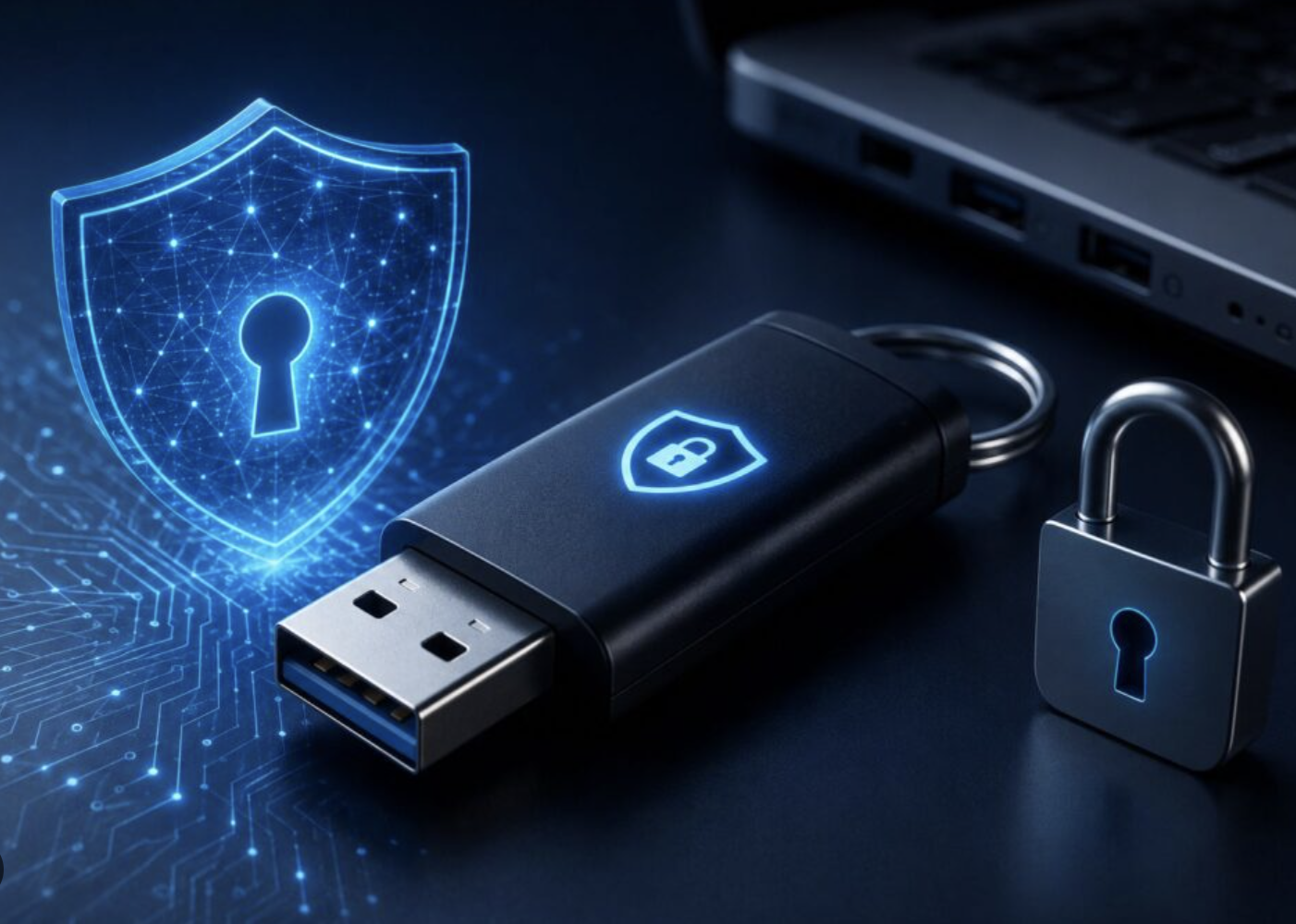
A quantum-security USB device is a secure storage device designed to protect information against both today’s cybersecurity threats and potential future attacks involving powerful quantum computers.
Traditional secure USB drives may use hardware-based AES encryption, PIN authentication, secure microprocessors, and tamper-resistant components.
Newer products may additionally incorporate post-quantum cryptography (PQC) or other technologies intended to remain secure against future quantum attacks.
It is important to understand the distinction.
A USB drive marketed as “quantum secure” does not necessarily contain a quantum computer.
In many cases, “quantum secure” means the device uses cryptographic methods designed to resist attacks that could eventually be enabled by large-scale quantum computers.
Why Quantum Computing Matters for Personal Data
Today’s encryption protects enormous amounts of digital information.
However, sufficiently powerful quantum computers could threaten some widely used public-key cryptographic algorithms.
This creates a long-term concern for information that needs to remain confidential for many years.
Attackers could potentially collect encrypted information today and attempt to decrypt it in the future if technology becomes capable of breaking the underlying cryptography.
This concept is often called “harvest now, decrypt later.”
For personal information that needs long-term protection, preparing for future cryptographic threats can therefore make sense.
How Secure USB Drives Protect Data
Modern secure USB devices typically combine several layers of protection.
These can include:
- Hardware encryption
- Strong authentication
- PIN protection
- Secure microprocessors
- Tamper-resistant hardware
- Secure key storage
- Firmware protection
- Automatic locking
- Cryptographic algorithms
For example, iStorage’s datAshur PRO² uses AES-XTS 256-bit hardware encryption and PIN authentication. The manufacturer also describes its design as quantum-resistant because it relies on symmetric encryption rather than vulnerable RSA or ECC algorithms.
This shows why “quantum security” does not always mean quantum cryptography.
Hardware Encryption Is a Major Advantage
One of the most useful features of secure USB devices is hardware encryption.
Instead of depending entirely on software running on the connected computer, encryption can happen directly inside the storage device.
This provides an additional security layer.
If the drive is removed from the computer, the stored information remains encrypted.
Some secure drives can also lock themselves automatically when disconnected or after repeated failed authentication attempts.
This makes physical theft less useful to an attacker.
PIN Authentication Adds Another Layer
Some secure USB drives include a physical keypad or another authentication mechanism.
The user must enter the correct PIN before the device allows access to its stored information.
This means someone who finds the physical drive cannot simply plug it into a computer and immediately browse its contents.
The datAshur PRO², for example, uses PIN authentication before the drive can be accessed.
A strong PIN and proper device-management practices remain important.
What Makes Security “Quantum Resistant”?
Quantum-resistant security focuses on cryptographic algorithms designed to withstand attacks from future quantum computers.
Organizations are increasingly preparing for this transition because cryptographic systems have long replacement cycles.
The National Institute of Standards and Technology (NIST) has standardized post-quantum algorithms, including ML-KEM for key establishment and ML-DSA and SLH-DSA for digital signatures.
This does not mean every secure USB drive already uses every new post-quantum algorithm.
Consumers should therefore examine the manufacturer’s technical documentation rather than trusting the words “quantum secure” on packaging.
Quantum Random Number Generation
Some advanced security devices use quantum random number generation (QRNG).
Cryptographic systems depend on unpredictable random values for creating secure keys.
Quantum phenomena can generate inherently unpredictable sources of randomness rooted in physical laws.
Some emerging quantum-security hardware combines quantum random-number generation with other security technologies.
This is different from simply using a larger encryption key.
Tamper Resistance Matters Too
Encryption is only one part of physical device security.
A sophisticated attacker with physical access to a device may attempt to open it, extract components, or manipulate the hardware.
Secure USB products can therefore include tamper-resistant or tamper-evident construction.
Some devices are designed so that attempting to physically access internal components damages the device or makes tampering obvious.
This provides another barrier against attacks that cannot be solved by software alone.
Secure Boot and Firmware Protection
The security of a USB device also depends on its firmware.
If an attacker can replace legitimate firmware with malicious code, strong encryption may not be enough.
Secure boot technologies can verify that trusted software is running before the device operates.
Modern hardware-security guidance increasingly emphasizes cryptographic verification of firmware and secure boot processes. OWASP’s IoT security requirements, for example, recommend cryptographically verifying boot components and supporting post-quantum signatures for certain devices expected to operate beyond 2030.
Who Needs Quantum-Security USB Devices?
Not everyone needs an advanced secure USB drive.
For ordinary files such as temporary documents or non-sensitive media, a standard storage device may be sufficient.
However, stronger protection can make sense for people handling highly sensitive information.
Potential users include:
- Business owners
- Journalists
- Financial professionals
- Healthcare workers
- Lawyers
- Government employees
- Researchers
- IT administrators
- Executives
- Security professionals
Individuals storing highly private documents may also benefit from hardware-encrypted storage.
What Personal Data Can Be Protected?
A secure USB device can protect many types of information, including:
- Personal photographs
- Tax documents
- Financial records
- Password backups
- Business documents
- Legal files
- Customer information
- Intellectual property
- Private research
- Sensitive identification documents
The most important benefit is that the information remains encrypted when the physical device is not being accessed.
Are Quantum Security USB Drives Completely Hack-Proof?
No.
This is one of the most important points.
No security device should be considered completely hack-proof.
A quantum-resistant USB drive can reduce certain risks, but attackers can still target:
- The user’s password
- The connected computer
- Malware
- Phishing
- Social engineering
- Stolen authentication information
- Vulnerable firmware
- Poor security practices
For example, if a user enters a PIN into a compromised computer or voluntarily gives it to an attacker, strong hardware encryption cannot solve every problem.
Security works best as a layered system.
Quantum Security Does Not Replace Basic Cybersecurity
Buying an advanced USB drive does not eliminate the need for basic security practices.
Users should still:
- Use strong authentication
- Keep computers updated
- Avoid suspicious downloads
- Protect recovery credentials
- Back up important information
- Avoid unknown USB devices
- Use reputable security software
- Keep sensitive files encrypted
- Store devices securely
The USB device should be one layer in a broader security strategy.
Why Quantum-Resistant Storage Is Becoming Important in 2026
The cybersecurity industry is increasingly preparing for the possibility that quantum computers will eventually threaten some existing cryptographic systems.
This is why quantum-resistant technologies are moving from research discussions toward practical products.
The 2026 market already includes secure USB products described as quantum-resistant and hardware-encrypted.
This does not mean quantum computers can currently break ordinary USB encryption.
Instead, the industry is preparing ahead of time.
Long-lived data can remain sensitive for decades, so upgrading security before a major cryptographic transition becomes urgent can be a sensible strategy.
How to Choose a Secure USB Device
If you are considering a secure USB drive, do not focus only on the phrase “quantum secure.”
Check the actual specifications.
Look for:
Hardware Encryption
Prefer devices with strong, well-documented hardware encryption.
Authentication
PIN authentication or another strong access-control mechanism can help protect a lost or stolen drive.
Security Certifications
Look for recognized security certifications where appropriate.
For example, some professional secure-storage devices pursue FIPS validation.
Tamper Protection
Physical protection can make unauthorized hardware access more difficult.
Firmware Security
Secure boot and signed firmware can reduce the risk of malicious firmware modification.
Key Management
Understand how encryption keys are generated, stored, protected, and recovered.
Manufacturer Transparency
A trustworthy manufacturer should clearly explain the security technology instead of relying entirely on marketing claims.
The Future of Secure USB Storage
USB storage is unlikely to disappear simply because cloud storage has become popular.
Portable physical storage remains useful when people need offline access, controlled data transfers, or protection from internet-based attacks.
The next generation of secure storage is likely to combine traditional hardware encryption with stronger authentication, secure elements, tamper protection, and post-quantum cryptography.
Some specialized products may also incorporate quantum random-number generation.
This could lead to the development of storage solutions that are prepared to counter both current security threats and those emerging in the future.
Final Thoughts
Quantum security USB devices represent an important evolution in portable data protection.
The biggest advantage is not that they magically make data impossible to steal. Instead, they combine multiple security technologies to make unauthorized access significantly more difficult.
Hardware encryption protects stored information. PIN authentication controls physical access. Secure processors can protect cryptographic keys. Tamper-resistant construction can discourage hardware attacks. And quantum-resistant cryptography can help prepare data for a future where quantum computers become powerful enough to threaten some existing encryption systems.
As sensitive personal and business data becomes increasingly valuable, secure physical storage remains relevant.
By 2026, the most effective strategy will be to avoid depending solely on a single “quantum” designation. Look at the actual security architecture, encryption standards, authentication mechanisms, certifications, firmware protections, and reputation of the manufacturer.
Quantum-resistant storage is preparation for the future, but strong cybersecurity habits remain essential today.
FAQ’s
1. Are quantum security USB drives really quantum?
Not necessarily. Many are conventional hardware-encrypted USB devices that use quantum-resistant cryptography or security technologies designed to address future quantum threats.
2. Can quantum computers break USB encryption?
A sufficiently powerful future quantum computer could threaten some existing cryptographic algorithms. Strong symmetric encryption such as AES-256 is generally considered much more resistant to known quantum attacks than vulnerable public-key systems.
3. Are quantum secure USB drives worth buying?
They can be worthwhile if you store highly sensitive or long-term information. For ordinary files, a reputable encrypted USB drive may provide sufficient protection.
4. What should I look for in a secure USB drive?
Look for strong hardware encryption, authentication, secure key storage, tamper protection, firmware security, reputable certifications, and clear information about the cryptography being used.
5. Can a secure USB drive stop hackers completely?
No. It primarily protects the data stored on the device. Malware, phishing, stolen credentials, compromised computers, and social engineering can still create security risks.