
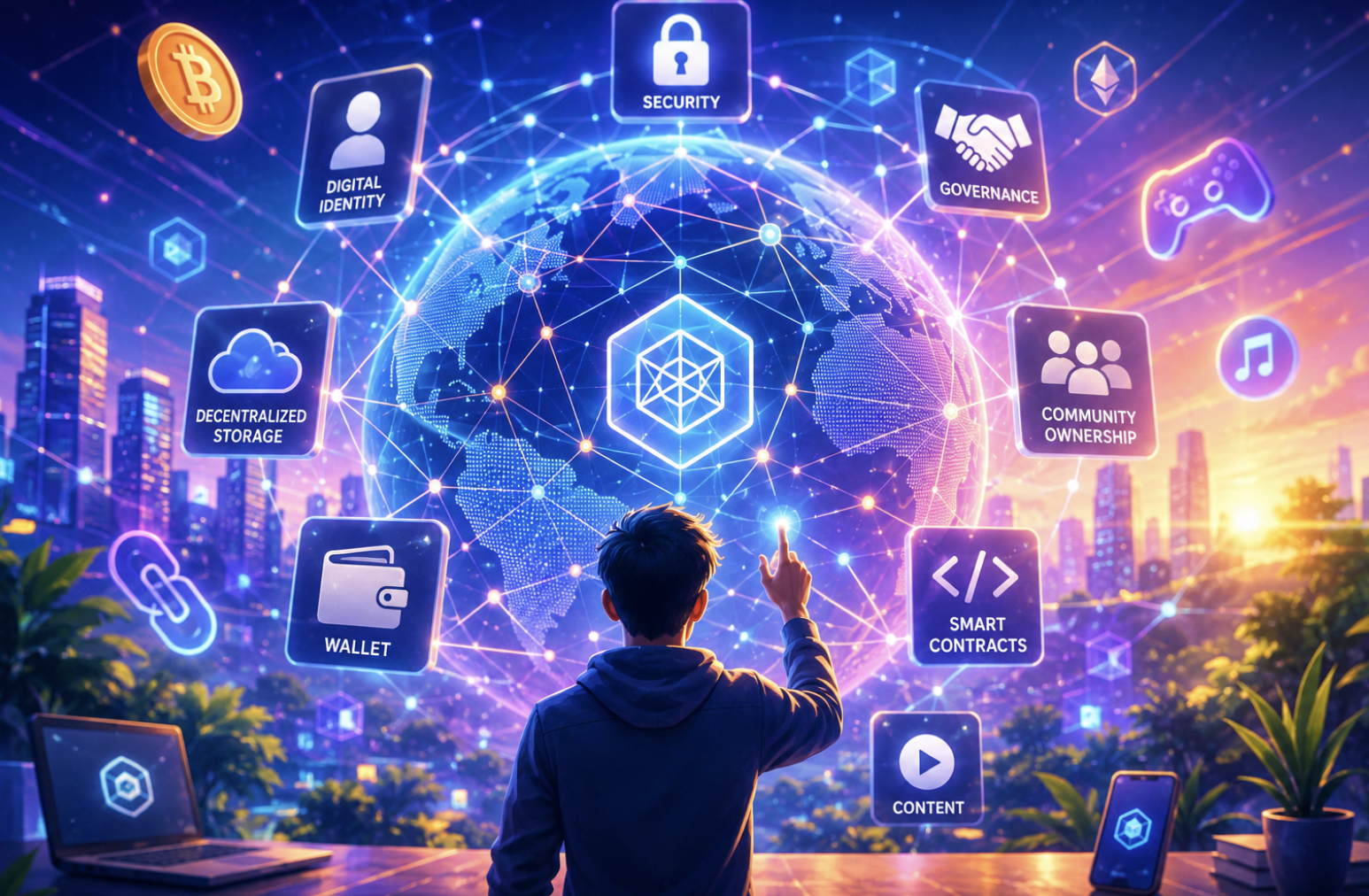
The Decentralized Internet Explained: How Web3 Could Rewrite the Rules of the Digital World
The internet feels limitless, yet much of it depends on surprisingly few powerful companies. They run major platforms, cloud infrastructure, app stores, databases, and digital services. That structure has made online life fast, convenient, and remarkably scalable. However, it also creates an important question. What happens when users want more control over their data, identity, and digital assets? That question sits at the heart of the decentralized internet. Instead of placing control in one company’s hands, decentralized networks distribute responsibilities among multiple participants.
Consequently, users can interact with services through open networks rather than closed platforms. This idea could influence digital identity, online communities, payments, storage, content, and ownership. However, decentralization is not a magical replacement for everything online.
It introduces exciting possibilities while creating new technical and practical challenges. So, what exactly is the decentralized internet, and why does it matter? Let’s explore how this emerging internet model could reshape your digital future.
What Is the Decentralized Internet?
The decentralized internet describes online systems that distribute control, infrastructure, or data across multiple independent participants. Traditional services commonly depend on centralized servers and organizations. For example, one company may operate the servers behind your account and online activity. That company can manage access, store information, enforce rules, and control its platform. A decentralized network takes a different approach.
Instead, several computers, organizations, or users can contribute resources and maintain network operations. Therefore, the system does not necessarily depend on one central authority. However, decentralization exists on a spectrum.
Some platforms distribute specific functions while keeping other components centralized. Others attempt to decentralize infrastructure, governance, storage, identity, and ownership simultaneously. Therefore, the term describes an architectural approach rather than one specific technology.
How Does a Decentralized Internet Actually Work?
Several technologies can support decentralized internet infrastructure. Each technology solves a different problem within the broader ecosystem.
Peer-to-Peer Networking
Peer-to-peer networks allow participating computers to communicate directly with one another. Therefore, information does not always need to pass through one central server.
This approach can improve resilience because multiple participants can provide network resources. If one participant disappears, other participants may continue serving the network.
Blockchain Networks
Blockchain technology provides shared records maintained across distributed networks. Participants can verify transactions without depending completely on a single central database. Moreover, cryptographic techniques help protect records from unauthorized alterations.
Blockchain can support digital assets, smart contracts, decentralized applications, and programmable transactions. However, blockchain represents only one part of decentralized technology.
Distributed Storage
Decentralized storage can divide information across multiple network participants. Consequently, users may avoid depending entirely on one storage company.
Some systems also use cryptographic methods to protect stored information. However, users must still consider availability, privacy, performance, and recovery.
Decentralized Applications
Decentralized applications, commonly called dApps, operate using distributed technologies. Some rely on blockchain networks for transactions or application logic. Others can use peer-to-peer systems and decentralized storage.
Therefore, dApps can reduce dependence on traditional centralized application infrastructure.
Why Is Internet Decentralization Becoming Important?
Centralization has created enormous benefits for internet users. Large companies can invest billions in infrastructure and deliver highly reliable services. However, concentration can also create significant dependencies. A platform outage can affect millions of people simultaneously. Likewise, policy changes can suddenly affect creators, businesses, and communities. Data concentration can also create attractive targets for cybercriminals.
Furthermore, users may have limited control over information stored inside private platforms. Decentralization attempts to address some of these concerns. Instead of concentrating every function, networks can distribute specific responsibilities.
As a result, users may gain greater control and flexibility. Still, decentralization does not automatically solve every internet problem. The actual outcome depends on the technology, governance model, and implementation.
Decentralized Internet vs Traditional Internet
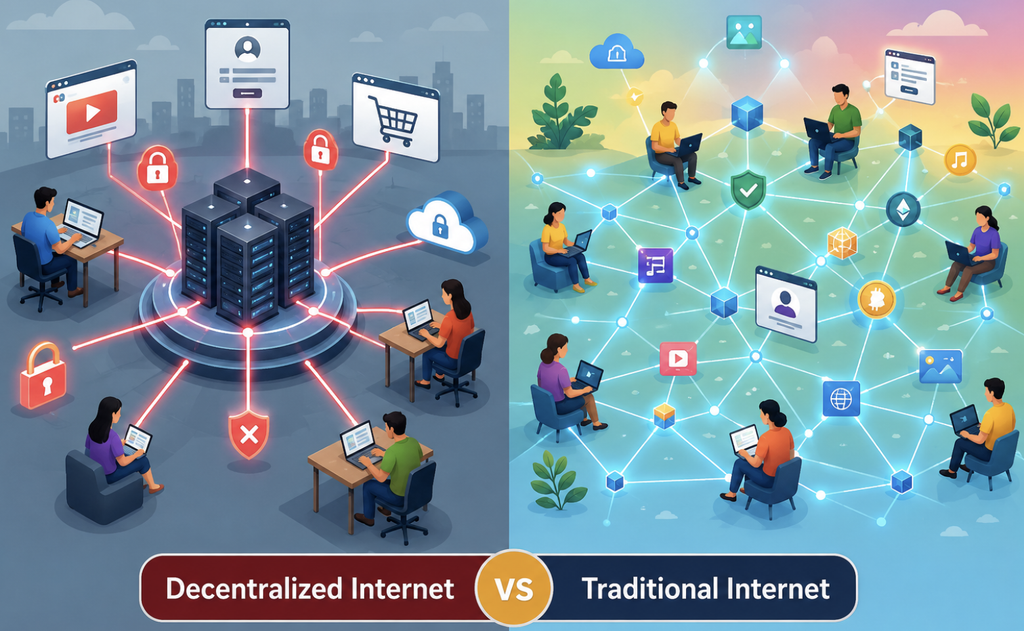
The biggest difference involves where control and responsibility reside. Traditional platforms commonly place major responsibilities with one company. That company can manage servers, accounts, databases, policies, and user access. Decentralized systems distribute some of these responsibilities across network participants. For example, centralized storage can place information with one provider. Meanwhile, decentralized storage can distribute information across multiple nodes. Similarly, traditional platforms can control user accounts through company databases. Decentralized identity systems can instead give users greater control over credentials.
Therefore, decentralization changes the relationship between users and online infrastructure. It can shift some authority away from platforms and toward protocols or communities.
However, centralized systems can still outperform decentralized alternatives in convenience and speed. The better model therefore depends on the specific use case.
Could Decentralization Change Digital Ownership?
Digital ownership represents one of the most interesting areas of decentralization. Traditionally, buying a digital item does not always provide complete ownership. Instead, users often receive permission to access content through a particular platform. If that platform closes, changes its rules, or removes access, users may lose functionality. Blockchain-based systems can introduce verifiable records of digital ownership.
For example, digital assets can have unique identifiers recorded on public networks. Users can control these assets through cryptographic wallets. Furthermore, compatible applications can potentially recognize the same asset. This creates opportunities for portable digital ownership.
However, ownership still depends on legal rights, software support, and network design. Therefore, owning a blockchain token does not automatically mean owning every related legal right.
Decentralized Identity Could Change Online Accounts
Online identity currently depends heavily on usernames, passwords, email addresses, and platform accounts. This system forces users to create separate identities across many services. Decentralized identity offers another possibility. Users could hold digital credentials through systems designed for greater portability. Instead of repeatedly submitting the same information, users could present verified credentials.
For example, a digital credential could confirm eligibility without revealing unnecessary information. This approach can support privacy-focused identity verification. Moreover, users could potentially reuse credentials across compatible services.
However, adoption requires common standards and strong security practices. Without interoperability, decentralized identity could simply create another collection of disconnected systems.
What About Privacy on a Decentralized Internet?
Many people associate decentralization with better privacy. However, that assumption requires careful consideration. A decentralized system can reduce certain forms of centralized data collection. Nevertheless, some decentralized networks publicly expose transaction information.
For example, blockchain addresses may remain visible even when real identities remain unknown. Additionally, decentralized applications can still collect user information. Therefore, decentralization does not automatically equal anonymity.
Privacy depends on encryption, data policies, network architecture, and application design. Users should always examine how a service handles personal information. They should also understand whether their activity becomes publicly visible.
How Could Decentralization Improve Online Resilience?
Resilience represents another major advantage of distributed networks. A centralized service can experience problems when critical infrastructure fails. For instance, one server cluster could become unavailable because of technical problems.
A distributed network can spread operations across numerous independent participants. Consequently, individual failures may have less impact on the overall system. This structure can also reduce certain single points of failure.
However, decentralization does not guarantee uninterrupted service. Networks can still experience software bugs, congestion, attacks, or governance disputes. Therefore, resilience depends on the quality and distribution of the network.
Could Decentralization Reduce Censorship?
Some decentralized networks aim to make unilateral control more difficult. When no single organization controls the entire infrastructure, removing information can become more complicated. This feature can support open communication and independent publishing.
However, censorship resistance has important limitations. Network operators, developers, governments, and application interfaces can still influence access.
Furthermore, laws can affect how decentralized services operate. Therefore, decentralization may reduce certain forms of centralized control without eliminating restrictions entirely.
What Are the Biggest Benefits of a Decentralized Internet?
Decentralization offers several potential benefits for users and organizations.
Greater User Control
Users can potentially control digital assets, credentials, and other online resources directly.
Reduced Platform Dependence
People may access services without depending entirely on one company.
Improved Network Resilience
Distributed infrastructure can reduce the impact of individual infrastructure failures.
Open Participation
Open protocols can allow developers to build services without traditional platform approval.
Digital Portability
Users may eventually move identities, assets, and information between compatible services.
New Business Models
Decentralized systems can support new approaches to payments, communities, ownership, and digital services. However, these benefits depend heavily on practical implementation.
What Problems Could Slow Decentralized Internet Adoption?
Decentralization still faces several significant obstacles.
Scalability Challenges
Some distributed networks struggle when millions of users generate activity simultaneously.
Consequently, transaction speeds can decrease while network costs increase. Developers continue working on technologies designed to improve scalability.
Difficult User Experiences
Wallets, private keys, network fees, and decentralized applications can confuse new users. Mainstream services usually hide complex technical processes. Therefore, decentralized platforms need simpler interfaces for broader adoption.
Private Key Responsibility
Self-custody can provide greater control. However, losing a private key can also mean losing access to digital assets. This responsibility differs significantly from resetting a forgotten password.
Security Vulnerabilities
Smart contracts and decentralized applications can contain coding mistakes. Attackers can exploit vulnerabilities when developers overlook security weaknesses. Therefore, decentralization requires strong auditing and responsible development.
Regulatory Uncertainty
Governments continue developing rules around blockchain, digital assets, identity, and decentralized finance. Regulation can influence adoption, business models, and platform accessibility.
Energy and Infrastructure Concerns
Some blockchain networks consume substantial computing resources. However, newer network designs can use more efficient validation methods. Therefore, environmental impact varies considerably between decentralized systems.
What Is Web3 and How Does It Connect to Decentralization?
Web3 describes a broad vision for a more user-centered internet. It commonly includes blockchain networks, digital ownership, decentralized applications, and open protocols. Web1 mainly provided information through relatively static websites.
Web2 introduced highly interactive platforms and user-generated content. However, Web2 also concentrated significant power within major technology companies. Web3 proposes greater user participation and ownership.
Importantly, these categories are simplified frameworks. Real-world internet services often combine centralized and decentralized technologies. Therefore, Web3 should not be treated as a completely separate internet.
What New Internet Services Could Decentralization Enable?
Decentralization could support several emerging categories. Decentralized finance can provide blockchain-based financial services. Decentralized social networks can experiment with portable identities and community governance. Decentralized storage can distribute information across participating nodes. Decentralized identity can provide portable digital credentials. Tokenized communities can create new membership and participation models.
Meanwhile, decentralized marketplaces can connect buyers and sellers through open protocols. These systems can create opportunities that traditional platforms may not easily support.
Nevertheless, successful adoption requires strong security, usability, regulation, and interoperability.
Why Interoperability Could Become the Real Game Changer
Interoperability may prove more important than decentralization itself. Today, many platforms operate as separate digital islands. Your social profile usually remains tied to one service. Your purchased digital content may remain tied to another ecosystem. Your account information may also remain locked inside individual databases. Decentralized protocols can potentially connect different services.
As a result, users could move between applications without rebuilding their digital identities. This could encourage stronger competition between service providers.
Platforms would need to earn user loyalty rather than simply trapping users inside closed ecosystems. However, interoperability requires shared standards and widespread developer support.
How Could Businesses Benefit From Decentralized Technologies?
Businesses can explore decentralized technologies for several practical applications. Supply chains can use distributed records to verify product information. Companies can issue digital credentials for employees, customers, or members. Financial institutions can explore blockchain based settlement systems. Brands can create verifiable digital ownership experiences.
Organizations can also use decentralized governance for community-driven projects. However, businesses should avoid adopting decentralization purely because it sounds innovative.
Every technology should solve a genuine operational problem. If a centralized database performs better, a business may not need blockchain. Therefore, careful cost-benefit analysis remains essential.
Will the Decentralized Internet Replace Today’s Internet?
A complete replacement seems unlikely in the near future. Instead, centralized and decentralized systems will probably continue operating together. Centralized infrastructure offers excellent performance, affordability, and convenience.
Meanwhile, decentralized technologies can provide valuable alternatives for specific applications. This could produce a hybrid internet.
Some services may remain centralized while using decentralized components underneath. Other services may become increasingly distributed as the technology matures. Therefore, the future may involve cooperation rather than total replacement.
What Could the Decentralized Internet Mean for Everyday Users?
You may eventually notice decentralization without understanding its technical foundations. You could use portable digital credentials across multiple services. You might transfer digital assets between compatible applications. You could access content through distributed storage networks.
You may also participate in online communities with greater ownership. Most importantly, the relationship between users and platforms could change. Users could gain more choices regarding identity, assets, data, and digital communities.
However, convenience will remain essential. Most people will adopt decentralized services only when they provide clear benefits without unnecessary complexity.
The Future of the Decentralized Internet
The decentralized internet represents more than blockchain or cryptocurrency. It reflects a broader effort to rethink control, ownership, identity, infrastructure, and participation online. Some ideas will succeed, while others will disappear. Meanwhile, centralized platforms will continue improving and serving billions of users. Therefore, the future will likely combine both approaches. The most successful decentralized technologies will probably remain practical rather than purely ideological.
They will solve real problems, simplify user experiences, and work across different environments. Ultimately, decentralization could give people more choices over their digital lives.
However, its success will depend on usability, security, interoperability, regulation, and genuine user demand. The internet is unlikely to change overnight. Instead, its architecture may gradually evolve toward a more distributed digital ecosystem.
Frequently Asked Questions
1. What is a decentralized internet?
A decentralized internet distributes certain data, infrastructure, or control across multiple independent participants.
2. Is the decentralized internet the same as Web3?
No, Web3 is a broader concept that commonly includes decentralization, blockchain, digital ownership, and open protocols.
3. Does decentralization guarantee privacy?
No, privacy depends on the technology, application design, encryption, and information collected.
4. Does blockchain create a decentralized internet?
Blockchain can support decentralization, but peer-to-peer networks and distributed storage can also contribute.
5. Can decentralized networks be hacked?
Yes, decentralized systems can still face software vulnerabilities, attacks, scams, and compromised accounts.
6. Is decentralized storage better than cloud storage?
It depends on your needs because centralized and decentralized storage provide different performance, control, and security tradeoffs.
7. Can users own their digital identity?
Some decentralized identity systems can give users greater control over digital credentials and identity information.
8. Will decentralized applications replace normal apps?
Decentralized applications may complement traditional apps rather than completely replacing them.
9. Why is interoperability important?
Interoperability can allow users, identities, assets, and information to move between compatible services.
10. Is the decentralized internet already available?
Yes, various decentralized networks, applications, storage systems, and identity projects already exist.
11. Is decentralization always more secure?
No, it removes some centralized risks while introducing different technical and user-level security challenges.
12. Will businesses adopt decentralized technology?
Businesses will likely adopt it when it provides measurable benefits over conventional infrastructure.
13. Can decentralized systems work without cryptocurrency?
Yes, decentralization can use technologies that do not depend on cryptocurrencies.
14. What is the biggest challenge facing Web3?
Usability remains a major challenge because many decentralized services are still difficult for ordinary users.
15. Will the decentralized internet replace centralized platforms?
Most likely, both models will coexist and serve different purposes across the evolving digital ecosystem.