
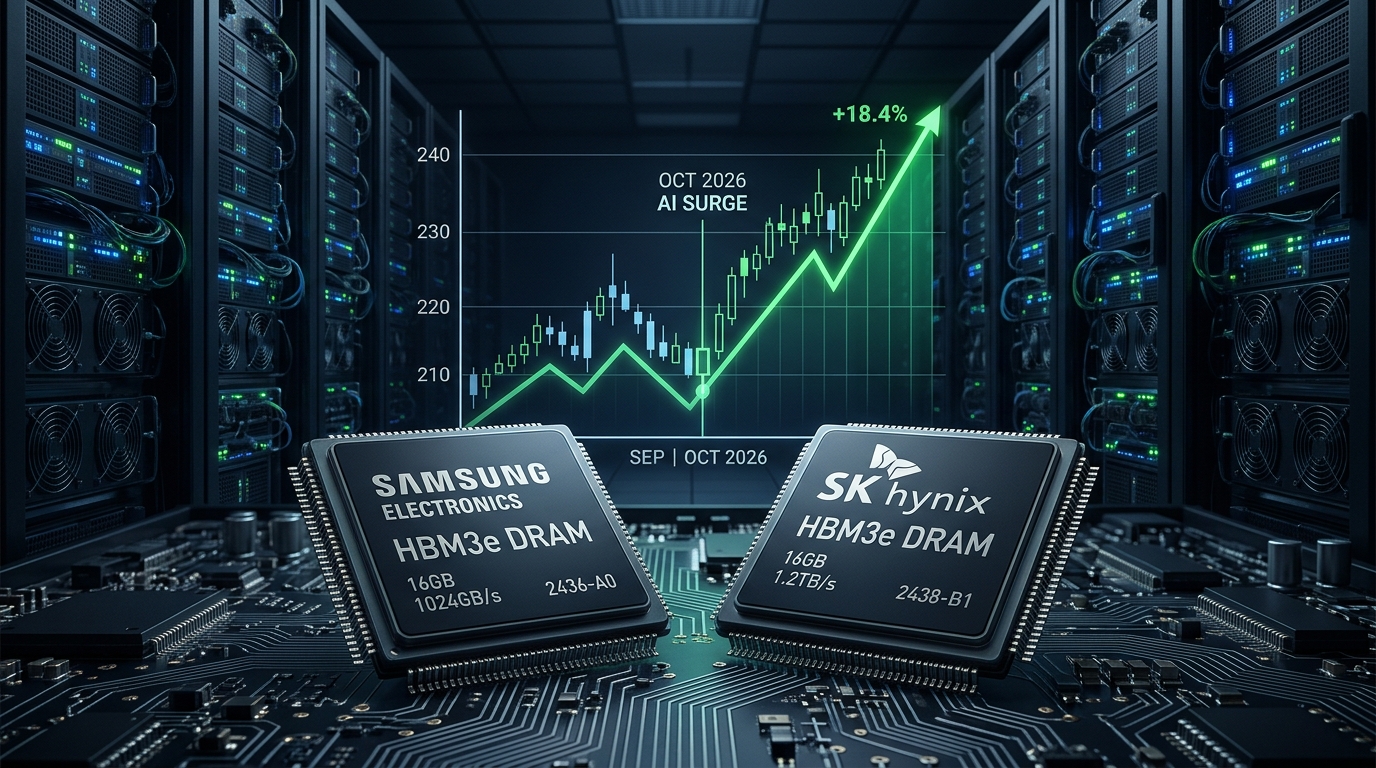
Samsung and SK Hynix Shares Gain 5% After Anthropic Filing Boosts AI Chip Demand
Samsung Electronics and SK Hynix shares are attracting investor attention as artificial intelligence spending reshapes the semiconductor market. A reported 5% gain following an Anthropic filing highlights growing interest in companies supplying AI infrastructure.
The development also reflects a broader investment trend. As AI companies expand their computing capabilities, demand for advanced memory chips continues to attract market attention.
Why Samsung and SK Hynix Shares Are Rising
Samsung Electronics and SK Hynix are major players in the global memory semiconductor industry. Both companies supply components that support data centers, cloud computing, and AI workloads.
However, investors increasingly focus on high-bandwidth memory, commonly known as HBM. These specialized chips help AI accelerators process large amounts of data efficiently.
Consequently, expectations for stronger AI infrastructure spending can influence semiconductor stock prices. When investors anticipate higher chip demand, memory manufacturers may benefit from improved earnings expectations.
Nevertheless, a stock price increase does not automatically confirm stronger revenue or profits. Investors must examine the underlying announcement and company fundamentals before drawing conclusions.
How Anthropic’s Filing Could Affect Semiconductor Stocks
Anthropic develops artificial intelligence models and related products. Its business depends on substantial computing resources, including advanced processors and supporting memory technologies.
Therefore, disclosures about Anthropic’s business, financing, infrastructure plans, or computing requirements can attract investor attention. Market participants may interpret such information as a signal of future AI investment.
However, the connection between an Anthropic filing and Samsung or SK Hynix stock performance requires careful verification. A filing does not necessarily establish a direct purchase agreement with either manufacturer.
Instead, investors may respond to the potential implications for the wider AI supply chain. This includes chip designers, memory manufacturers, server suppliers, and data center operators.
Why AI Companies Need High-Bandwidth Memory
Modern AI systems process enormous datasets and perform complex calculations. These workloads require fast communication between processors and memory.
High-bandwidth memory helps address this challenge by delivering large amounts of data to AI accelerators. As a result, HBM has become an important component of advanced AI computing systems.
Moreover, demand can increase as companies train larger models and serve more users. AI inference, which involves running trained models, also requires substantial computing capacity.
This creates opportunities for semiconductor manufacturers that can deliver reliable, high-performance memory products. However, production capacity, manufacturing costs, and competition remain important considerations.
Samsung vs. SK Hynix in the AI Memory Market
Samsung Electronics and SK Hynix are leading rivals in the worldwide memory-chip industry. Both companies are investing in technologies designed to support increasingly demanding AI workloads.
Samsung has a broad semiconductor business that includes memory, foundry services, and other chip technologies. This diversification gives the company exposure to several areas of the technology industry.
Meanwhile, SK Hynix has developed a strong position in high-bandwidth memory. Its performance in this segment can influence investor expectations about future growth.
However, the two companies face different opportunities and challenges. Their results depend on product quality, customer qualification, manufacturing yields, pricing, and execution.
Therefore, investors should compare their financial results and confirmed HBM developments rather than relying solely on daily share movements.
What the Share Gain Means for AI Investors
A reported 5% rise can indicate increased investor optimism. However, the significance depends on the trading session, market conditions, and the specific event behind the movement.
First, investors should verify the share-price data and the original Anthropic filing. Next, they should determine whether the market reaction reflects confirmed business developments or broader expectations.
Additionally, semiconductor stocks can experience sharp price swings. Positive AI news may already be reflected in valuations before investors have time to react.
Investors should also consider earnings forecasts, capital spending, competition, and broader economic conditions. These factors can influence long-term returns more than a single trading session.
Risks That Could Limit Further Growth
Despite strong interest in AI chips, the semiconductor industry faces several risks.
First, manufacturers must invest heavily in production equipment and advanced manufacturing processes. These investments can pressure margins if demand falls short of expectations.
Second, competitors continue developing alternative memory technologies and improving their own HBM products. Consequently, market leadership can change as customers evaluate performance and pricing.
Third, AI infrastructure spending may fluctuate. If major technology companies reduce investment, demand expectations could weaken across the semiconductor supply chain.
Finally, geopolitical tensions and export restrictions can affect manufacturing, sales, and access to important markets. Investors should account for these uncertainties when evaluating both companies.
What to Watch Next
Investors should monitor upcoming earnings reports from Samsung Electronics and SK Hynix. Revenue growth, operating margins, and memory pricing can help reveal whether AI demand is translating into financial results.
They should also watch announcements about HBM production, customer qualifications, and capacity expansion. These developments provide more concrete evidence than market speculation alone.
Furthermore, the original Anthropic filing deserves close attention. Its contents must establish what changed and whether that development has a meaningful connection to semiconductor demand.
Conclusion
The reported 5% gain in Samsung and SK Hynix shares highlights the market’s sensitivity to developments across the AI industry. Growing demand for advanced memory could support both companies as AI infrastructure expands.
However, investors should verify the reported price movement and examine the filing before assuming a direct connection. Ultimately, sustained demand, competitive execution, and profitable growth will determine whether current optimism lasts.