What Is GraphQL and Why Developers Are Abandoning REST APIs for It
Modern applications depend heavily on APIs to move data between websites, mobile apps, cloud services, and backend systems. For years, REST APIs have been the standard choice for building these connections. However, GraphQL has emerged as a powerful alternative, especially for applications that need flexible data access and efficient communication.
GraphQL does not simply replace REST. Instead, it changes how applications request and receive data. Developers can specify exactly which information they need rather than relying on fixed server responses. This approach can reduce unnecessary data transfer and make complex applications easier to manage.
What Is GraphQL?
GraphQL is an API query language and runtime originally developed by Facebook and released publicly in 2015. It allows clients to request specific fields from an API through a strongly typed schema.
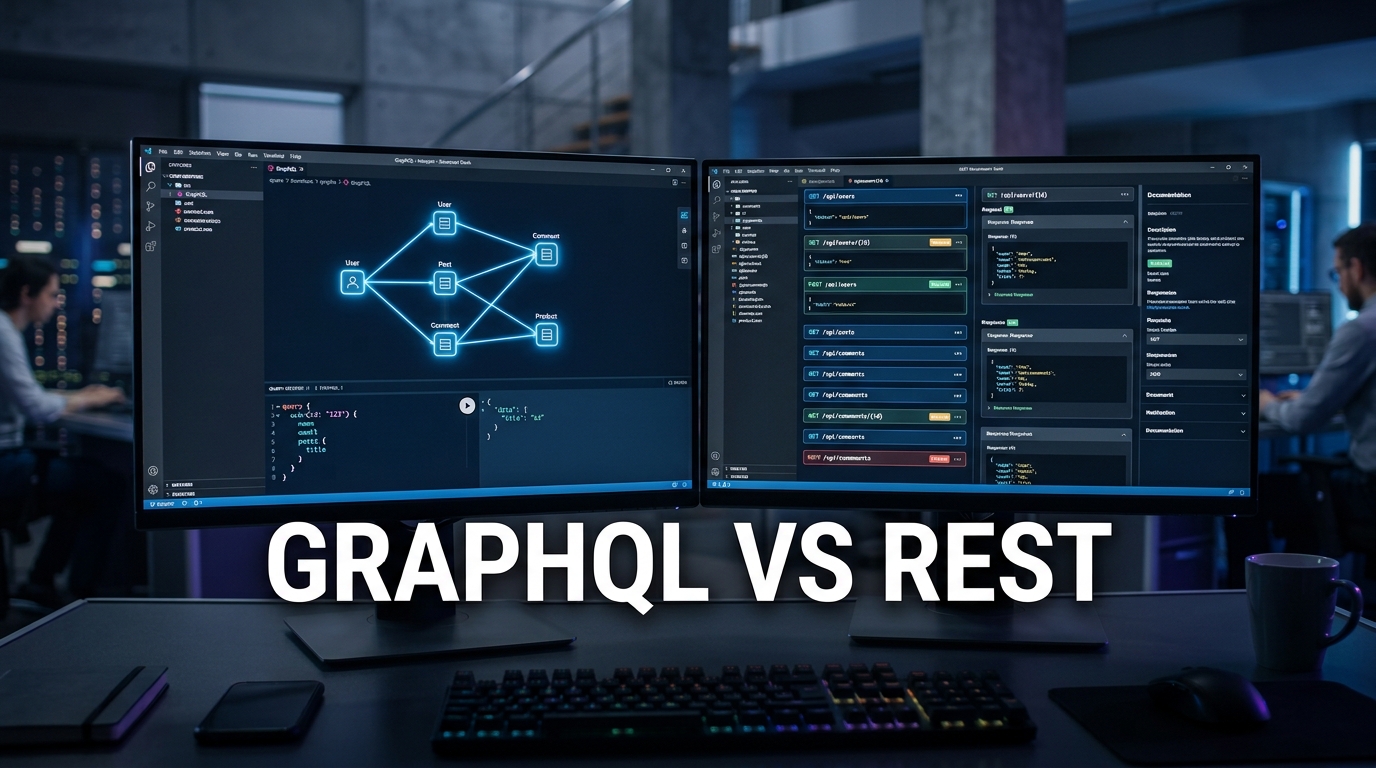
With a traditional REST API, different URLs commonly represent different resources. For example, an application might use one endpoint for users, another for posts, and another for comments.
GraphQL usually exposes a single endpoint. The client sends a query describing the exact data it needs, and the server returns a response that closely matches that request.
For example, a client could request a user’s name and their latest posts in one GraphQL query instead of making several REST requests.
This makes GraphQL particularly useful when applications have complicated relationships between data.
How GraphQL Works
GraphQL is built around a schema that defines available data and operations. The schema tells developers what types exist, which fields are available, and what relationships exist between those fields.
A GraphQL API generally supports three main operation types:
- Queries for retrieving data
- Mutations for creating, updating, or deleting data
- Subscriptions for receiving real-time updates
A simplified query might look like this:
query {
user(id: “123”) {
name
posts {
title
}
}
}
The client requests only the required fields. If the application does not need a user’s email address, it simply leaves that field out.
The server then resolves the requested fields and returns structured data.
Why Developers Are Moving Beyond Traditional REST APIs
REST remains widely used, but developers sometimes encounter limitations when applications become larger and more data-intensive.
One common problem is over-fetching. A REST endpoint may return significantly more information than an application actually needs.
Imagine a mobile application that needs only a user’s name and profile image. If the REST endpoint returns dozens of additional fields, the application receives unnecessary data.
GraphQL addresses this by allowing clients to specify the fields they require.
Another problem is under-fetching. An application may need information from several related resources. With REST, this can require multiple API requests.
For example, displaying a product page might require:
- Product information
- Seller information
- Reviews
- Inventory data
- Related products
Depending on the API design, these resources may be available through separate endpoints.
GraphQL can often retrieve related information through a single query.
GraphQL vs REST API
The biggest difference between GraphQL and REST is how they approach data retrieval.
| Feature | GraphQL | REST |
| Endpoints | Often one endpoint | Usually multiple endpoints |
| Data selection | Client chooses fields | Server defines response |
| Over-fetching | Reduced | More common |
| Under-fetching | Reduced in many cases | More common |
| Schema | Strongly typed | Depends on implementation |
| Versioning | Often handled through schema evolution | Commonly uses versions |
| Real-time updates | Supported through subscriptions | Usually requires additional mechanisms |
| Learning curve | Higher initially | Generally familiar |
Neither approach is automatically better for every project. The right choice depends on application requirements, team experience, infrastructure, and API complexity.
GraphQL Reduces Unnecessary Data Transfer
One of GraphQL’s most attractive features is its ability to give clients control over the response shape.
Consider a mobile application operating on a slow network. Sending unnecessary fields repeatedly can increase bandwidth consumption and affect performance.
GraphQL queries can request only the information required by a particular screen.
For example, a product listing might request:
{
products {
name
price
image
}
}
The response contains those requested fields instead of automatically returning every available product attribute.
This can be particularly useful for mobile applications and interfaces that operate across different devices.
GraphQL Makes Complex Relationships Easier to Query
Modern applications rarely contain isolated pieces of information. Users have orders, orders contain products, products have reviews, and reviews may have authors.
REST can represent these relationships effectively, but developers may need several requests or specially designed endpoints.
GraphQL represents relationships directly within its schema.
A query can therefore traverse related data in a structured way.
For example:
{
user(id: “123”) {
name
orders {
id
products {
name
price
}
}
}
}
This makes GraphQL attractive for applications where users frequently need connected data.
Strong Typing Improves API Development
GraphQL uses a strongly typed schema. Every field has a defined type, such as a string, integer, Boolean value, object, or custom type.
This provides several development advantages.
Tools can inspect the schema and understand what the API supports. Developers can receive better autocomplete, validation, and documentation while writing queries.
If a requested field does not exist, the query can be rejected rather than silently producing an unexpected response.
This can make large APIs easier to understand and maintain.
GraphQL Can Improve Frontend Development
Frontend applications often evolve faster than backend APIs. A design team may add a new component that requires information the existing endpoint was not designed to return.
With a traditional REST architecture, developers may need to create or modify an endpoint.
GraphQL provides more flexibility because the frontend can request fields already exposed through the schema.
This is especially useful for applications built with modern frontend frameworks where different screens require different combinations of data.
Instead of creating a new endpoint for every screen, teams can often reuse the same GraphQL API with different queries.
GraphQL Is Not Always Better Than REST
Despite its advantages, GraphQL is not a universal replacement for REST.
REST can be simpler for straightforward APIs. A small service with predictable resources may not benefit enough from GraphQL to justify its additional complexity.
GraphQL also introduces concepts that development teams need to understand, including schemas, resolvers, query complexity, caching strategies, authorization, and performance optimization.
Poorly designed GraphQL queries can also create performance problems.
For example, deeply nested queries can force the server to retrieve large amounts of related information. Developers therefore need appropriate limits and monitoring.
GraphQL Caching Can Be More Complicated
REST APIs often benefit from established HTTP caching mechanisms because individual resources commonly have predictable URLs.
GraphQL frequently uses a single endpoint, which can make traditional HTTP caching less straightforward.
Modern GraphQL implementations can still use caching at different layers, including client-side caching, persisted queries, gateway caching, and application-level caching.
However, caching strategy needs to be designed carefully.
This is one area where REST can remain attractive for APIs that depend heavily on conventional HTTP caching behavior.
Security Considerations for GraphQL
GraphQL introduces several security considerations that developers should address.
Because clients can construct queries, servers should avoid allowing unlimited query complexity. Depth limits, query cost analysis, authentication, authorization, rate limiting, and input validation can help protect the API.
Sensitive fields should also be protected at the resolver level.
Simply hiding fields from documentation is not sufficient security. The server must enforce access controls when a request is processed.
When Should a Developer Choose GraphQL?
GraphQL can be particularly useful when:
- Applications require data from multiple related resources.
- Different clients need different data fields.
- Mobile bandwidth efficiency is important.
- Frontend requirements change frequently.
- The API contains complex relationships.
- Multiple platforms consume the same backend.
- Developers want a strongly typed API schema.
REST may remain a practical choice when:
- The API is small and straightforward.
- Resources map naturally to HTTP endpoints.
- Conventional HTTP caching is important.
- The team already has mature REST infrastructure.
- Clients generally need predictable responses.
The decision should therefore be based on the application’s actual requirements rather than assuming one technology is always superior.
The Future of GraphQL and REST APIs
GraphQL has changed how developers think about API design. Instead of defining every response around a fixed endpoint, it allows clients to describe the data they require.
That flexibility has made it popular for complex web applications, mobile applications, and platforms with multiple clients.
However, REST is not disappearing. It remains deeply established across software development and continues to work well for many services.
The more accurate trend is that developers now have more API architecture choices. GraphQL is becoming an important option where flexible queries, connected data, and client-specific responses provide meaningful advantages.
Final Thoughts
GraphQL offers a flexible approach to API development by allowing clients to request precisely the data they need. It can reduce unnecessary requests, simplify access to related data, and provide a strongly typed schema for modern applications.
At the same time, GraphQL introduces additional complexity around security, caching, query optimization, and infrastructure.
For simple services, REST can remain an efficient and familiar solution. For applications with complex data relationships and multiple clients, GraphQL can provide a different development model that better matches modern application requirements.
The key difference is not simply GraphQL versus REST. It is choosing an API architecture that matches how an application actually consumes and manages data.