
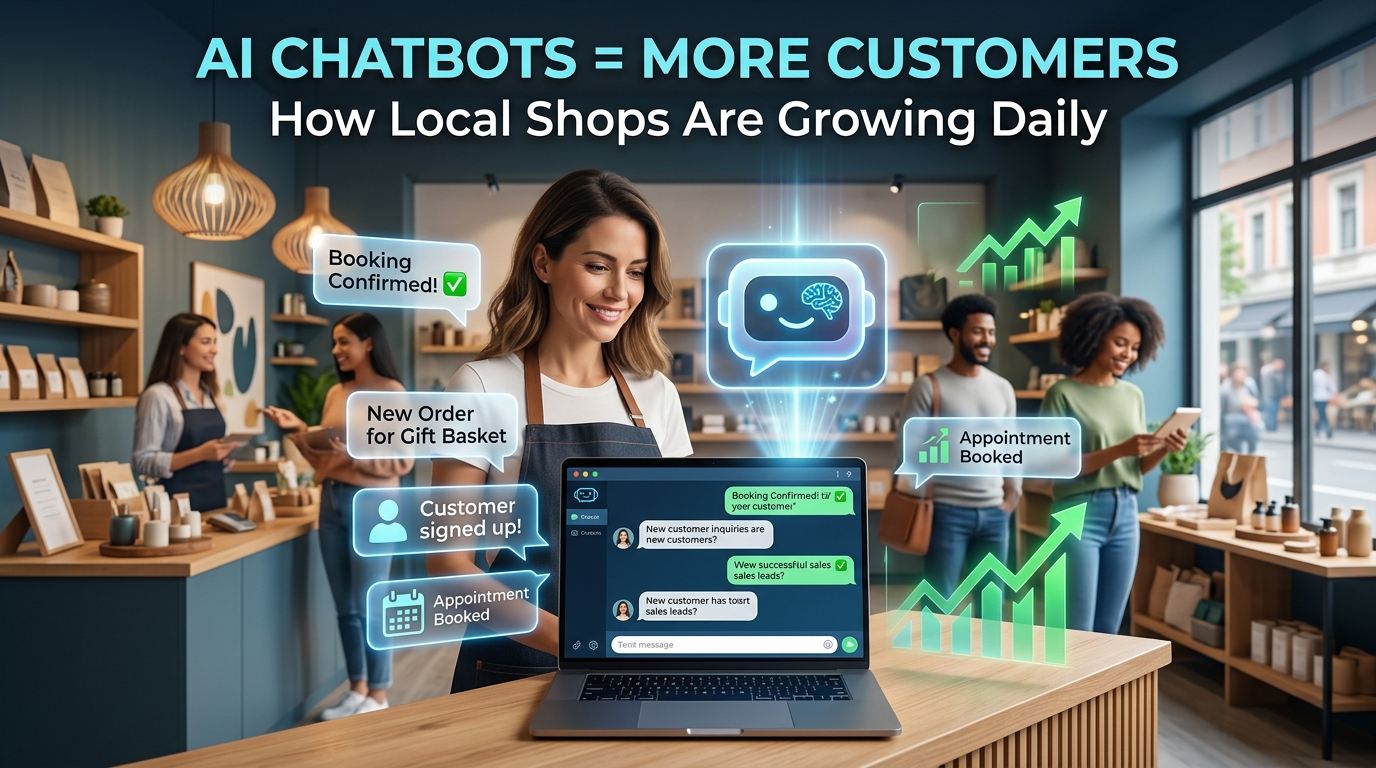
How Local Shops Are Using AI Chatbots to Get More Customers Daily
Running a local shop is not easy. Customers ask questions at all hours, staff members get busy, messages go unanswered, and potential buyers may choose a competitor simply because they did not receive a quick response.
This is where AI chatbots are becoming useful.
Local businesses are using AI chatbots to answer customer questions, recommend products, collect leads, book appointments, and provide support around the clock. A small shop does not need a large customer service team to respond to every basic question.
When used properly, an AI chatbot can help a business respond faster and create more opportunities to turn interested visitors into paying customers.
This article explains how local shops are using AI chatbots to get more customers daily and how small businesses can use this technology effectively.
What Is an AI Chatbot?
An AI chatbot is software that can communicate with customers through text and, in some cases, voice.
Unlike a basic chatbot that only follows a fixed set of rules, an AI-powered chatbot can often understand natural language and respond more flexibly to different questions.
For example, a customer might ask:
- What time do you close today?
- Do you have this product in stock?
- How much does delivery cost?
- Can I book an appointment?
- Where is your shop located?
- What is your return policy?
An AI chatbot can provide answers based on the information it has been given.
For local businesses, this can reduce the number of repetitive questions employees need to answer manually.
Why AI Chatbots Are Useful for Local Shops
Small businesses often have limited staff and limited time.
A customer may send a message while employees are helping people in the store. If nobody responds quickly, that potential customer may lose interest.
An AI chatbot can help by handling basic conversations immediately.
This does not mean a chatbot needs to replace human employees. Instead, it can handle simple tasks while staff members focus on customers and more complicated problems.
Some of the biggest benefits include:
- Faster customer responses
- 24/7 availability
- Fewer missed leads
- Automated appointment bookings
- Better product recommendations
- Reduced repetitive work
- Improved customer experience
Answering Customer Questions Instantly
One of the simplest ways to use an AI chatbot is to answer frequently asked questions.
A local restaurant may receive questions about:
- Opening hours
- Menu items
- Reservations
- Delivery areas
- Special offers
A clothing shop may receive questions about:
- Product availability
- Sizes
- Prices
- Returns
- Store location
Instead of making customers wait for a staff member, the chatbot can provide an immediate response.
Fast answers can make a major difference, especially when customers are comparing several businesses.
Turning Website Visitors Into Leads
Many people visit a business website without making a purchase.
An AI chatbot can start a conversation and help the visitor find what they need.
For example, a visitor may be looking for a specific service.
The chatbot could ask:
“What service are you looking for today?”
Based on the answer, it can guide the visitor to the correct page, collect contact information, or offer to schedule an appointment.
This creates a smoother path between visiting a website and becoming a potential customer.
Helping Customers Find the Right Products
Local shops with many products can use AI chatbots as digital shopping assistants.
Instead of forcing visitors to search through dozens of categories, a chatbot can ask simple questions.
For example:
- What are you looking for?
- What is your budget?
- Who is the product for?
- Do you have a preferred brand?
Using the responses provided, the chatbot is able to suggest products that are most suitable.
A customer who quickly finds the right product is more likely to complete a purchase.
Booking Appointments Automatically
Appointment-based businesses can save time by using AI chatbots to handle basic booking tasks.
This can be useful for:
- Salons
- Clinics
- Repair services
- Consultants
- Tutors
- Fitness businesses
- Home service providers
The chatbot can collect basic information such as the customer’s preferred date, service, and contact details.
If connected to a scheduling system, it may also help customers view available times and book appointments.
This reduces the number of manual messages employees need to handle.
Following Up With Potential Customers
Not every customer makes a decision immediately.
Someone may ask about a product or service and then leave without buying.
With the customer’s permission and appropriate communication practices, businesses can use automated follow-ups to continue the conversation.
For example:
- “Would you like more information about this service?”
- “Do you still need help choosing a product?”
- “We have availability this week if you would like to book.”
The goal should not be to spam customers.
Follow-up messages should be relevant, useful, and sent only through appropriate channels.
Providing Support After Business Hours
A local shop may close at 8 PM, but customers may still search for information later.
An AI chatbot can continue answering basic questions after employees leave.
For example, it can provide:
- Store hours
- Location information
- Product details
- Delivery information
- Return policies
- Appointment availability
The next morning, staff members can focus on conversations that require human assistance.
This can make a small business appear more responsive without requiring employees to work around the clock.
Using AI Chatbots on Social Media
Customers do not always visit a website first.
Many local businesses receive messages through social media platforms.
An AI-powered assistant can help organize and respond to common questions across these communication channels.
For example, a customer might send a message asking:
“Are you open on Sunday?”
The chatbot can provide an immediate answer.
If the customer asks a complex question, the conversation can be transferred to a human employee.
This combination of automation and human support can improve response times without making every interaction feel completely automated.
Helping Customers Discover Local Services
An AI chatbot can also guide customers toward the most relevant service.
Imagine a home repair business offering:
- Plumbing
- Electrical repairs
- Painting
- Air conditioning services
A visitor may not know exactly which service they need.
The chatbot can ask a few basic questions and guide them toward the appropriate option.
For example:
“What problem are you experiencing?”
Based on the answer, the chatbot can recommend the relevant service and encourage the visitor to request a quote.
This makes it easier for customers to take the next step.
Collecting Useful Customer Information
A chatbot can collect information that helps a business understand customer needs.
Depending on the business and appropriate privacy practices, this may include:
- Name
- Contact details
- Product interest
- Service requirements
- Preferred appointment time
- Frequently asked questions
Over time, this information can help identify common customer problems.
For example, if many customers ask whether a product is available in a specific size, the business may decide to stock more of that item.
AI chatbots can therefore support both customer service and business decision-making.
Creating a Better Customer Experience
Customers do not always want a long conversation.
Sometimes they simply want a quick answer.
A good AI chatbot should make the process easier, not more frustrating.
The best chatbots usually:
- Answer clearly
- Ask simple questions
- Avoid unnecessary messages
- Provide useful options
- Transfer complex issues to a human
- Avoid pretending to know information they do not have
Accuracy is extremely important.
A chatbot that gives incorrect prices, store hours, or product information can damage customer trust.
How AI Chatbots Help Small Businesses Save Time
Consider how many times a business owner answers the same questions every week.
Questions such as:
- What are your opening hours?
- Where are you located?
- How much does this cost?
- Do you offer delivery?
- How can I book?
Although each task might only require a few minutes to complete, collectively, they accumulate over time.
An AI chatbot can handle many repetitive conversations automatically.
This gives employees more time to focus on:
- Serving customers
- Completing orders
- Managing inventory
- Solving difficult problems
- Growing the business
For a small team, saving even a few hours each week can be valuable.
Choosing the Right AI Chatbot for a Local Business
Not every business needs a complicated system.
Before choosing a chatbot, consider what problem you want to solve.
Ask:
- Do customers frequently ask the same questions?
- Do we miss messages after business hours?
- Do we need more leads?
- Do customers need help booking appointments?
- Do we have a large product catalog?
- Do we need human support for complex questions?
Start with one or two clear goals.
For example, a local salon may begin by automating appointment questions.
A local electronics shop may begin by helping customers find products.
Starting small makes it easier to measure results.
Common Mistakes to Avoid
Giving the Chatbot Too Much Responsibility
A chatbot should not make important decisions that require human judgment.
Complex complaints, refunds, sensitive customer issues, and unusual requests may need human support.
Using Outdated Information
A chatbot is only as useful as the information available to it.
Keep details such as:
- Opening hours
- Prices
- Product availability
- Policies
- Contact information
up to date.
Making Conversations Too Complicated
Customers should not need to answer ten questions to find basic information.
Keep conversations simple and focused.
Forgetting About Privacy
Businesses should be careful when collecting customer information.
Only request information that is genuinely necessary, protect it appropriately, and be transparent about how customer data is handled.
Removing Human Support Completely
Some customers prefer speaking with a real person.
Always provide a clear option for customers to contact a human when necessary.
A Simple AI Chatbot Strategy for Local Shops
You do not need to automate everything immediately.
Start with this simple process.
Step 1: List Your Most Common Questions
Look at customer messages and write down the questions you receive most often.
Step 2: Create Accurate Answers
Prepare short, clear answers for each question.
Step 3: Identify Sales Opportunities
Decide where the chatbot can naturally recommend:
- A product
- A service
- An appointment
- A consultation
- A special offer
Step 4: Add Human Handoff
Create a simple process for transferring complicated conversations to a staff member.
Step 5: Monitor the Results
Track whether the chatbot helps increase:
- Customer inquiries
- Leads
- Appointments
- Sales
- Response speed
Then improve the chatbot based on real customer conversations.
The Future of AI Chatbots for Local Businesses
AI chatbots are becoming more capable of understanding natural conversations and assisting customers.
For local shops, the biggest opportunity is not necessarily replacing employees.
It is using AI to make small teams more efficient.
A chatbot can act as a first point of contact, answer basic questions, guide customers, and collect useful information.
Employees can then focus on situations where human knowledge and personal service matter most.
As AI tools become easier to use, more small businesses may begin using chatbots as part of their daily customer service and marketing strategy.
Final Thoughts
AI chatbots can help local shops attract and serve more customers by making communication faster and easier.
They can answer common questions, guide visitors toward products, collect leads, book appointments, and provide support outside normal business hours.
The key is to use automation carefully.
A successful chatbot should provide accurate information, solve simple problems quickly, and connect customers with a real person when necessary.
For many local businesses, the best approach is to start small.
Choose one problem, such as missed customer messages or appointment booking, and build the chatbot around that need. Then track the results and expand its role over time.
When combined with good customer service and accurate business information, an AI chatbot can become a useful tool for turning more daily conversations into real customers.