

What Is a Real Estate Agent AI Prompt Library and How to Build One
Real estate agents have a long list of responsibilities every day. They answer client questions, write property descriptions, create social media posts, follow up with leads, prepare emails, and research local markets. These tasks are important, but they can also take up a lot of time.
Artificial intelligence is changing the way many real estate professionals work. Tools powered by AI can help agents create content, organize ideas, and complete repetitive tasks faster. However, getting useful results from AI often depends on asking the right questions.
This is where a Real Estate Agent AI Prompt Library becomes valuable.
Instead of creating a new prompt every time you need help, you can build a collection of proven prompts for your most common tasks. This article explains what an AI prompt library is, why real estate agents need one, and how to build a simple and effective library for everyday work.
What Is a Real Estate Agent AI Prompt Library?
A Real Estate Agent AI Prompt Library is an organized collection of pre-written instructions that a real estate professional can use with AI tools.
A prompt tells an AI tool what you want it to do. For example, you might ask AI to write a property listing, create a follow-up email, or suggest social media ideas.
Instead of typing the same instructions repeatedly, you save your best prompts in one organized place.
Your prompt library might include categories such as:
- Property listing descriptions
- Lead follow-up messages
- Social media content
- Email marketing
- Client communication
- Market research
- Open house promotion
- Video scripts
- Blog content
Think of it as a personal toolkit. When you need help with a task, you simply find the right prompt, customize it, and use it.
Why Do Real Estate Agents Need an AI Prompt Library?
Time is one of the most valuable resources for a real estate agent. Many daily tasks involve writing and communication, which can be repetitive.
An AI prompt library can help reduce the time spent starting from a blank page.
For example, instead of thinking about how to write a follow-up message for every new lead, you can use a proven prompt and personalize the final result.
This creates a more efficient workflow while allowing you to spend more time on activities that require a human touch, such as building relationships and understanding client needs.
Save Time on Repetitive Tasks
Real estate agents often perform similar tasks again and again. They write listing descriptions, respond to inquiries, and create marketing content.
A saved prompt can give you a starting point within seconds.
You do not have to reinvent the process every time. This can make your daily workflow faster and more consistent.
Improve Content Consistency
A strong personal brand is important in real estate. Your emails, social media posts, and marketing materials should have a consistent voice.
A prompt library can include instructions about your preferred writing style.
For example:
Write in a friendly, professional, and local tone. Use simple language and avoid exaggerated claims.
Adding these instructions to your saved prompts can help maintain consistency across different types of content.
Make AI Easier to Use
Many people try AI once or twice and become disappointed because the results are too generic.
Usually, the problem is not the technology. The instructions may simply be too vague.
A good prompt provides context, details, and clear expectations. When you save successful prompts, you do not need to learn the same lessons repeatedly.
Over time, your library becomes smarter because you keep improving the prompts based on the results you receive.
What Should You Include in Your AI Prompt Library?
The best prompt library is built around the tasks you actually perform.
You do not need hundreds of prompts on the first day. Begin by focusing on the tasks and areas where you dedicate the majority of your time.
Property Listing Prompts
Property descriptions are an important part of real estate marketing.
A useful prompt can ask AI to create a clear and attractive description based on details you provide.
For example:
Prompt idea:
“Craft a compelling and polished real estate listing for a [property type] situated in [location]. Highlight the key features, lifestyle benefits, and nearby amenities. Use clear, natural language and avoid misleading claims.”
Always review the final content carefully to ensure that it is accurate and complies with local advertising rules.
Lead Follow-Up Prompts
Following up with potential clients is essential, but writing similar messages every day can become tiring.
Your library can include prompts for:
- New online leads
- Buyers who have stopped responding
- Open house visitors
- Previous clients
- Referral follow-ups
You can create different versions depending on the situation and the level of urgency.
Social Media Prompts
Social media can help real estate agents stay visible and build trust in their local market.
AI can help generate ideas for posts, captions, short videos, and educational content.
For example:
“Create 10 helpful social media post ideas for a real estate agent serving [location]. Focus on local home-buying tips, market education, and community information. Make the ideas useful and easy to understand.”
The best content should still reflect your real experience and local knowledge.
Email Marketing Prompts
Email remains a useful way to stay connected with leads and past clients.
Your AI prompt library can include prompts for newsletters, property announcements, market updates, and client follow-ups.
You can also save a prompt that helps you turn one long article into several short email ideas.
This allows you to get more value from your existing content.
How to Build a Real Estate Agent AI Prompt Library
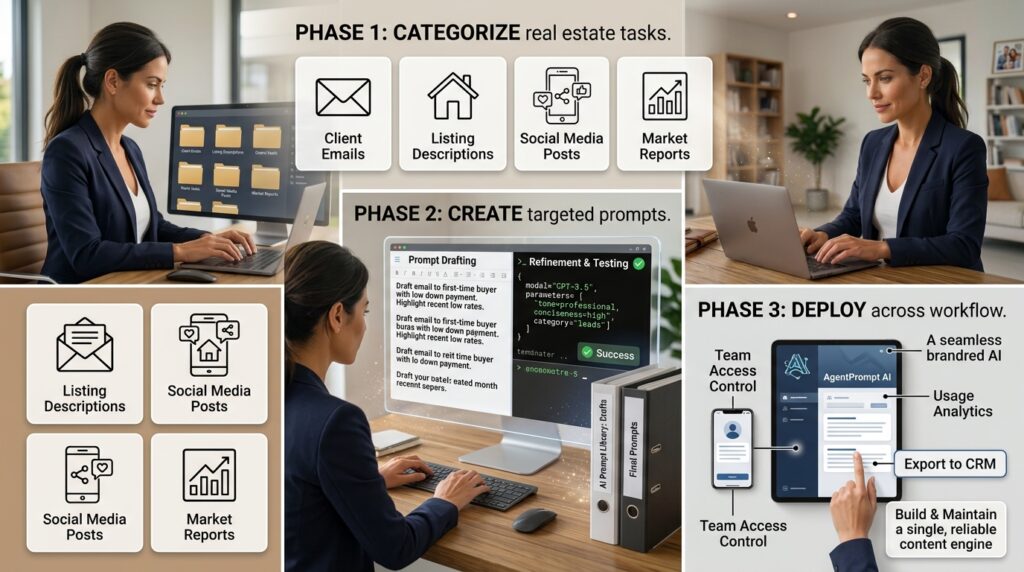
Building your own library does not have to be complicated. Follow these simple steps.
Step 1: List Your Most Common Tasks
Begin by noting down the recurring tasks you perform on a weekly basis.
Ask yourself:
- What takes too much time?
- What do I write repeatedly?
- Which tasks are difficult to start?
- Where could AI help me brainstorm or create a first draft?
Your answers will help you decide which prompts to create first.
Step 2: Create Categories
Organize your prompts into simple categories.
For example:
- Listings
- Leads
- Social Media
- Market Content
- Client Communication
- Video Marketing
Clear categories make it easier to find the right prompt when you need it.
You can store your prompt library in a document, spreadsheet, knowledge management tool, or another organized workspace.
Step 3: Build Prompts Using a Simple Formula
A useful AI prompt usually includes four important parts:
Role + Task + Context + Desired Result
For example:
- Role: Act as an experienced real estate marketing assistant.
- Task: Write a property description.
- Context: Here are the property details and target audience.
- Desired Result: Make it clear, engaging, professional, and easy to read.
This simple formula can dramatically improve the quality of your prompts.
How to Write Better Real Estate AI Prompts
The more useful information you provide, the easier it is for AI to create relevant content.
Instead of writing:
“Write a post about buying a home.”
Try something more specific:
“Create a warm and inviting 150-word social media message aimed at first-time homebuyers in [city]. Explain three things they should check before making an offer. Use simple language and end with a helpful question.”
Specific instructions usually lead to more useful results.
Test and Improve Your Prompts
Your first prompt does not have to be perfect.
Use it, review the results, and make improvements.
If the content sounds too formal, add instructions to make it more conversational. If the answers are too long, specify a word limit. If the information feels generic, provide more context about your audience and location.
Save your improved version in your library.
Over time, you will build a collection of prompts that work better for your specific business.
Keep Client Information Private
AI can be useful, but real estate professionals should be careful when using client information.
Avoid sharing unnecessary personal or confidential details with AI tools. Review the privacy settings and policies of the tools you use, and follow applicable laws and professional requirements.
A good rule is to provide only the information needed for the task.
For example, AI may help you draft a general follow-up email without needing sensitive personal details about a client.
Privacy and professional responsibility should always come before convenience.
AI Should Support Your Work, Not Replace You
AI can create a useful first draft, but it does not replace your experience, judgment, or local knowledge.
Real estate is built on trust and relationships. Clients want accurate information and personalized guidance.
Use AI to handle repetitive work, generate ideas, and speed up content creation. Then add your own expertise before publishing or sending anything.
Always review AI-generated content for accuracy, fairness, and compliance with relevant advertising and real estate regulations.
Start Small and Build Over Time
You do not need a massive AI prompt library to see results.
Start with five to ten prompts that solve your biggest daily problems. Once those prompts are working well, add more.
You might begin with:
- One listing description prompt
- Two lead follow-up prompts
- Two social media prompts
- One email prompt
- One video script prompt
Within a few weeks, you can build a practical library that saves time and makes your workflow more organized.
Common Mistakes to Avoid
Using the Same Generic Prompt for Everything
Different tasks require different instructions. A prompt for a property listing should not be used for client communication without adjustments.
Publishing AI Content Without Reviewing It
AI can make mistakes or create information that does not match your situation. Always check facts before publishing.
Forgetting Your Personal Voice
AI-generated content should not make your brand sound like everyone else. Add your personality, experience, and local expertise.
Ignoring Privacy and Professional Standards
Never let convenience lead to careless handling of confidential information. Build responsible practices into your AI workflow from the beginning.
Final Thoughts
A Real Estate Agent AI Prompt Library is a simple but powerful way to make AI more useful in your daily work.
Instead of starting from scratch every time, you can create a collection of tested prompts for listings, emails, social media, lead follow-ups, and other important tasks.
The secret is not having the largest collection of prompts. It is having the right prompts for the work you actually do.
Start small, organize your prompts clearly, test and improve them, and always add your human expertise before sharing the final result.
When used responsibly, an AI prompt library can help real estate agents save time, create more consistent content, and focus on what matters most—building strong relationships and helping clients make confident decisions.
The future of real estate is not about AI replacing agents. It is about smart professionals using AI tools to work more efficiently while delivering the personal service that technology cannot replace.