
Rate Limiting in API Design: How It Actually Works
A single misbehaving script accidentally enters an infinite loop and starts hammering a company’s API with thousands of requests per second, and within moments, the shared infrastructure serving every other legitimate customer starts slowing to a crawl.
Without rate limiting in place, one careless mistake from a single user can degrade service for literally everyone else sharing that same system.
What Rate Limiting Actually Means
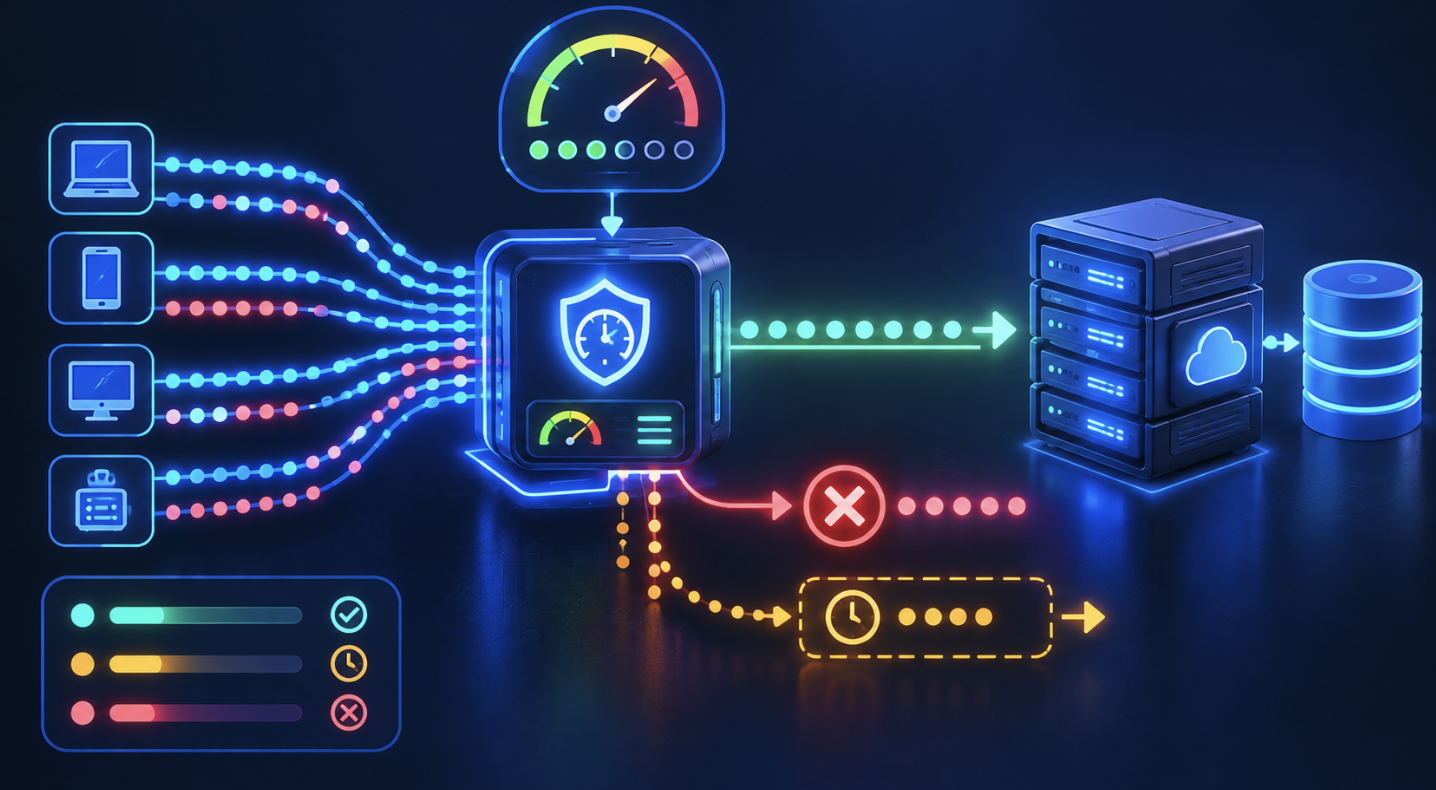
Rate limiting is a technique that restricts how many requests a client can make to an API within a specific time period, protecting the underlying system from being overwhelmed by excessive traffic, whether from misuse, bugs, or actual malicious activity. This protective mechanism helps ensure fair resource access across multiple users while protecting overall system stability and performance.
This protective function explains why rate limiting has become such standard practice across virtually all public and many internal APIs, given that without this protection, a single client’s excessive requests, whether accidental like our infinite loop scenario or malicious, could degrade service quality for every other user sharing that same underlying infrastructure.
Why APIs Need This Kind of Protection
Without limits, a single client experiencing a bug or deliberately behaving maliciously could consume disproportionate system resources. This excessive consumption can degrade performance for other legitimate users sharing the same infrastructure. Rate limiting specifically prevents any single client from monopolizing shared resources at the expense of everyone else.
Shared API infrastructure serves numerous different clients simultaneously, meaning resource consumption by any single client directly affects the resources available for every other client using that same system, making rate limiting an essential fairness mechanism, not simply a technical protective measure alone.
Common Approaches to Actually Implementing Rate Limiting
Fixed window approaches count requests within specific, defined time periods, resetting the count at set intervals. Sliding window approaches provide more precise rate limiting by considering a continuously moving time window rather than fixed reset points.
Token bucket approaches allow some flexibility for brief traffic bursts while still maintaining an overall average rate limit.
How Rate Limits Typically Get Communicated to Clients
APIs typically communicate rate limit information through specific HTTP response headers, indicating current usage and remaining available requests. When a client exceeds their limit, the API typically returns a specific error response indicating this limit has been exceeded. Understanding these communication patterns helps developers build applications that appropriately handle rate limiting.
This header-based communication deserves particular emphasis, since well-designed APIs provide, proactive visibility into current rate limit status, letting well-behaved client applications actually adjust their request patterns before actually hitting the limit, rather than simply discovering the limit reactively only after already receiving an error response.
Why Different Endpoints Often Have Different Rate Limits
Some API operations require more computational resources than others, justifying different specific limits. Particularly sensitive or resource-intensive operations often warrant more restrictive rate limiting compared to simpler, lightweight operations.
Understanding your specific API’s particular rate limit structure across different endpoints matters for building applications that work reliably within these constraints.
How Clients Should Actually Handle Rate Limit Responses
Well-designed client applications should detect rate limit responses and implement appropriate retry logic with delays. Simply retrying immediately after hitting a rate limit typically just triggers the same limit again. Understanding proper backoff strategies helps client applications work considerably more effectively within API rate constraints.
Implementing exponential backoff, where retry delays increase progressively after repeated rate limit responses, represents a widely recommended practice for handling this situation gracefully, since this approach helps ensure client applications don’t simply continue hammering an API that has already indicated it needs the client to slow down considerably.
Trade-Offs API Providers Navigate When Setting Rate Limits
Overly restrictive rate limits can frustrate legitimate users trying to accomplish reasonable tasks. Overly generous limits may fail to protect system resources during periods of high demand or actual misuse.
Finding appropriate rate limit levels requires understanding of typical legitimate usage patterns alongside realistic system capacity constraints.
How Rate Limiting Differs for Authenticated Versus Anonymous Users
APIs often apply different rate limits for authenticated users compared to anonymous or unauthenticated requests. Authenticated users may receive higher limits, reflecting greater accountability and typically more legitimate usage patterns.
Understanding this distinction helps clarify why authentication sometimes provides practical benefits beyond simply access control alone.
What Would Have Happened Without Rate Limiting During Our Opening Incident
Without rate limiting in place, that infinite loop would have continued hammering the API indefinitely, consuming an ever-growing share of shared infrastructure capacity while every other legitimate customer’s requests slowed progressively, potentially cascading into an outage affecting the entire platform.
With proper rate limiting in place, that misbehaving script would have quickly hit its allotted limit, started receiving clear rate-limit error responses instead of successful requests, and the damage would have stayed contained to that one script’s own frustrated requests rather than spreading outward to degrade service for every other customer sharing the platform.
How Rate Limiting Actually Gets Implemented Across Distributed Infrastructure
Implementing rate limiting correctly becomes more complicated once an API runs across multiple servers behind a load balancer, since tracking request counts requires some shared, centrally accessible mechanism that every server instance can consult, rather than each server independently tracking counts that would only reflect a fraction of a specific client’s total actual request volume across the entire distributed system.
This shared tracking typically relies on a fast, centrally accessible data store that all API server instances can query and update with minimal added delay, since the rate limiting check itself needs to happen quickly enough that it doesn’t meaningfully slow down every single request passing through the system.
Choosing and properly scaling this shared tracking infrastructure represents engineering work in its own right, particularly for platforms handling enough traffic that the rate limiting mechanism itself needs to avoid becoming a new bottleneck.
Why Some APIs Implement Rate Limiting at Multiple Different Levels Simultaneously
Sophisticated API platforms often apply rate limiting at several distinct levels simultaneously, rather than relying on just one single, uniform limit. A platform might apply an overall limit per API key, a separate, more restrictive limit specifically for particularly expensive operations, and potentially even a global limit protecting the entire system during periods of unusually high aggregate demand across all customers combined.
This layered approach lets platforms protect against different specific failure scenarios simultaneously, since a single uniform limit might adequately protect against one misbehaving client while still leaving the system vulnerable to aggregate load from many well-behaved clients simultaneously making legitimate, though collectively excessive, requests during a period of unusual overall demand. Understanding which specific limits actually apply to your particular usage pattern matters considerably for building applications that work reliably within a platform’s complete, layered rate limiting structure.
How Rate Limiting Strategy Connects to Broader API Business Models
Rate limiting increasingly serves purposes extending beyond pure infrastructure protection, often directly connecting to how API providers structure their actual pricing and service tiers. Higher-paying customers commonly receive higher rate limits as part of their specific service tier, making rate limiting simultaneously a technical protective mechanism and a business lever for differentiating between service levels.
This dual purpose explains why rate limit increases sometimes require a conversation with a provider’s sales team rather than simply being a technical configuration change, since the specific limit a customer receives often reflects a deliberate business decision tied to their particular subscription level, not purely a technical capacity calculation based solely on what the underlying infrastructure could theoretically support for that specific customer.
Why Rate Limiting Documentation Quality Affects Developer Experience
Well-documented rate limiting policies make a meaningful difference in how smoothly developers can actually build against a specific API, since clear documentation lets developers design their application’s request patterns appropriately from the very beginning, rather than discovering limits only through trial and error involving actual rejected requests during development or, worse, in production.
APIs with clear, comprehensive rate limiting documentation typically specify not just the numeric limits themselves, but also practical guidance around recommended retry strategies and any available mechanisms for requesting limit increases. This level of documentation detail reflects a provider’s broader commitment to developer experience, and its relative absence often signals that developers should expect to spend more trial-and-error effort simply understanding how to work reliably within that specific API’s actual constraints.
Why Distinguishing Between Legitimate Traffic Spikes and Abuse Challenges Rate Limiting Design
Sophisticated rate limiting systems increasingly need to distinguish between a legitimate customer experiencing a genuine, sudden surge in their own business activity, and actual abusive or malicious traffic patterns, since applying identical restrictive treatment to both scenarios frustrates legitimate customers during exactly the moments their business needs reliable API access most.
Some platforms implement more nuanced approaches that consider a client’s historical usage patterns and account standing when actually determining how strictly to enforce limits during a sudden spike.
This nuance matters because a rigid, purely mechanical rate limiting approach that treats every traffic spike identically regardless of its underlying cause can harm a platform’s relationship with its best, most legitimate customers precisely during their moments of greatest actual need, like a retailer experiencing a surge in orders during a major sales event.
Building rate limiting systems sophisticated enough to make this kind of nuanced distinction represents more engineering investment than simple, uniform limits, though many platforms find this investment worthwhile given how much it improves the experience for their legitimate customer base.
How Client-Side Rate Limit Awareness Improves Overall System Behavior
Beyond simply reacting to rate limit errors after they occur, well-designed client applications can benefit from proactively tracking their own current usage against known limits, adjusting their request pacing preemptively rather than waiting to actually hit the limit and receive an error response first. This proactive approach, sometimes called client-side throttling, means an application voluntarily slows its own request rate as it approaches a known limit, avoiding the inefficiency of repeatedly hitting limits and needing to handle rejected requests and subsequent retries.
This proactive pacing becomes particularly valuable for applications making high-volume, automated requests, like data synchronization jobs processing large datasets, where naively sending requests as fast as possible until hitting a limit produces an inefficient, stop-and-start pattern compared to a smoother, deliberately paced approach that stays consistently within limits from the very beginning.
Building this kind of rate awareness into client applications represents additional development effort, though it typically produces considerably more reliable, efficient behavior compared to a purely reactive approach that only responds to limits after they’ve already been exceeded.
Final Thoughts
Rate limiting provides essential protection for API infrastructure, preventing any single client from monopolizing shared resources whether through misuse, bugs, or deliberate malicious activity. For that platform whose infinite loop could have taken down service for every single customer, rate limiting is precisely the contained, graceful failure that kept one script’s mistake from becoming everyone else’s problem.
Frequently Asked Questions
1. Do all APIs implement rate limiting, or is this optional?
While not universal, rate limiting has become standard practice across most public APIs and many internal systems, given the protective benefits it provides against both accidental and deliberate excessive usage.
2. How does a developer know what rate limits apply to a specific API?
This information is typically documented within the API’s official documentation, often supplemented by genuine, real-time information provided through response headers indicating current usage and remaining available requests.
3. Can rate limits be increased for specific use cases requiring higher volume?
Many API providers do offer options for requesting increased rate limits, often tied to specific pricing tiers or requiring direct communication with the provider about your particular, legitimate use case needs.
4. What happens if an application repeatedly exceeds its rate limit?
Consequences vary by specific provider, ranging from temporary access restriction to more significant, account-level consequences for consistently problematic usage patterns that persist despite repeated rate limit violations.
5. Is rate limiting the same thing as throttling?
These terms are often used interchangeably, though throttling sometimes specifically refers to actively slowing down requests, while rate limiting more broadly encompasses various different approaches to restricting request volume, including outright rejection.
6. Do rate limits apply equally to all types of API requests?
Not necessarily, since different endpoints or operation types often have different specific limits, reflecting their different resource requirements and the provider’s own particular usage policies for each type of operation.